







Summary
Math intervention activities and lessons help students strengthen foundational math skills through targeted instruction, practice, and support.
Key takeaways
- Targeted support is most impactful when it addresses unfinished learning while keeping students engaged in grade-level mathematical thinking.
- Building confidence is an important part of math intervention, helping students take risks, persevere through challenges, and stay engaged in learning.
- Flexible instructional approaches allow educators to respond to individual learning needs while maintaining high expectations for all students.
In a perfect world, you begin a new topic, your students learn it through instruction and practice, and come time for the summative test, they’re all experts!
Of course, teachers of all stripes can rattle off reasons why it doesn’t usually happen like that. Many students need more time and support to stay on track in their core math instruction, and some need to bridge over a full year’s gap worth of learning. In this article, you’ll get activities, lessons, and general strategies broken down by grade level to support students who need help closing this gap.
What is math intervention?
In general, math interventions are techniques that provide additional support to students who need it in their math instruction. This is what we mean by math intervention in this post.
Sometimes, however, the term math intervention is used to refer specifically to the intensive and often individualized instruction given to students who are performing two or more years below grade level in math. In this sense, math intervention means Tier 3 intervention, where student achievement is segmented into three tiers of learning according to a multi-tiered system of supports, or MTSS:
- Tier 1: High-quality universal math instruction provided to all students in a core classroom.
- Tier 2: Interventions provided to students not responding to Tier 1 instruction, often provided in small group settings.
- Tier 3: Interventions provided to students not responding to Tier 2 supports, often provided in one-on-one settings.
The MTSS framework is a helpful way of establishing who needs intervention support, and is the overall framework for which other common frameworks, such as RTI (Response to Intervention) can be considered a part. Students receiving intervention commonly move between tiers as topics change and students grow. Matt Moschel, intervention specialist for Dorchester School District 2 in South Carolina, explains how he approaches the work: “My goal is to help create equity across all tiers of instruction. . . . My ultimate goal is to see the students in Tier 2 and Tier 3 move. We want to see them move and be comfortable, confident learners in Tier 1 as a result of the support.”
Making a math intervention activity effective
Students may need math intervention for many reasons, and it can be challenging to match the right activity to a student’s specific learning needs. The What Works Clearinghouse, an initiative of the Institute of Education Sciences, published a practice guide on recommendations for intervention students in the elementary grades. The guide has a variety of evidence-based strategies incorporated throughout this post, such as teaching clear mathematical language and using a well-chosen set of representations.
One overarching consideration is about making sure the instruction is rigorous. No matter the tier, research suggests that math instruction is most effective when it preserves rigor. The activities described in this article generally zero in on one of three aspects of rigor:
- Conceptual understanding
- Procedural skills and fluency
- Application
We provide a fourth type of activity, too, which can target challenges like having a negative mindset about math:
- Engagement-driven and metacognitive interventions
Math intervention strategies across all grades
This article provides a range of activities across Tiers 2 and 3, and you can deliver many of them as part of a dedicated intervention class or as part of core classroom instruction. Before getting into specific grade bands, let’s start with some strategies for math intervention across all grades. Our article on math interventions for struggling students provides more detail and additional ideas.
Account for student strengths: When students are interested in what they’re learning, they’re more motivated to learn—a positive feedback loop. Try relating math problems to previous concepts your students understand, or try choosing contexts that match your students’ interests. Take a look at our library of free resources, including math activities that relate to fashion, sports, business, and art, to name a few examples.
Employ metacognitive strategies: Try thinking about thinking. Look for ways that your students can take a step back and examine their own thinking. One strategy is to ask them to verbalize their thinking, which lets them attend to their thinking while allowing you to give feedback. Another strategy can be to dissuade students from thinking they’re “non-math people,” an unfair label that many children (and adults) have for themselves. You can take a look at our article on math thinking routines for more ways to investigate student thinking.
Use multiple representations: This gets at the heart of what mathematics is: an abstracted way of looking at the world that describes everything from planets to protons. Show different mathematical models, such as bar models, area models, and base-ten blocks, to help your students visualize a concept and offer different entry points into understanding. The number line is an especially powerful model, as it seamlessly unites fractions and decimals.
Math intervention activities by grade
The math intervention activities below are broken down into the following grade bands:
- Grades K–1
- Grades 2–3
- Grades 4–5
- Middle school
- High school
But note that it can be hard to assign grades too prescriptively! Part of the challenge of intervention is finding content that is both rigorous and relevant to the learner. Intervention often happens in one-on-one settings, and so the right activity frequently depends on the individual student.
Math intervention activities: Kindergarten–1st Grade
For young students, your interventions will often be focused on helping them apply math to the world, such as counting objects or estimating size. Another common focus is on the basic foundations of math, such as properties of whole numbers.
Show math in context: One intervention is to have children view the world mathematically. This intervention, which is recommended by What Works Clearinghouse, means asking students to describe math concepts based on what they see and sense. Lessons can take many forms. Try tasking your students with real-world counting (for example, counting people) or comparing magnitude (for example, asking which class has more students).
Number bingo: This is a more targeted activity. Give your students different bingo-style game boards filled with numbers or shapes, call out what’s on the boards one at a time, and have students fill their boards in. It’s a fun, interactive way to have students practice fundamental skills like numbers or shapes, and as the teacher, you get control over how big the game boards are, what’s on them, and how you want to call them out.
Some more activity ideas:
- Teach how to identify shapes: If students need support specifically with identifying shapes, check out our lesson on teaching flat plane and solid shapes.
- Kindergarten math activities: In this post, we aggregate math activities appropriate for kindergarteners, with topics like sorting, counting, and adding.
- 1st and 2nd grade math activities: This article aggregates math activities appropriate for students in Grades 1 and 2. Look for concepts your students need extra support with.
Math intervention activities: 2nd–3rd Grade
Intervention for students in second or third grade often means practicing addition, subtraction, place value, and other K–1 skills. In our article on elementary math activities, we have a few ideas to help you practice these early skills with your students.
Cool Counting Trick: Start the lesson out with a magic trick! The only way to figure out how this trick works is to think critically about counting. It even gets kids drawing elephants and learning about magic tricks they can take to their families.
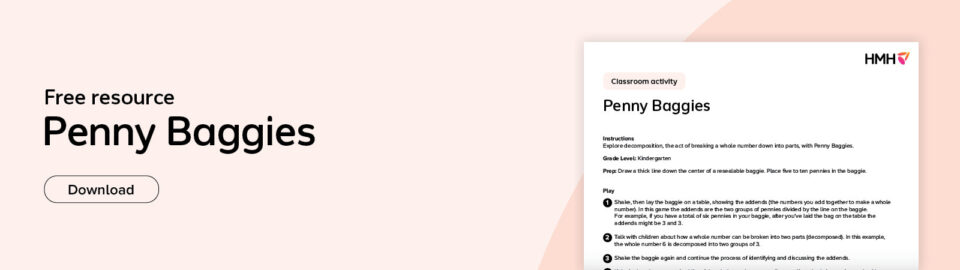
Penny Baggies: Alternatively, you can try this activity that happens to relate to the modern history of penny production being suspended in 2025. Students explore number decomposition by seeing how pennies (or other coins or counters) split up inside a resealable baggie.
Some more activity ideas:
- “The greatest” game: One of the activities in our blog on small-group math activities is a game that can help students with place value through hundreds.
- Break numbers apart: We explain what it means to break numbers apart in math to further help with ideas of place value through thousands.
- Gumball machine project: We have activity ideas on our gumball machine blog that get students practicing how to count and add within 100.
Math intervention activities: 4th–5th Grade
If you teach fourth or fifth grade students, fractions become critically important. Students will commonly feel stuck because they’re confused by fractions or aren’t yet fluent with the prerequisite skill of knowing math facts. The activities below address these issues directly.
Cover-copy-compare: This activity, which is explained in detail in our article on math intervention strategies, gets students practicing math facts. Students see a list of math facts, cover the answers, try to complete the list on their own (“copy”), and then compare the results. This intervention has been studied with evidence of its effectiveness.
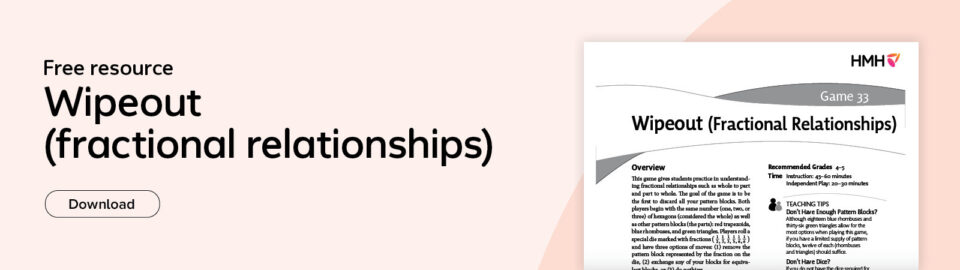
Wipeout: Fractions are a place where many fourth and fifth graders feel stuck, and this game is focused on making fractions visual and fun. It comes from our article on fun fifth grade math activities and is adapted from Lessons for Introducing Fractions: Grades 4–5 by Marilyn Burns.
Some more activity ideas:
- Practice fact retrieval: The cover-copy-compare activity above is just one way to do this. Practicing math facts can be approached in many ways and helps to develop procedural fluency.
- Teach order of operations: If students need a refresher on order of operations, we’ve put together a two-part lesson to help you teach it explicitly.
- Use accessible numbers: Our article on math interventions for elementary students describes a strategy of using accessible numbers (for example, dividing 90 ÷ 9 instead of 91 ÷ 7) as a scaffold for students who need it.
Math activities for math intervention: Middle school
In middle school, students are early enough in their math development that catching up to grade level proficiency is realistic for most, but students are also old enough to grapple with complicated real-world problems. HMH’s math intervention solution Math 180 for Grades 3 and up was originally designed to support middle school intervention and is replete with activities for students at that level.
Peer tutoring: The idea of having students work directly with their peers one-on-one is a powerful intervention, with research supporting its effectiveness especially for middle schoolers. Both students benefit. The tutor gets targeted support, and the tutee ultimately learns the concept more deeply, too.
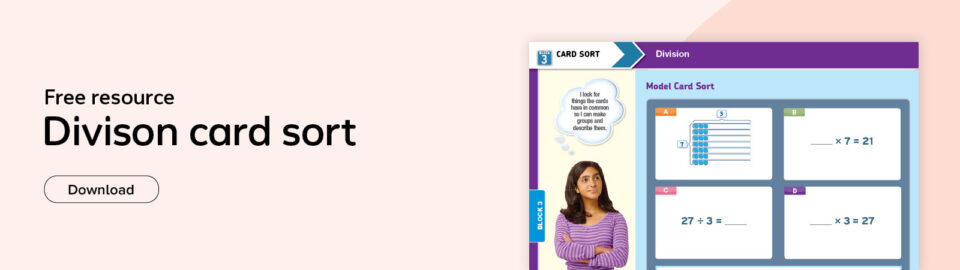
Division card sort: If your students could use practice with division, try the card sort activity below, where students sort different representations of multiplication and division expressions.
Some more activity ideas:
- Develop math mindsets: Fostering a positive math mindset is valuable at any age, but focusing on a growth mindset about math can be especially powerful for middle schoolers, where feelings about math are increasingly solidified as the content becomes more complex.
- Clear the board: This activity is on our blog dedicated to fifth-grade math activities, and it is a fun way for students of all ages to build number sense and develop fluency.
- Fireworks celebration: This prime factorization activity, which is in our blog on Memorial Day math activities, can be used year-round to help your students understand factorization.
Math intervention activities for high school
If you’re looking to provide intervention to high school students, there’s no question you have a difficult task! Your students are further in their math instruction, and so their skill gaps can be wide and what your students need extra support with can be hard to pin down.
Develop a choice board: You can cover a range of skills with one intervention activity by making a choice board. This is an entire menu of activities, where each activity can be as short as an individual problem or as involved as a full project. Students can complete the activities in any order and with guidelines that you set (for example, “complete one activity in each row”). This board can cover multiple skills that need practice, or it can cover one skill exhaustively. By formatting it as a choice board, students are also afforded agency, hopefully adding some motivation to their math learning.
Magnitude Madness: One recommendation from the What Works Clearinghouse is to ensure that intervention instruction focuses “intensely on in-depth treatment” of rational numbers. Although developed for middle schoolers, our Magnitude Madness activity, which can be found on our article on fun math activities, can engage high schoolers too who need practice with rational numbers. Students compare real-life situations (“the price went down $2.20”) to numbers (–2.2), which may appear as integers, fractions, or decimals.
Some more activity ideas:
- Root-O!: This game, available on our article on math center ideas, can help students who need practice with evaluating square roots.
- Math at Work activities: If students need support seeing the relevance of math to the real world, we’ve developed a series of “Math at Work” videos and activities that connect math to different industries, such as sports, fashion, and entrepreneurship, in a way that can especially help to motivate older students.
- Numbers facts pass: This short activity is listed among our math icebreakers for high schoolers but can be adapted to all skill levels and used year-round as a quick way to practice math facts.
Math intervention lesson plan template
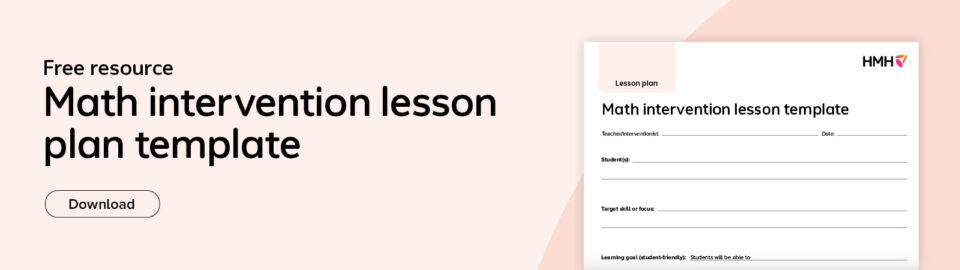
The strategies in this article include quite a range! Some are broad and can work across many grades. Some are narrow and are primarily for certain grade levels and topics. To figure out what’s right for you, it may help to write down exactly which students need intervention, what skills they need support in, and how you’ll organize the lesson and check for understanding. We’ve developed a template that you are free to use or adapt to help guide your next intervention lesson.
Teaching math intervention will always be a customized learning experience to the students who need it. No two students are alike, and this includes where they are in their math achievement. Hopefully there’s a strategy or two in here that can spark the ideas you need to help all of your students achieve grade-level proficiency. With the right supports, there’s no limit to how far your students can progress!
***
HMH offers math intervention programs for students in Grades 3–12 to unlock mathematical learning in the students who need it most.
We want to hear from you! For questions, comments, or feedback, please contact us at Shaped@hmhco.com or follow us on Instagram, LinkedIn, and YouTube.
Get our free math intervention ebook today.
Related Reading

Try these research-based math interventions for elementary students to help raise math achievement for students struggling in math.

Try these 7 small-group math activities and lessons to make math learning fun and improve student outcomes
These strategies provide differentiated math instruction to K-12 teachers looking for ways to personalize their mathematics teaching.