







You plan a lesson, and you deliver it. Afterward, you reflect on how it went. While many students were engaged with the learning as planned, some may have benefited from an additional challenge, and others may have benefited from more support.
A one-size-fits-all approach often leaves the needs of students at both ends of the readiness spectrum unaddressed.
Thankfully, there’s an effective approach: tiered assignments, designed to meet all students where they are.
Tiered assignments: Definition
As Carol Ann Tomlinson explains in How to Differentiate Instruction in Mixed-Ability Classrooms, tiered assignments are one of many differentiated instruction strategies that challenge students across different readiness levels. These assignments share the same learning objective. However, the journey to skill or content mastery looks different for every student. Tiered assignments generally differ in complexity, depth, or abstraction.
How tiering assignments work
In practice, tiered assignments work like this: A teacher provides different degrees of scaffolding, support, or direction. Every student works toward the same goal at an appropriate level that builds on what they already know and moves them forward.
How tiered assignments support differentiated instruction
Differentiated instruction and tiered assignments have the same intent: helping students work toward the same learning objective while tailoring how they get there based on their individual strengths or learning needs. What sets tiered assignments apart is their deliberate focus on student readiness.
Difference between tiered and scaffolded assignments
Both tiered and scaffolded assignments can address students’ diverse needs. However, they do so in different ways. Tiered assignments, for example, involve modifying the task itself based on student readiness so that every student is appropriately challenged. Scaffolded assignments, on the other hand, focus on how and when support is provided, gradually removing it as students build understanding and skill. In fact, scaffolding is often one of the tools teachers use within a tiered assignment, especially at the below-grade-level tier.
Respectful tasks in tiered assignments
One way to ensure tiered assignments maintain their rigor, regardless of readiness level, is to consider how you plan them. Tomlinson’s approach, which research suggests more effectively maintains high standards across all tiers, recommends planning for advanced learners first and then modifying activities for on-grade-level and below-grade-level students. By starting from a challenging standard and modifying assignments from there, it becomes easier to ensure what Tomlinson calls “respectful tasks” across all levels. As Tomlinson explains in one article: “Each student’s work should be equally interesting, equally appealing, and equally focused on essential understandings and skills . . . everyone is continually working with tasks that students and teachers perceive to be worthwhile and valuable.”
Benefits and challenges of tiered assignments
Tiered assignments benefit both teachers and students. One way they do this is by personalizing learning, a teaching approach designed to match students’ individual learning needs. As one teacher, Ken Schofield, puts it, “Personalized learning is finding what each child needs to be successful and using that learning opportunity to help the student become more proficient.” Tiered assignments do exactly that—they match the assignment to where each student is.
Additionally, tiered assignments allow students to spend more time in their zone of proximal development, challenging students to explore their intellectual boundaries. First introduced by psychologist Lev Vygotsky, the zone of proximal development, as educator Brooke Mabry explains, is the “metaphorical gap between what a learner can do and what they can’t do . . . yet.” When tasks sit within each student’s zone of proximal development, students are challenged without being overwhelmed, which helps them to grow academically.
Research shows tiered assignments’ overall positive impact on student performance. One study found that tiered instruction led to significantly improved scores in a science classroom, particularly for students with limited background knowledge. These students benefited the most from having tasks matched to their readiness level.
The most significant challenge of tiered assignments is the time required to create them. However, because of their benefits, tiered assignments are worth the effort.
Is a three-tiered approach always needed?
Designing for three tiers (above-, at-, and below-grade level) is common when creating tiered assignments, but it’s not always the best approach for every classroom. Lesson planning will always depend on where you teach and who your students are. For example, in one blog post on differentiation, educator Jennifer G. Beasley says, “We typically think of planning for three levels of an activity, but it depends on what your assessment shows. There may not actually be any students who are above-grade level on a particular skill.” Beasley instead plans for two levels of an activity. She first designs an above-grade-level activity because that’s where she wants everyone to be, and then adds scaffolding for at- or below-level students, allowing assessment data to determine how many tiers she needs.
Examples of tiered assignments by subject
What do tiered assignments look like in the classroom? Let’s walk through examples of tiered assignments, focusing particularly on what a fifth-grade teacher might use across subjects.
Reading and writing
Reading comprehension lesson
Core task: Read a story and demonstrate understanding of its key elements.
Below-grade level: Using a story map graphic organizer, students identify the story’s setting, characters, plot, conflict, and resolution.
On-grade level: Without a graphic organizer, students write a summary that covers the key story elements and explains how the conflict drives the plot.
Above-grade level: Students analyze how the author uses story elements to develop the theme, supporting their analysis with evidence from the text.
Math
Fractions lesson
Core task: Compare fractions and explain what makes one fraction greater than another.
Below-grade level: Students can use the provided pie or bar models to compare fractions with the same denominator. Using the models as a guide, students identify which fraction is greater and complete a sentence frame: ________ is greater than ________ because ________ .
On-grade level: Students compare fractions with unlike denominators and explain their reasoning in writing, using a visual model of their choice as support.
Above-grade level: Students investigate whether ⅔ is always greater than ½ by exploring real-world contexts where the whole changes. For example, ⅔ of a small apple versus ½ of a large pizza. Students present their findings in the format of their choice: a written explanation or a diagram.
Science
Ecosystems lesson
Core task: Model an ecosystem to show how matter and energy move among organisms and their environment.
Below-grade level: Students are provided with a pre-selected ecosystem (for example, a forest or ocean) and a list of organisms already identified as producers, consumers, scavengers, or decomposers. Using the provided organisms, students arrange them into at least one food chain and illustrate or model their ecosystem using available material.
On-grade level: Students choose their own ecosystem, research its organisms, and classify each as a producer, consumer, scavenger, or decomposer. They arrange the organisms into food chains, connect overlapping chains into a food web, and describe how matter moves through their ecosystem in writing.
Above-grade level: Students complete the on-grade-level task. Then, they extend their investigation by removing one organism from their food web and predicting the impact on the rest of the ecosystem. They state a claim and cite evidence from their model to support it. Finally, they determine another question they would like to ask about how matter moves through an ecosystem.
Social studies
United States regions lesson
Core task: Compare two regions of the United States, demonstrating the regions’ similarities and differences.
Below-grade level: Students are provided with information on pre-selected regions. Using a Venn diagram, students list at least two similarities and two differences of the regions, such as climate, geography, population, and economy.
On-grade level: Through their own research, students choose two regions to compare, using a Venn diagram if needed to organize their notes. Afterward, they explain in writing the regions’ similarities and differences.
Above-grade level: Through their own research, students choose two regions to compare. Then, using a choice board, students can select how they demonstrate their understanding of the two regions, whether through writing, a slideshow, or a presentation, explaining what makes each region distinctive and how they compare.
Tiering assignments by grade level
While the examples above focus on fifth grade, tiered assignments can be used at any grade level. Here are some ways to approach tiering assignments in elementary, middle, and high school.
Elementary school
In elementary school, tangible supports, such as graphic organizers, sentence frames, and manipulatives, are especially effective for students who need more support. These hands-on tools provide support when needed but can be gradually removed as students build confidence and independence.
Middle school
According to math educators Marian Small and Amy Lin, it can be difficult for middle school teachers to create multiple instructional paths for every student. Rather than abandoning differentiation altogether, strategies such as tiered assignments can offer students choice and ownership over their learning. Building student choice into tiered assignments, particularly for above-grade-level students, can help reduce teachers’ planning load while ensuring all students are appropriately challenged.
High school
Like in elementary and middle school, tiered assignments can help address high school students’ wide range of background knowledge and readiness levels. In high school, even the below-grade tier should prioritize depth of thinking, with appropriate guidance and support provided as needed.
Tiered assignments for gifted students
Designing tiered assignments for gifted students means challenging them to work with greater complexity, not simply removing scaffolding and support. One way to ensure this is to follow Tomlinson’s approach: create the above-grade-level tier assignment first, then modify activities for other students from that challenging standard. For example, “compacting” the curriculum, or removing parts of the lesson that students already know, frees students up to work on something more challenging. To learn more about curriculum compacting and other strategies for advanced learners, explore our blog on differentiated instruction for gifted students.
How to create tiered assignments
Regardless of the planning approach, here are some practical tips for creating tiered assignments:
- Assess student readiness: Using student data to plan tiered assignments helps teachers identify skill gaps, determine which topics may need revisiting, and decide which tiers are needed for a given lesson.
- Ensure rigor across tiers: While tiering assignments simplifies tasks based on student readiness, students should still be intellectually challenged and afforded ways to think creatively and deeply. Designing for above-level students first, then scaffolding, helps maintain rigor across all tiers.
- Give students agency: Even though you’re choosing the assignment, you can give students some choice in their learning as well. Tiered assignments can give students agency by letting them decide how to engage with the assigned content, for example, by offering multiple options for how they demonstrate their learning.
Assessing tiered assignments
Teachers can use formative assessments to gauge students’ knowledge of a lesson. Conducting formative assessments is an ongoing process used to gather evidence of student understanding to improve learning outcomes. Exit tickets, a type of formative assessment, offer a quick way to check for understanding after a lesson. Depending on what teachers learn, they can determine whether students require additional support or should move to another tier.
Tiered assignment planning resources
Planning tiered assignments is a layered process, from assessing students to gathering the appropriate materials. We’ve provided resources below as a starting point.
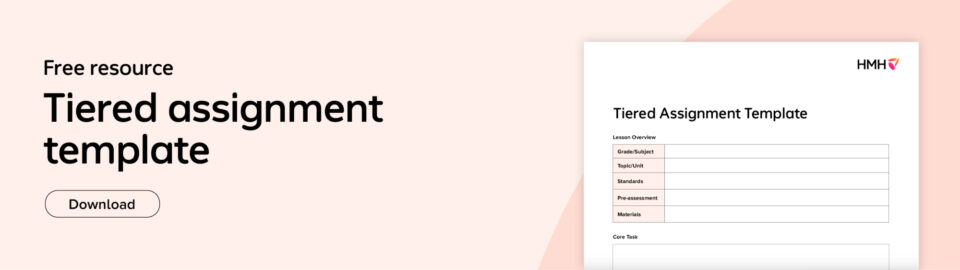
Tiered assignment template
The template below provides guidance for organizing a tiered assignment, with sections for pre-assessment, a core task, tiered tasks, evaluation criteria, and more.
Tiered assignment menu
A tiered assignment menu is more commonly referred to as a choice board. Choice boards for students are menus of activity options that allow students to choose how they practice a skill or show what they know. Choice boards are another differentiation tool that can complement tiered assignments, particularly when teachers want to give students more ownership over their learning.
The purpose of tiered assignments
Research shows that tiered assignments are effective, especially when driven by student data. Rather than teaching a one-size-fits-all lesson that leaves some students needing more support and others eager for more of a challenge, tiered assignments can ensure every student has the right support as they journey toward the same learning objective.
Share your ideas with us!
We’d love to hear about how you use tiered assignments to meet students at their readiness level. Share your favorite tiered activities with us via email at shaped@hmhco.com or reach out on Instagram.
***
For more ways to meet the needs of every student, explore our range of differentiated instruction articles.
HMH Professional Learning provides coaching memberships to support differentiated instruction in the classroom. Learn more.
Be the first to read the latest from Shaped.