






Summary
Within an MTSS framework, Tier 2 intervention provides targeted small-group support for students who need additional help beyond core classroom instruction.
Key takeaways
- Targeted interventions work best when they complement core instruction and help students maintain access to grade-level learning.
- Flexible intervention systems allow schools to adjust support as student needs change over time.
- Effective intervention frameworks prioritize prevention and early action, helping students build skills and confidence before challenges become more significant.
As a classroom teacher, you likely spend a lot of time planning and delivering core instruction. This is no easy task and involves differentiating instruction and managing a classroom filled with students who bring their own backgrounds and experiences. Teaching requires flexibility, responsiveness, and strategic planning. So what do you do when some of your students aren’t responding to your instruction and need more specialized support?
This is where an evidence-based approach such as Multi-Tiered System of Supports (MTSS) is especially important. MTSS is a framework that aims to harness the complex system that surrounds student learning: screening, monitoring progress, applying prevention strategies, and making data-based decisions. It organizes instruction and intervention into tiers, or levels, of support.
In this article, we’ll take a look at how Tier 2 intervention—a critical bridge between core instruction and intensive individual services—can provide timely, targeted support that helps keep students on track and engaged.
What is the difference between Tier 1, 2, and 3 interventions?
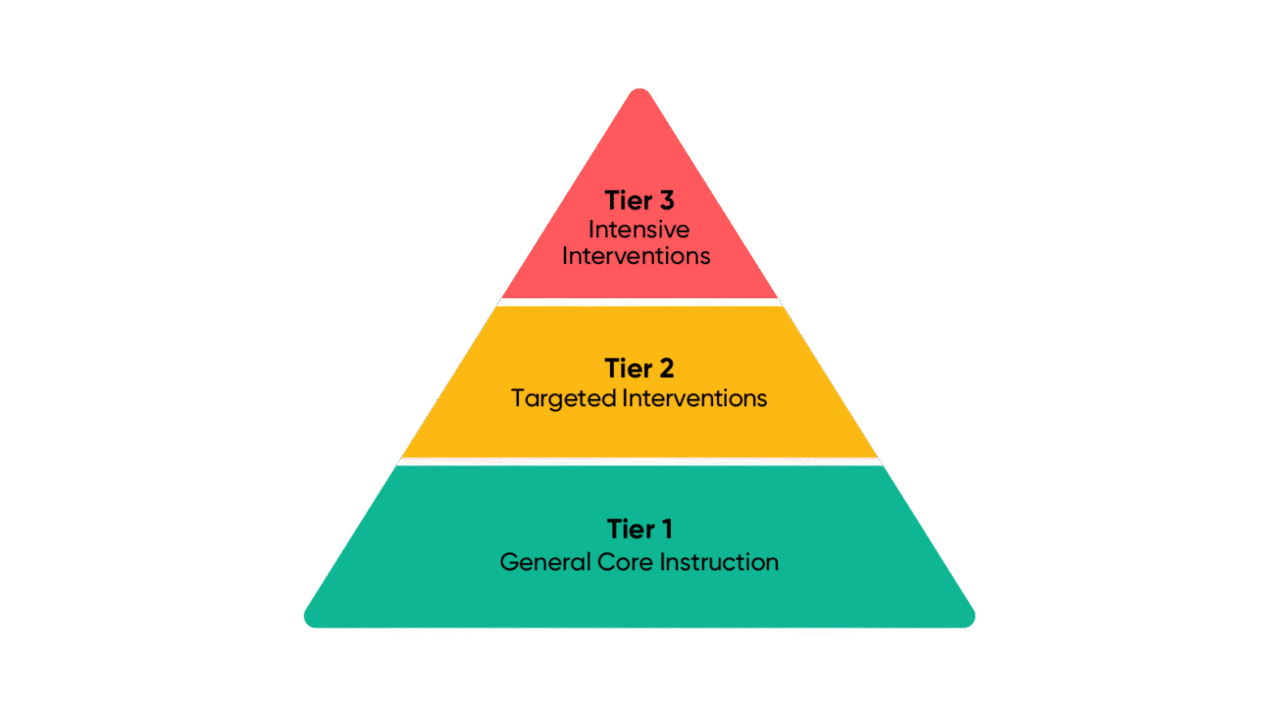
MTSS is an integrated, proactive framework of tiered instruction and support for all students that helps educators effectively allocate instructional resources and align academic and behavioral standards. A defining feature of the framework is its three tiers of instructional support:
- Tier 1: High-quality core instruction provided to all students. Tier 1 is not intervention, although the misleading term “Tier 1 intervention” is sometimes used colloquially to refer to this universal instruction.
- Tier 2: Targeted intervention for students who need additional support, typically delivered in small-group settings.
- Tier 3: Intensive, individualized intervention for students with the most significant needs.
The tiers are often shown as a pyramid because all students receive Tier 1 instruction but, in many schools, only a subset of those students require Tier 2 support, and a smaller subset still need Tier 3 interventions.
What is a Tier 2 intervention?
Tier 2 interventions are often supplemental supports provided within the core classroom, although they can be delivered with varying degrees of intensity and personalization. They provide two critical functions:
- Tier 2 interventions address specific skill gaps before they widen, thus allowing students uninterrupted access to the general curriculum.
- Tier 2 interventions provide key progress-monitoring data to guide instructional decisions and determine which students need more intensive, individualized intervention.
The pyramid may make it seem simple, but intervention in education should be customized to the complex, changing needs of your specific class. The whole pyramid can also be viewed using a bell curve visualization. This shows student needs relative to grade-level proficiency and can help solve large-scale problems like identifying missing curricular needs. In the image of the more functional model below, students receiving Tier 2 interventions are those whose performance falls in the yellow and orange portions under the curve.

To be effective, all three tiers of MTSS must work together as one system, with high-quality materials, differentiated instruction, progress monitoring, and professional development all working to support student success.
Tier 2 across MTSS, RTI, and PBIS
Tier 2 is commonly associated with MTSS, but the concept also exists within related frameworks, notably Response to Intervention (RTI), which focuses on academic support, and Positive Behavioral Interventions and Supports (PBIS), which focuses on behavior support. Across all three frameworks, Tier 2 refers to tailored interventions for students who need additional support beyond the general classroom instruction but do not yet need intensive, individualized Tier 3 interventions.
The benefits of Tier 2 interventions
Tier 2 interventions help schools provide timely support for students before academic or behavioral challenges become more significant barriers to learning. By identifying needs early and providing tailored interventions, schools can help students stay connected to the core classroom learning while improving identified areas of need.
Tier 2 intervention, progress monitoring, and data-based decision making
For MTSS or any similarly tiered framework to succeed, all three tiers of support rely on universal screening, progress monitoring, and data-based decision making to identify student needs early and ensure that supports are appropriately matched to those needs.
How are students identified for Tier 2 supports?
Universal screeners are systematic assessments administered to students to identify those who may need additional academic or behavioral support. These screenings are typically brief and conducted several times over the course of a school year to help gather data based on consistent criteria. As such, they are often the entry point for Tier 2 intervention.
When screening data indicates that a student may need support beyond universal core instruction, there are often teams who analyze additional information, such as teacher observations and class performance, to determine whether Tier 2 intervention is appropriate. Some schools have more standardized protocols that don’t require teams in the same way.
What does Tier 2 intervention look like?
Using data gathered through assessments and observations, interventions tailored to specific student needs are developed and delivered—usually in small groups of students with similar needs, several times per week. Tier 2 interventions are supplemental, time-bound, and focused on specific gaps. Several examples are given later in this article. These interventions do not replace Tier 1 core instruction.
Where do Tier 2 interventions take place?
Tier 2 interventions can take place in a variety of settings depending on student needs and school resources. Some interventions are implemented in the classroom during small-group instruction. Others might occur during designated blocks outside of the classroom. In any location, the goal of Tier 2 interventions remains the same: to provide targeted support for students struggling to achieve grade-level proficiency.
Progress monitoring and data-based decision making
Progress monitoring is essential to determine if students are responding to Tier 2 support. Ongoing assessment allows for adjustments to instruction. Students who show meaningful progress may no longer need additional Tier 2 supports and will continue to receive Tier 1 instruction, while those who need additional support may be considered for Tier 3 services.
Tier 2 interventions do not necessarily require different materials from Tier 1. In many MTSS models, the core curriculum can be adapted through changes, such as in pacing or grouping, to meet student needs. Many programs, such as Into Math or Into Reading, have a variety of resources specifically meant to reteach skills and provide remediation.
Tier 2 intervention strategies
Effective Tier 2 intervention strategies are data-informed and designed to address specific academic or behavioral needs that aren’t otherwise being addressed in Tier 1 core instruction. Supports often include small-group instruction, explicit modeling, and scaffolded practice.
HMH has published many articles providing different strategies. To learn more about practical approaches to small-group instruction, check out 7 Small-Group Intervention Strategies.
For content-area specific strategies, check out 10 Math Interventions for Struggling Students and Reading Intervention Strategies for Struggling Readers.
For a broader overview of evidence-based instructional supports, see 11 Instructional Intervention Strategies and Examples.
Examples of Tier 2 interventions in the classroom
Let’s look at how Tier 2 can functionally play out within an MTSS framework. The examples below show how schools can use screening data to design focused and time-bound academic interventions to address specific skill gaps while maintaining students’ access to core instruction.
Example: Tier 2 reading intervention
A universal screener might reveal that several fourth-grade students are able to decode texts accurately but struggle with reading comprehension. Using an MTSS framework, the school could implement a targeted 4-week comprehension intervention such as the following:
- Instructional setting: Small-group intervention delivered to a group of students based on specific need during core literacy instruction
- Group size: 4–6 students
- Frequency: 4 days per week for 30 minutes
- Duration: 4 weeks
- Focus and approach: Explicit instruction in comprehension strategies (e.g., summarizing and making inferences) through modeling, guided application, and independent practice. For example, you might model summarizing by thinking aloud during a read-aloud, then guiding students as they identify main ideas in a short passage.
- Progress monitoring: Ongoing data collection using short assessments aligned to comprehension strategies
After the designated 4 weeks, students who show meaningful progress may no longer need Tier 2 supports while continuing to receive Tier 1 instruction. Students who show partial progress may continue in Tier 2 with adjusted strategies, and students who need further support may be considered for Tier 3 services.
Example: Tier 2 math intervention
A universal screener might reveal that several fifth-grade students are struggling with multi-digit multiplication. In response, the school could implement a targeted math intervention such as the following:
- Instructional setting: Small-group intervention delivered during a designated intervention block or support period.
- Group size: 3–5 students
- Frequency: 4 days per week for 30 minutes
- Duration: 3 weeks
- Focus and approach: Targeted practice in place value and multi-digit multiplication strategies through modeling, visual representations, guided application, and immediate feedback. For example, you might have students play a math practice game with levels focused on multi-digit multiplication.
- Progress monitoring: Ongoing data collection using short assessments aligned to multiplication skills and place value understanding
After the designated 3 weeks, students who show meaningful progress may no longer need Tier 2 supports while continuing to receive Tier 1 instruction. Students who show partial progress may continue in Tier 2 with adjusted strategies, and students who need further support may be considered for Tier 3 services.
Tier 2 behavioral and social skills interventions
Tier 2 interventions may be implemented for more than academic issues. Behavioral and social skills interventions follow a similar structure in terms of a set frequency and duration with a specific and measurable focus, but student behavioral needs are often identified by teacher observations rather than universal screening.
For example, if a teacher notices that several second-grade students are struggling to cooperate with their peers, these students might be recommended for structured support during an intervention period focused on conflict resolution. Supports might include explicit modeling, opportunities to practice skills, and positive reinforcement.
Schools implementing behavioral supports may use the Positive Behavioral Interventions and Supports (PBIS) framework, which focuses on improving student behavior through school-wide supports. The goal is to proactively address student needs through clear expectations and interventions that are sustainable and effective. To learn more, see What Is PBIS in Education?
A point made in the webinar MTSS in Action: Designing Inclusive Instruction for Tiered Support is that high-quality materials and strong instructional practices can support both academic and behavioral outcomes for students. Dr. Suzanne Jimenez, director of academic planning at HMH, emphasizes that when educators deliver instruction that is engaging, predictable, and informed by assessments, it can significantly improve the overall learning experience for students across all tiers of support.
Tier 2 interventions and special education
Special education is not a tier. It exists across all tiers of support and can be provided as part of a tiered framework. The instruction that special education students receive is based on each student’s needs and Individualized Education Program, or IEP.
Education attorney Julie Weatherly notes in the webinar MTSS in Action: Designing Inclusive Instruction for Tiered Support that instruction is not defined by whether a resource originates in general or special education, but rather by how the content, delivery, and methodology are modified to meet individual student needs. The ultimate goal is that a student’s IEP is implemented with fidelity, regardless of what materials are used to implement it.
How does Tier 2 intervention support special education?
In the webinar, John Eisenberg, executive director of the National Association of State Directors of Special Education, outlines obstacles faced by special education professionals:
- Special education staffing shortages and inadequate funding
- Post-pandemic learning gaps, behavioral issues, and chronic absenteeism
- Focus on regulation compliance at the expense of learning outcomes
- Increasing number of students requiring additional academic, behavioral, and mental health support
Tier 2 intervention can play an important role in triaging student needs and helping schools to address academic problems early.
Is Tier 2 intervention special education?
Tier 2 intervention is not the same as special education. However, Tier 2 can mitigate some of these challenges by addressing student needs before they intensify to the point of requiring more specialized services. It allows schools to allocate resources strategically and prevent students from falling significantly behind.
How do you know Tier 2 is working?
According to the Center on MTSS, typically only around 20% of a district’s student population requires Tier 2, or if necessary, Tier 3 interventions. No matter your school’s individual makeup, the interventions are successful when students achieve the necessary growth and can go on to succeed in grade-level instruction.
Matt Moschel is the MTSS coordinator for Dorchester School District 2 in South Carolina and has worked his whole career towards creating equity across all tiers of instruction. “My ultimate goal is to see the students in Tier 2 and Tier 3 move,” says Moschel. “We want to see them move and be comfortable, confident learners in Tier 1 as a result of the support.”
The purpose of Tier 2 interventions
Teaching a classroom is an endless balancing act. Students come with a range of abilities and backgrounds, and as the school year goes on, different strengths and needs emerge. As the teacher, you must consider every student, and not just their current performance, but their potential, too.
Tier 2 interventions are a critical piece of the instructional puzzle. By identifying needs early and using progress monitoring to guide targeted support, these evidence-based interventions can address challenges before they become barriers to learning. Between planning lessons, delivering instruction, managing relationships, and organizing assessment (to name a few responsibilities), tiered instruction serves as a tool to ensure that all students can experience success in school.
***
Take your MTSS approach to the next level. Learn how to design inclusive, tiered supports in our webinar, MTSS in Action: Designing Inclusive Instruction for Tiered Support.
Find more lesson plans and classroom resources on Shaped.
Frequently asked questions
-
How long should students receive Tier 2 intervention before educators evaluate its effectiveness?
The timeline varies based on student needs and the intervention being used, but regular progress monitoring helps educators determine whether students are responding or need adjustments to support.
-
What role do families and caregivers play in supporting Tier 2 intervention?
Families and caregivers can reinforce learning goals, encourage practice, and maintain communication with educators. Consistent support across school and home can strengthen student progress.
-
How can schools balance Tier 2 intervention with grade-level instruction?
Effective Tier 2 intervention provides targeted support while ensuring students remain connected to core instruction and grade-level learning. Schools can schedule intervention in ways that minimize missed classroom learning and focus supports on specific skill gaps. By pairing targeted intervention with continued access to grade-level content, educators can help students strengthen foundational skills while staying engaged in broader classroom learning.
-
What should educators do if a student is not making progress in Tier 2 intervention?
If a student is not making expected progress, educators should review progress-monitoring data, examine the fidelity of implementation, and evaluate whether the intervention is appropriately matched to the student's needs. If data shows that targeted supports are not producing sufficient progress over time, the student may need more intensive, individualized support through Tier 3 intervention.
Get our free reading intervention ebook today.
Related Reading

What is Tier 1 intervention in education? Learn what Tier 1 intervention really means, how it supports differentiated instruction, and which instructional strategies strengthen core instruction for all students.

Discover the ultimate guide to MTSS and the 3 tiers of support. Find MTSS examples by tier.

Explore 7 small-group intervention strategies, plus download a free lesson plan template to support targeted instruction.