







Your students may notice it’s getting dark outside earlier than at the start of the school year. As the days grow shorter and nights stretch longer, we approach the winter solstice: the turning point when one of Earth’s poles is tilted farthest away from the sun. In the Northern Hemisphere, it usually occurs around December 21 or 22, signaling the official start of winter.
This astronomical event is a fantastic learning opportunity for students to learn about how Earth’s tilt shapes our seasons or discover the rich cultural traditions that celebrate this turning point. These winter solstice activities for the classroom will help you turn the solstice into a memorable, educational experience.
Winter solstice lesson plans and activities
Below are 6 engaging winter classroom activities focused on the winter solstice.
1. Create a model of the solstices (Grades 1–6)
One of the best ways to teach a winter solstice lesson is by having students create a model that demonstrates what it is. This activity helps students visualize how the sun’s position and Earth’s tilt impact the seasons.
Materials needed:
- Styrofoam balls (one per student)
- Wooden skewers (to act as Earth’s axis)
- Paint, markers, or colored paper
- Lamps or flashlights
What to do:
- Begin this activity by giving your students time to decorate their own Earth with paint or markers. This can be a great opportunity for students to spend some time learning about geography by having them label the continents and oceans. Once they’ve finished decorating their globes, have them mark where they live with a dot or sticker.
- Show students how Earth’s axis works by inserting a skewer through the ball at an angle of about 23.5 degrees (Earth’s tilt). Explain that this tilt remains constant as Earth orbits the sun, which is why we have predictable seasons. You can use NASA’s solstice animations to help students visualize this. You may need to help your students as they create an axis for their own Earths.
- Next, in pairs or small groups, place a lamp or flashlight on the table to represent the sun. Keep the light source in a fixed position. Students should then take turns moving their Earth’s model counterclockwise around the light, simulating Earth’s orbit, while maintaining the same tilt throughout.
As students move their globes, they will observe:
- Top of the skewer leans towards the light: Represents summer in the Northern Hemisphere. When their marked location is closest to the light, this is the summer solstice, the longest day of the year.
- Skewer parallel to the light: Represents fall or spring, when both hemispheres receive equal sunlight. This is known as the equinox, which occurs twice a year (usually around March 20 and September 22).
- Top of the skewer leans away from the light: Represents winter in the Northern Hemisphere. When their marked location is farthest from the light, this is the winter solstice, the shortest day of the year.
- Your students should also note that the bottom of the skewer will be doing the opposite as the top. This represents the Southern Hemisphere, which experiences the opposite season at the same time.
To wrap up the activity, lead your students in a discussion by asking questions such as: “What patterns did you notice as you moved your globe around the sun?” and “Why do the Northern and Southern Hemisphere experience opposite seasons at the same time?”
2. Compare and contrast the winter and summer solstice (Grades 3–8)
Both the winter and summer solstices mark pivotal points in the Earth’s orbit around the sun, though they represent opposite extremes of the year. The winter solstice is the shortest day and longest night, while the summer solstice is the longest day and shortest night. Using a Venn diagram, have your students think about the similarities and differences between the solstices. They might consider factors such as the date, daylight hours, sun position, temperature, and cultural significances.
After students have completed their Venn diagram, invite them to share their observations and explain the similarities and differences they identified. For older students, you can take the activity further by having them write an expository essay that compares and contrasts the two solstices.

3. Calculate daylight hours (Grades 3–5)
Daylight hours during the winter solstice are at their shortest, but after the solstice, the days gradually begin to lengthen as we move towards spring. Calculating daylight hours can be a fun, hands-on activity for elementary students to learn more about how daylight changes throughout the year.
- Students should begin this activity by creating a method to organize their data. It may look like a table with columns labeled: date, sunrise, sunset, daylight hours.
- Students should then find sunrise and sunset times for 7–10 days before and after the winter solstice. They can look up this data online or use local weather reports.
- Next, students should calculate the daylight hours for each day. To do that, they will take the sunrise time and subtract it from the sunset time. For example, if sunrise was at 7:10 AM and sunset was at 4:15 PM, then there were 9 hours and 5 minutes of daylight.
- Using graph paper or digital graphing tools, your students can then create a graph with the dates on the horizontal axis and daylight hours on the vertical axis. Your students should notice that daylight decreases until the solstice then starts increasing.
- Have your students discuss with a partner or with the class what they notice. What pattern do they see in the graph? Why does daylight start to increase after the solstice?
4. Explore culture around the winter solstice (Grades 3–12)
All around the world, people celebrate the winter solstice. While each celebration is unique, there are common themes of light overcoming darkness and symbols of renewal and new beginnings after the longest night of the year. These celebrations often include traditions and symbols that reflect the values and beliefs of the people who observe them.
Have students work in pairs or small groups to choose a culture to research. This article from History.com has some examples of holidays celebrating the winter solstice, such as Yule in Northern Europe, Dongzhi in China, and Inti Raymi in Peru. You can ask each group to select a different culture to ensure there are a variety of perspectives that give the class a global view of winter solstice traditions.
As they research, they can look up questions such as:
- What symbols or rituals are part of this celebration?
- How do these traditions reflect the culture’s values or worldview?
- What role does light play in the celebration?
- How does the timing of the solstice influence food, music, or activities?
After students present their findings to the class, lead a reflective discussion about all the cultures they learned about. Consider questions such as: “Why do so many cultures celebrate light during the darkest time of year?” “What similarities and differences did you notice among traditions?” “Which tradition surprised you the most, and why?”
5. Record shadow measurements (Grades 3–5)
During the winter solstice, the sun sits at its lowest point in the sky, creating longer shadows than any other time of year. By observing shadows, we can learn more about the sun’s position, making the winter solstice a perfect time to explore the connection between light and darkness.
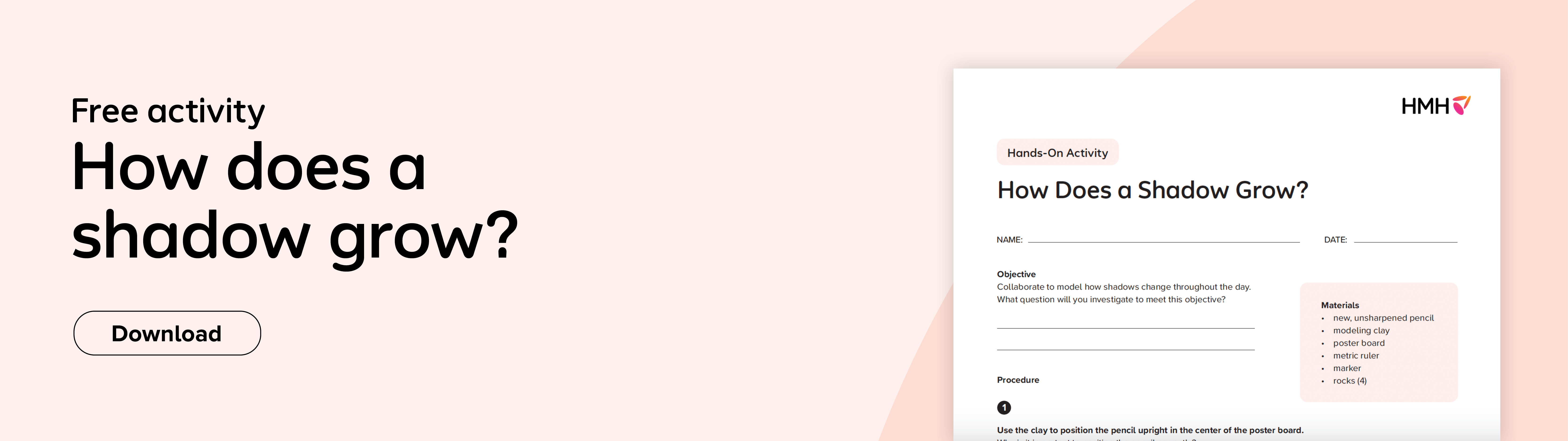
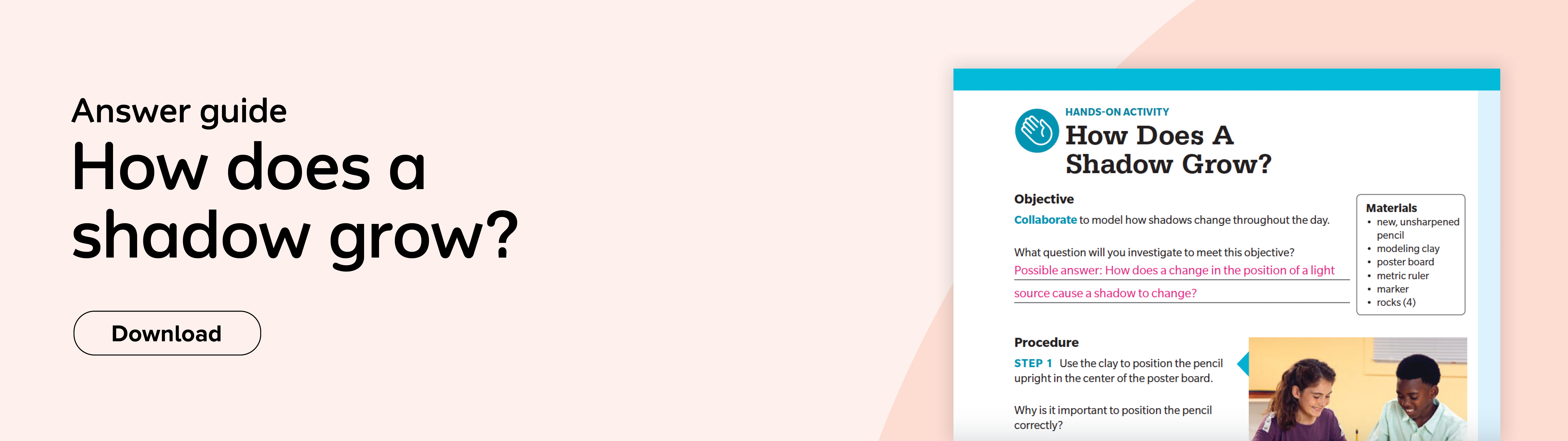
In this winter solstice science activity, students will create a simple sundial and use it to track how shadows change throughout the day. The STEM downloadable provides step-by-step instructions and guides students in recording measurements at regular intervals to identify patterns in shadow length and direction. Download the student worksheet and answer key to get started.
6. Creative writing prompts (Grades 3–12)
The winter solstice is the perfect time to spark creativity and explore themes of light and darkness through writing. Below are some imaginative writing activities about the winter solstice.
- The polar night is a natural phenomenon in polar regions where the sun does not rise for more than 24 hours, resulting in days of continuous darkness during winter. Write a short story about what daily life would be like in this extreme environment. How would you adapt to the endless night? What challenges and surprises might you encounter?
- Write a story from the sun’s point of view as it watches Earth tilt and turn through the seasons. How does the sun feel about the solstice?
- Create a fantasy tale where light and darkness are characters battling for control during the solstice. Is there a winner, and if so, what does that mean for the world?
The winter solstice is a wonderful time to bring winter science experiments, culture, and creativity in the classroom. It’s also the perfect season to incorporate winter holiday activities that make learning festive, fun, and engaging. Share your own winter solstice ideas with us on Instagram at @hmhlearn.
***
Find more lesson plans and classroom resources on Shaped.
Download our FREE calendar of activities!