






Many teachers are looking for ways to keep every student engaged in classroom discussions, especially when some learners are shy or hesitant to participate. The think-pair-share activity offers a practical solution, helping students become active contributors rather than passive listeners.
Shaddoe Lambert, who was a secondary ELA teacher for eight years before becoming an HMH product manager, shares, "Think-pair-share is an effective strategy for student engagement because it puts some of the responsibility back on the student. Students are no longer just consumers of information; they're required to create and synthesize it."
This blog provides classroom-ready instructions, rubrics, and examples to help teachers make think-pair-share activities a routine that works for every learner.
What is a think-pair-share activity?
The think-pair-share strategy is a collaborative learning activity where students first think about a prompt individually, then pair up to discuss their ideas, and finally share their thoughts with the whole class. This approach fosters autonomy, reduces the stress of whole-class participation, and helps students synthesize information in a supportive environment.
Some of the key benefits of think-pair-share activities include:
- Fostering collaboration and peer learning
- Supporting formative assessment
- Enabling differentiated instruction
Lambert emphasizes that the strategy provides students with a "safety net with their peers," making it easier for shy students to participate and for all students to develop autonomy in their learning.
Think-pair-share activity instructions
Implementing a think-pair-share activity is straightforward, but thoughtful planning can make it even more effective.
Lambert recommends waiting until students are comfortable with classroom routines, "Think-pair-share is not something I would do on the first day of school. Give students some time to acclimatize themselves to the classroom and your teaching style. Once you know your students and how they interact you can provide the structure and safe space they need."
Step-by-step guide to think-pair-share:
- Think: Present a prompt and give students time to reflect individually. For younger students, this might involve drawing or using emojis; older students can write or brainstorm ideas.
- Pair: Students discuss their thoughts with a partner. Lambert suggests providing sentence frames or note-catchers to help students organize their ideas, "If they can write, I really suggest having some kind of tool or documentation for their notes. Have them think and write on their own first, then write new information or extensions after pairing."
- Share: Pairs present their ideas to the class. Allow time for whole-group discussion and encourage students to take notes from other groups.
Timing tips:
- Set clear time limits for each phase, such as 2 minutes to think, 5 minutes to pair, 8 minutes to share.
- Adjust timing based on age and classroom dynamics. You may want to use a timer to help students their time.
Classroom management strategies:
There are some general strategies that teachers can try to ensure to help think-pair-share go smoothly, such as:
- Pair students strategically, for example pair a less talkative student with a more vocal peer.
- Use written note-catchers to help students organize thoughts and reduce anxiety during sharing.
- Start with visually prompted activities or simple prompts before moving to more complex discussions.
Checking for understanding:
Think-pair-share is a quick, effective way to check for understanding. Lambert explains, "As teachers, we are monitoring our classes, walking around, and able to quickly glance to see if our students are getting it. Hearing student conversations lets us know if they're effectively communicating and describing what we're discussing."
Rubrics for think-pair-share activity
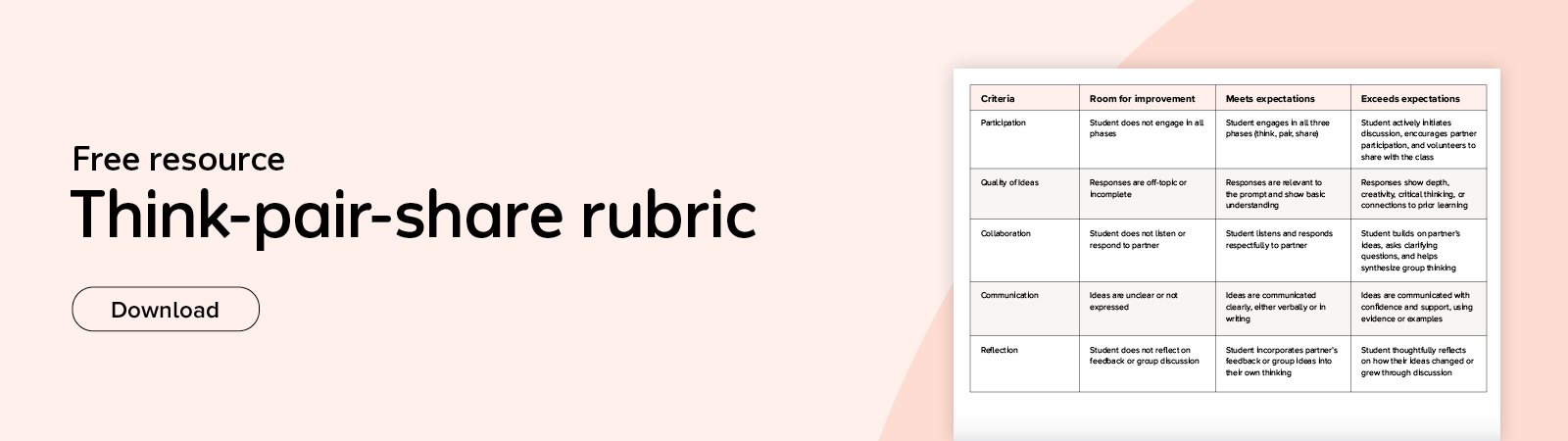
Rubrics help teachers set clear expectations and provide meaningful feedback during think-pair-share activities. Lambert recommends using both "must-have" and "amazing" criteria to support all learners and encourage growth. She explains, "Your 'must-have' criteria are what you absolutely have to have in a rubric, but then you have some 'amazing' criteria, and this also helps with your differentiation across the board."
Rubrics can also support as a type of formative assessment by helping teachers quickly identify student understanding and areas for growth. But Lambert advises that think-pair-share should not add pressure or become a high-stakes assessment. "If you are going to assign a grade to it, make it that participation grade. You don't want something where you expect your students to comfortably share to become more stressful."
Download this sample rubric to get started easily with the 'must-have' criteria of participation, collaboration, and quality of ideas shared.
Think-pair-share activity examples and ideas
Think-pair-share activities can be adapted for any subject area and grade level. Lambert highlights the flexibility of the strategy, "This can really be as creative as you want it to be. For littles, it could be drawing a picture association or using emojis. For older students, open-ended prompts can spark debate or deeper analysis."
Here are several examples of think-pair-share activities:
1. Literature discussion prompt
The teacher may display an image from a story, such as the beating heart from "The Tell-Tale Heart." Students are asked to think about what the image makes them feel or what it represents. After reflecting individually, students pair up to discuss their interpretations and then share their ideas with the class.
Lambert notes, "It's a great way to introduce your text—look at an image associated with that text to get students thinking about thematic elements." This approach encourages students to make personal connections and explore symbolism or mood before diving into the text itself.
2. Math problem-solving
A math problem is presented before any instruction is shared on how to solve it. Students first consider possible approaches on their own, then pair up to discuss strategies, and finally share their solutions and reasoning with the class.
Lambert recommends using think-pair-share to "spark learning" (like the “Spark Your Learning" features that start out every lesson of HMH Into Math) and encourage collaborative problem-solving. This method allows students to see multiple ways to approach a problem and builds mathematical reasoning skills.
3. Science hypothesis sharing
Students are asked to predict the outcome of an experiment or scientific scenario. After individual reflection, they pair up to discuss their hypotheses and reasoning. The class then shares and compares predictions, discussing which ideas were supported by evidence and which were not. This activity helps students practice scientific thinking and learn from their peers' perspectives.
4. Debate starter
An open-ended question is posed, such as "Should pets be allowed to come to school?" Students form opinions individually, discuss their viewpoints with a partner, and then share their arguments with the group. This format encourages critical thinking, respectful disagreement, and the development of persuasive communication skills.
5. Vocabulary building
For younger students (K–2), teachers may use images or emojis to represent new vocabulary words. Students draw or write selected words, pair up to discuss their choices, and share with the group. This visual approach supports language development and helps students connect words to meaning in a concrete way.
6. Sentence Frames
Teachers provide fill-in-the-blank prompts to scaffold responses, such as "I think ___ because ___."
Lambert suggests, "For younger students, sentence frames or visual prompts can help get them started and build confidence." Sentence frames support all students, including emerging writers and English learners, by giving them a structure for expressing their ideas.
7. Whole-class graphic organizer
A three-box worksheet or graphic organizer is used to help students document their thinking at each stage: individual thoughts, partner's ideas, and whole-group notes. Lambert advises, "Have students document their thinking at each stage—this helps them organize ideas and reduces anxiety during sharing." This strategy also provides a record for formative assessment and reflection.
Try this free think-pair-share activity template.

Differentiated instruction tips
Differentiated instruction is important for successful implementation of think-pair-share activities. The following tips can help teachers adapt to meet a range of student needs:
- Prompts and supports should be adapted based on age, subject, and student needs.
- Visual prompts, such as images or emojis, work well for younger students or English learners.
- Sentence frames and structured note-catchers can scaffold participation for students who need more support.
- Open-ended questions and debate starters challenge older or more advanced students to think critically and articulate their reasoning.
- Vary the complexity of prompts, the amount of time given for each phase, and the format of sharing to meet the needs of learners.
Think-pair-share in practice
Think-pair-share activities offer teachers a simple yet powerful way to boost engagement, support learners, and create meaningful discussion routines across subject areas. By incorporating clear structures, flexible prompts, and supportive tools like rubrics and note-catchers, educators can help every student feel confident contributing to the conversation. With the right scaffolds and a consistent routine, think-pair-share activities can become a pathway to deeper understanding, collaboration, and student ownership of learning.
Think-pair-share is built into programs like:
- HMH Into Reading, where students use the strategy during read-alouds, vocabulary work, and essential question discussions.
- HMH Into Math, where students collaborate to solve problems and share strategies.
- Classcraft, where teachers group students, monitor participation, and capture student responses for formative assessment.
***
Discover how Classcraft can help capture student responses, track participation, and enhance collaboration in the classroom.
Get our free guide to differentiated instruction.