






Imagine a classroom transformed into a gallery, where students move freely to examine materials and share ideas with their peers.
That’s where the gallery walk teaching strategy comes in. Just like in an art gallery where viewers can move around and experience the art, a gallery walk converts a classroom into a space where students can get up, actively engage, and learn more about a topic.
Gallery walk teaching strategy
Think of what it’s like walking through a gallery. There are artworks and artifacts to observe and analyze, accompanying details for each piece, and sometimes even a guide or a self-guided listening device. The entire immersive experience ensures gallery goers engage deeply with what they’re viewing. Gallery walks in the classroom are similar, although they focus more on educational materials.
A gallery walk is an interactive activity that allows students to move around the classroom to different stations. At each station, they learn about a topic by observing art, documents, artifacts, or their peers’ work, or responding to prompts or questions. A gallery walk might also include display stations, note-taking materials, tablets, or laptops.
There are multiple ways to conduct the activity:
- Responding to prompts/questions: Stations can display different prompts or questions that students can respond to using sticky notes or another method. Alternatively, the teacher can provide a prompt or question before the activity.
- Offering written or verbal feedback: Students walk around and give feedback on other students’ work or projects.
- Learning and reviewing content: Stations have materials related to a topic students are learning.
Benefits of gallery walks
There are plenty of reasons why gallery walks are beneficial, no matter the approach. Gallery walks help to:
Encourage movement
Movement in learning can do wonders for students’ well-being. Research shows that movement can boost students’ memory and thinking skills. Movement also releases endorphins, which can improve mood.
Increase student engagement
In Building Thinking Classrooms in Mathematics, Peter Liljedahl speaks highly of gallery walks. (For more on thinking classrooms, this NWEA article offers a helpful overview.) In the book, Liljedahl explains how gallery walks are effective for increasing student engagement and thinking. He emphasizes movement throughout the room, careful selection and sequencing of work, and student interpretation of peers’ work in a gallery walk.
Promote higher-order thinking and speaking skills
According to one article from the Pennsylvania State University, gallery walks can help students develop higher-order thinking skills, such as analysis, evaluation, and synthesis, along with improving their speaking skills. Students can use gallery walks to analyze artifacts, discuss their ideas with peers, and afterward, students can prepare a presentation.
Improve teamwork
Students can work in small groups while rotating through stations. They can share their thoughts about what they learned with the entire class.
Gauge prior knowledge
Gallery walks can activate students’ prior knowledge as they respond to the materials based on what they already know. This is especially helpful before a new lesson. For example, teachers can post prompts or questions at stations to see what students already understand, identify misconceptions, and observe student responses.
Foster student voice and agency
Depending on the format, gallery walks can provide students with the chance to share their feedback, ideas, and opinions with their peers. If students are presenting their work after the gallery walk is over, they might be able to choose how they’ll do so.
How gallery walks help to differentiate instruction
Differentiated instruction is a teaching approach where all students work toward the same learning objective, but teachers tailor how students achieve that objective based on their individual strengths, challenges, or interests. There are four elements of instruction that teachers can think about differentiating. Gallery walks support differentiation in all four ways:
- Content: Within the stations, teachers can provide multiple content types to reach different learners, such as images, text, and technology.
- Process: Gallery walk stations allow students to engage in different ways. Some students might collaborate while others work independently. Teachers might offer additional support to students, such as graphic organizers or guiding questions.
- Product: Students can choose how to demonstrate their learning, such as through written reports, visual drawings, models, or oral presentations.
- Learning environment: Gallery walks transform the classroom space. Students move throughout the classroom from station to station.
Challenges and tips for success
As exciting as they are, setting up and running gallery walks comes with challenges.
Space
Setting up a gallery walk means using the available classroom space, which can create a logistical challenge for some teachers. Some teachers move beyond their classrooms and use hallways or other spaces accessible to their class and usable for at least one day. If using a more compact space, consider using QR codes that link to additional information.
Sufficient equipment
Depending on the setup, teachers may need a lot of materials to put together an effective gallery walk. Teachers can seek out reusable materials, such as whiteboards, or incorporate what’s readily available, such as classroom computers or already-prepared activity sheets.
Engaging reluctant participants
Any interactive activity that requires presentations, collaboration, or discussions will dissuade some students from participating. Emphasizing the skills students will develop during the exercise, such as team building and critical thinking, might inspire more reluctant participants. Alternatively, consider having one person lead discussions or provide other ways for students to share their thoughts, such as through written responses.
Classroom management
Gallery walks give students the chance to talk and interact with one another. Using timers can keep students focused on the task at hand. Additionally, using classroom noise monitors can help keep the volume in check when needed.
Gallery walk instructions for students
How students complete a gallery walk activity can vary. Here are two sets of instructions you can adapt based on your approach.
If you prepare the materials . . .
When you create materials for students to explore at each station, here are some steps they can follow, based on guidance from the Science Education Resource Center at Carleton College:
- Before the activity, set up stations with questions, prompts, images, or documents.
- Divide students into groups of 3–5 and provide note-taking materials.
- Explain that each group will have 3–5 minutes per station. Each group will rotate clockwise through all stations.
- Have students participate in a class discussion after the activity, where each group shares their observations and insights. Alternatively, give students the chance to write a report, individually or as a group, based on what they learned.
If students prepare the materials . . .
When students create the materials themselves, you can use these instructions from our blog post on professional development activities:
- Organize student work into a format that can be shared with others.
- Organize students into groups of 2–3 and provide directions on how they will complete the gallery walk.
- Provide students with question starters/prompts to discuss as they review their peers’ work samples.
- Allocate 3–5 minutes for students to visit each station.
When time expires, have the pairs/trios discuss what they learned from viewing their peers’ work and what they might have done differently on their version of the assignment (or will do differently the next time). Ask students to submit self-reflections as evidence of their learning.

Classroom gallery walk protocol for assessment
Amidst all the fun and excitement of a gallery walk, the most essential part remains the learning. Formative assessment is an ongoing process used to gather evidence of student understanding to improve learning outcomes. Teachers can observe students during the activity to gauge their knowledge or note misconceptions. For instance, teachers might quietly listen to student discussions. Or teachers might observe the quality of students’ feedback by listening for whether they support their observations with evidence.
Teachers can also check for student understanding after the lesson. For example, students can complete an exit ticket to show what they learned.
Gallery walk examples across subjects
Gallery walks come in all shapes and forms. Here are potential ideas:
Literacy
Grammar review: Post sentences with errors and have students correct the mistakes.
Writing skills development: Display students’ writing, allowing their classmates to provide feedback. Or feature different types of writing leads or openings and have students identify what makes them effective, as well as write their own.
Vocabulary building: Create stations with flashcards with words and visual examples. Have students practice using the words in sentences.
Social studies
Primary source analysis: Include documents, photographs, letters, or newspaper articles. Have students examine the sources and share their observations about the historical period, event, or person.
Holiday or heritage month exploration: Post different materials centering on the theme. Have students share what they learn.
Science
Project presentations: Have students display their completed STEM projects or experiments. Students’ peers can provide feedback.
Data analysis: Display graphs, charts, or other experimental data. Students can interpret the findings and draw conclusions.
Math
Strategy comparison: Include different solutions to the same math problem. Have students compare the approaches and discuss their preferred methods.
Problem solving: Have students practice solving problems at each station.
Gallery walks in action
Two educators share how gallery walks have positively impacted students. Assistant principal Anaïs Bakayoko of South Oak Cliff High School in Dallas, Texas, explains: “Our teachers frequently use gallery walks to increase critical thinking, collaboration, and scholarly discourse. Teachers have found that gallery walks help scholars process their thinking before engaging in written tasks.”
Bakayoko says that teachers value gallery walks because they allow students to offer different perspectives on complex questions and discuss their responses. In social studies classes, Bakayoko says that teachers have used political cartoons, maps, and primary sources to model the same process that students might find in a museum.
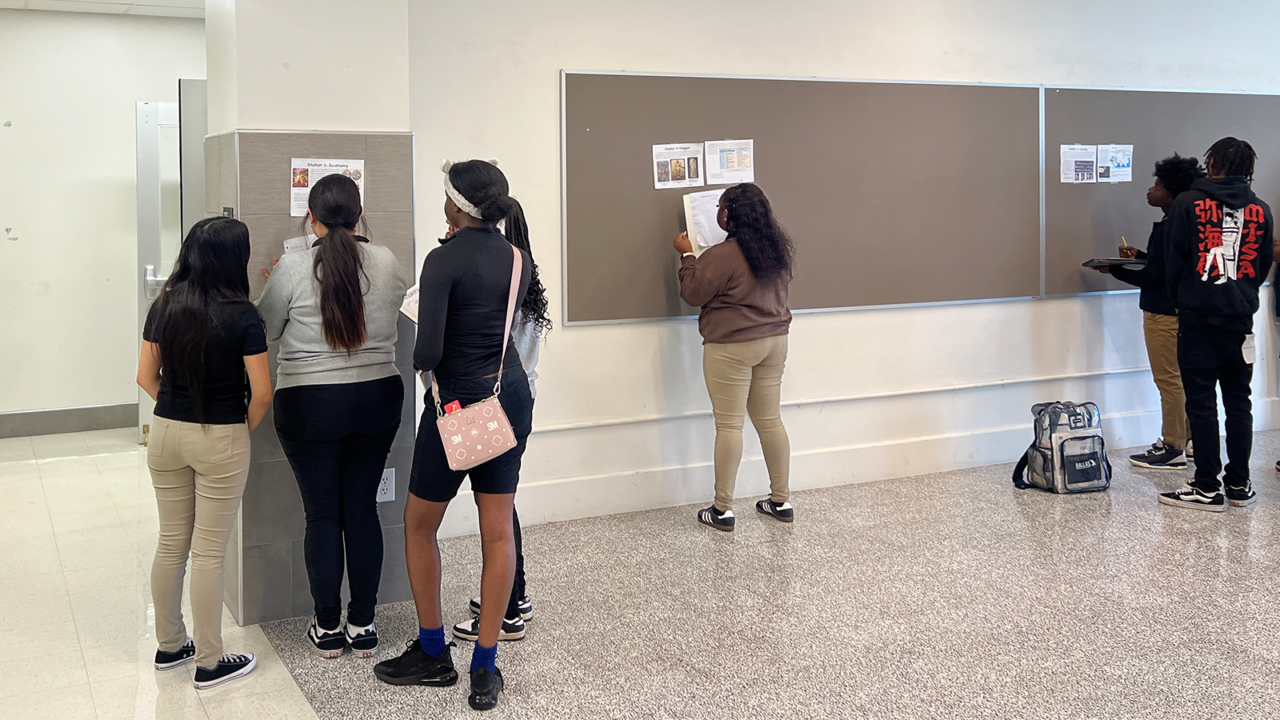
In this photo, students at South Oak Cliff High School explore a gallery walk during their World History class.
Bakayoko gives the following advice to teachers trying gallery walks for the first time: “Collaborate with someone in your department who has done it before. We have had the greatest success when our teachers partner together and co-teach.”
Ms. Caitlin Dee, an English teacher at Baldwin High School in Allegheny County, Pennsylvania, incorporated technology and discussions into a gallery walk marking the culmination of her tenth-grade English unit on the Holocaust. As a final project, her students researched a specific aspect of the Holocaust and created either a digital or physical museum exhibit to showcase their learning. This same approach can be applied to any major literary work or unit.
Dee believes the activity benefited her classroom in many ways, including students sharing their work beyond the classroom. Dee explains, “Speaking with guests from around our district—many of whom my students did not know well—gave students meaningful practice in communication, a skill essential for both the workplace and future college presentations.”
Beyond college and career readiness, Dee believes that gallery walks can foster student voice and choice. “In my upper-level English courses, [gallery walks] serve as the culminating activity for summative assessments that allow students to select the format in which they demonstrate their understanding. Options include podcasts, slideshows, social media campaigns, and traditional written work. This flexibility helps students feel more confident, as they gravitate toward media that best align with their strengths,” Dee says. Students also provide feedback during the activity. Dee shares that students “frequently note the creativity and quality of their peers’ projects, which naturally leads to deeper discussion and supports a collaborative classroom environment.”
Technology also plays a crucial role. For gallery walk assignments in Dee’s class, students have developed digital exhibits, social media campaigns, slideshows, videos, and podcasts using the school library’s podcasting studio.
Dee gives the following advice to teachers interested in trying a gallery walk activity: “I recommend keeping an open mind. I was initially hesitant, unsure whether students would fully engage with the activity or meaningfully interact with one another’s work. With reflection and a willingness to adjust, gallery walks can be highly successful.”
Alternative gallery walk activity ideas
Not all gallery walks follow a traditional layout. Variations of a traditional gallery walk could include the following:
- QR codes: In stations, QR codes can link to online content, such as webpages, videos, images, or audio recordings.
- Edtech elements: Rather than using posters or whiteboards, using laptops and tablets to share information creates a more interactive experience.
- Video: Think of exhibits with rooms where you can watch short films. The clips can be ones that already exist online or ones that students make for the gallery.
Share your gallery walk ideas
How have you ever transformed your classroom into a gallery walk? Share your favorite classroom gallery walk ideas with us via email at shaped@hmhco.com or reach out on Instagram.
***
HMH Professional Learning provides coaching memberships to support differentiated instruction in the classroom. Learn more.
Be the first to read the latest from Shaped.