





Summary
Key takeaways
- Keep expectations high while adjusting supports. Multilingual learners should engage in the same rigorous science learning as their peers, with scaffolds that increase access rather than reduce challenge.
- Build understanding through experience and discussion. Hands-on investigations, visual supports, and structured conversations help students develop both scientific thinking and language.
- Differentiate language support, not learning goals. Tailor scaffolds to students' English proficiency levels while maintaining common science standards and outcomes.
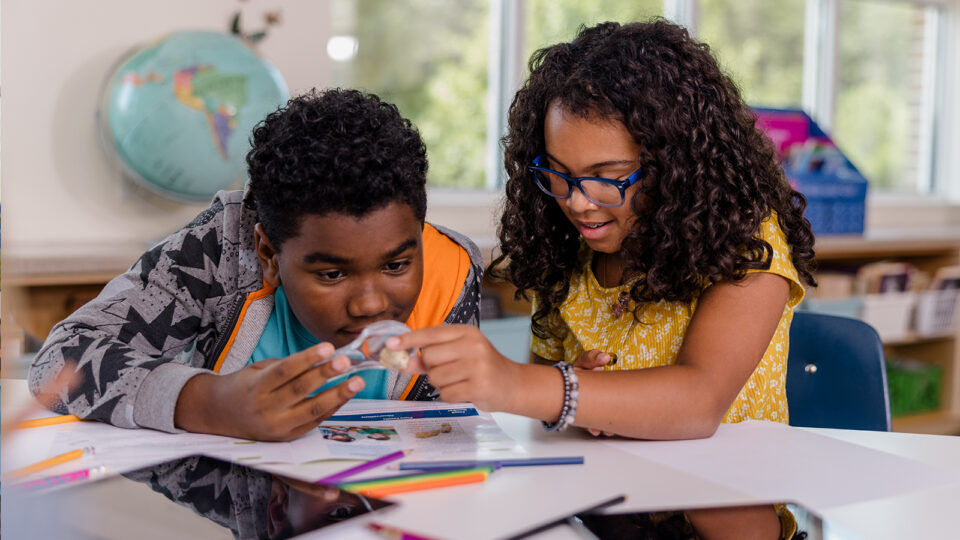
Enter into an elementary science classroom during a lesson on plant growth. Students gather around trays of seedlings, comparing observations and debating why some plants are thriving while others appear weak. One student points to a leaf and gestures animatedly while speaking in Spanish to a partner. Another sketches a diagram in a notebook before sharing an idea in emerging English. Across the room, students are constructing explanations, asking questions, and using evidence from their investigations to support their thinking.
In this classroom, language differences are not barriers to participation. They are part of the learning process.
This scene captures the heart of a powerful idea driving NGSS-aligned science instruction: all standards, all students. This principle reflects a commitment that every student, including multilingual learners (MLs or MLLs), has access to the full rigor of the science standards. Rather than receiving simplified assignments or being removed from science instruction to focus on language development, multilingual learners engage in the same scientific sensemaking as their peers while receiving the supports they need to succeed.
This approach represents a significant shift in educational thinking. For many years, language proficiency was often viewed as a prerequisite for science learning. Students were expected to learn English before they could fully participate in rigorous STEM experiences. Today, research and classroom experience suggest the opposite: students develop language most effectively when they are using it for meaningful purposes. Science provides exactly that opportunity.
When students investigate why ice melts, explore weather patterns, or design solutions to environmental problems, they are not only learning science. They are developing language by communicating ideas, analyzing evidence, and collaborating with others.
What “All standards, All Students” means
In an NGSS classroom, multilingual learners are expected to participate in the full range of three-dimensional learning. They engage with phenomena, apply science and engineering practices, connect ideas through crosscutting concepts, and deepen their understanding of disciplinary core ideas. They ask questions, build models, analyze data, develop explanations, and argue from evidence.
Importantly, they do not do this alone. Teachers provide intentional scaffolds that support access while keeping expectations high. Instead of replacing challenging tasks with easier ones, educators create pathways that allow students to participate meaningfully in the same learning experiences as everyone else.
When instruction is scaffolded, the teacher provides temporary support and presents concepts in smaller segments to facilitate student learning. However, as students build upon their learning and master new concepts, the teacher provides less support along the way.
A multilingual learner investigating a local weather phenomenon may use drawings, gestures, home-language discussions, and visual models to communicate ideas before expressing those ideas in English. Another student might use sentence frames to construct an evidence-based explanation. Both students are engaged in the same scientific thinking as their classmates.
In fact, one of the most important aspects of NGSS-aligned science is the recognition that students communicate in many ways. Scientific sensemaking does not happen only through written paragraphs or formal presentations. Students can use diagrams, models, gestures, conversations, observations, and home languages to develop and communicate understanding.
What does this look like in the science classroom?
The classroom experiences that emerge from this vision look different from more traditional approaches.
Consider a middle school class investigating why a stomp rocket travels different distances. Instead of starting a lesson reviewing a vocabulary list, students launch rockets, collect data, and discuss patterns they notice. They sketch observations, compare ideas with classmates, and develop initial explanations. Scientific vocabulary is introduced naturally from the investigation.
Similarly, in an elementary classroom exploring ecosystems, students may examine images, observe classroom habitats, and discuss evidence with partners before reading informational text. Their understanding develops through a combination of visual, oral, written, and hands-on experiences.
MLL science teaching strategies
Conversations about multilingual learner support often focus on accommodations, but the most effective science classrooms do something more powerful. They design learning experiences that make rigorous scientific thinking accessible while preserving the high expectations of the NGSS.
Teachers do not lower the cognitive demand of science concepts. Instead, they scaffold how students access information, participate in discussions, and communicate understanding. In other words, they provide support without simplifying the science material itself.
Create a shared experience around a phenomenon
Strong MLL support begins with creating a shared experience around a phenomenon. Before students read a text about a topic, they observe a demonstration, examine images, watch a short video, or conduct an investigation.
For example, during a lesson on weathering and erosion, students might observe water flowing over a tray of sand before reading about the process. Because they have seen it happen, they have a concrete experience to refer to during discussions.
Below are other ways students can become familiar with a phenomenon:
- Show photographs or real objects before reading.
- Use Notice and Wonder routines to invite low-risk participation.
- Allow home-language discussion before whole-group sharing.
- Create picture-based prediction activities.
- Build background knowledge through hands-on exploration.
Use multimodal scaffolds
Multilingual learners often understand far more science than they can immediately express in English. Effective teachers create multiple ways for students to demonstrate their thinking.
During a lesson on food webs, for example, a student may draw arrows showing energy flow between organisms and label relationships before writing a scientific explanation. The model provides evidence of understanding while supporting language development.
Other ways to scaffold science instruction include:
- Drawing diagrams of scientific models.
- Adding labels to illustrations.
- Creating physical representations using materials.
- Using gestures during explanations.
- Recording audio responses or oral rehearsals.
- Building concept maps before writing.
Provide language supports during scientific discourse
Science is inherently social. Students learn through explaining, questioning, debating, and refining ideas. To encourage participation, teachers provide structured discussion supports.
Sentence frames help students engage in grade-level scientific practices while developing academic language. The important point is that frames should support thinking—not replace it. You can use the following sentence frames in your science classroom during classroom discussions. Students can also use these sentence frames for written responses in a science journal.
| Scientific skill | Possible Sentence Frames |
| Asking questions | I wonder why _____. What would happen if _____? |
| Constructing explanations | I think _____ because _____. The evidence shows _____. |
| Argumentation | I agree with _____ because _____. My evidence suggests a different explanation because _____. |
| Data analysis | The pattern I notice is _____. The data indicates _____. |
| Modeling | My model shows _____. The arrow represents _____. |
Make vocabulary meaningful
A common misconception is that multilingual learners need extensive vocabulary instruction before participating in science. A more productive approach is to introduce vocabulary after students have explored a phenomenon and developed conceptual understanding.
For example, students may investigate why objects sink and float before learning the term density. Once students have experiences and observations to connect to the word, vocabulary becomes useful not just terms to memorize.
Here are some ways to incorporate vocabulary instruction into your science lesson.
- Use visual vocabulary cards and interactive word walls.
- Create picture dictionaries or vocabulary notebooks with sketches.
- Connect new terms to students’ lived experiences and classroom investigations.
- Use bilingual glossaries strategically rather than as a stand-alone task.
- Revisit vocabulary during modeling, talk, and writing.
Leverage students’ home languages
Students’ home languages are valuable resources for learning science. Teachers can encourage multilingualism by allowing students to brainstorm in their strongest language, use bilingual notes, or discuss ideas with peers before sharing in English.
For example, students studying weather patterns might interview family members about weather experiences in different countries. This approach strengthens both scientific understanding and cultural connections.
Differentiating instruction by language proficiency level
Multilingual learners enter the classroom at different English language proficiency (ELP) levels and may need different language supports. Effective science instruction adjusts scaffolds based on students’ language development while maintaining the same science learning goals. The standard stays the same; the pathway changes. Here are some ways to differentiate support depending on students’ English language proficiency levels.
| ELP Level | Students’ primary Need | Teaching strategy | Science Response Options |
| Emerging | High visual and oral support; opportunities to show understanding without extended English outpu | Use realia, gestures, modeled examples, picture cards, partner support, home-language resources, and short sentence frames. | Point, sort, match, draw, label, sequence picture cards, respond with words or short phrases, complete “The plant grew because ____.” |
| Developing | Structured opportunities to organize and elaborate ideas. | Use word banks, graphic organizers, sentence stems, partner rehearsal, guided writing, and scaffolded notebooks. | Complete Claim-Evidence organizers, write short explanations, explain to a partner before writing, use frames such as “The evidence suggests ____ because ____.” |
| Expanding / Bridging | Refinement of academic language, disciplinary vocabulary, and evidence-based reasoning. | Use discussion protocols, model exemplars, peer critique, academic vocabulary banks, and prompts that require justification. | Write CER arguments, compare models, lead small-group discussions, revise explanations using evidence, participate in academic debates. |
A further example of how this can look like is in a fifth-grade plant growth investigation, all students analyze the same data and explain why some plants grew better than others. Emerging learners may label diagrams and use a short frame. Developing learners may complete a Claim-Evidence organizer before writing. This is a structured framework that helps students and writers build clear, logical arguments by breaking them down into three core components. Expanding and bridging learners may write a full scientific explanation and compare results across groups. The expectation remains the same; the supports vary.
How Into Science and Science Dimensions support this vision
This philosophy is reflected in NGSS-aligned instructional programs such as HMH Into Science® and HMH Science Dimensions®. Both programs are grounded in phenomena-based instruction and three-dimensional learning, creating rich opportunities for multilingual learners to engage in sensemaking.
Into Science uses engaging videos, investigations, and collaborative tasks that provide multiple entry points into complex content. Science Dimensions structures learning around driving questions and phenomena, encouraging students to build understanding through exploration and evidence-based reasoning.
Both programs include language supports designed to help multilingual learners engage with grade-level science. Sentence frames, visual vocabulary resources, graphic organizers, multilingual glossaries, and structured discourse routines help students participate fully while maintaining high expectations.
When teachers make intentional adaptations, all learners are able access the rich content and expand their learning. A teacher might enhance access to a phenomenon by incorporating real objects, images, or short video clips before a lesson begins. Modeling activities can become more accessible through color coding, icons, and bilingual labels. When considering how to support students with text-heavy lessons, breaking it into manageable chunks and using language routines such as read-think-sketch allows all students to engage with the content. Discussion protocols such as “Turn and Talk or Claim-Evidence-Reasoning can create predictable opportunities for academic conversation.
These adaptations do not change what students are expected to learn. They change how students access and express their learning. That distinction lies at the heart of the “all standards, all students philosophy.
Ensuring science is for all students
Ultimately, this approach asks educators to see multilingual learners through an asset-based lens. Teachers can focus on what students can already do as thinkers, problem-solvers, and communicators rather than focusing on what students cannot yet do in English. Science becomes a space where language grows through curiosity, collaboration, and investigation.
When multilingual learners are given access to rigorous science experiences, they do more than learn scientific concepts. They develop confidence, agency, and academic language. They see themselves as capable contributors to scientific conversations.
Through “All Standards, All Students” every student, regardless of language background, has the opportunity to engage deeply with science, make sense of the world, and be part of the scientific community.
***
Learn more about HMH Science Dimensions and HMH Into Science—high-quality instructional materials for your science classroom.
Download our free guide to using response frames with multilingual learners.