








Summary
Knowledge building helps students deepen understanding by connecting ideas, vocabulary, and content across texts, topics, and disciplines over time.
Key takeaways
- Students develop deeper understanding when they revisit topics, engage with multiple texts, and build knowledge over time rather than through isolated lessons.
- Knowledge-rich instruction helps students build the context they need to understand increasingly complex texts and ideas.
- Knowledge building is most effective when learning is organized around coherent topics that allow students to continually expand their understanding.
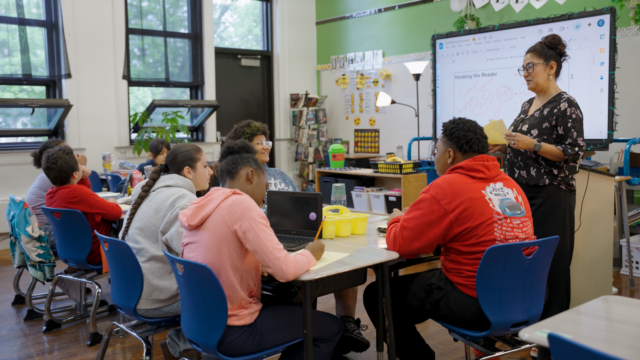
How can you spot knowledge building in the classroom? Students reference ideas from earlier lessons. They use new vocabulary with confidence and build on one another’s thinking. A discussion about a current reading might spark connections to a science investigation or a social studies topic from earlier in the unit.
This approach is more needed than ever considering many students aren’t turning to books for information, despite research demonstrating that print exposure plays a key role in building knowledge.
“Students often rely on video clips and social media, where language is more limited than in books,” says Dr. Anne Cunningham, a professor of learning sciences and human development at University of California, Berkeley, and an expert in reading development. “They’re not getting the complexity of language, so it has to be built into the curriculum.”
What does this mean for classroom instruction and how can educators design learning that helps students build knowledge? Let’s take a closer look.
Knowledge building definition and synonyms
Knowledge building in K–12 classrooms is the intentional, sustained work of helping students develop understanding by engaging with meaningful content and revisiting ideas across texts, topics, and disciplines over time. Rather than treating reading and writing as isolated skills, instruction focuses on topics that students revisit, so they continually build on knowledge. In everyday practice, this looks like students reading, discussing, and writing about a topic over multiple lessons, deepening their understanding as they go.
Educators may have heard this approach referred to as content‑rich instruction, knowledge‑rich curriculum, background knowledge development, building schema, coherent content, or topic‑based learning. While the language varies, the focus is the same: supporting comprehension and learning by systematically growing what students know.
What is knowledge building theory?
Knowledge building theory, developed by Marlene Scardamalia and Carl Bereiter, describes learning as an active, collaborative process in which students work together to ask questions, propose explanations, and refine their ideas using evidence from texts and discussion. Ideas are treated as works in progress—students revisit, revise, and strengthen their thinking as they learn more.
Students take shared responsibility for advancing understanding through dialogue, reading, and writing around topics they’re studying, rather than simply absorbing information. As students make their thinking visible, build on one another’s contributions, and return to earlier ideas with new evidence, learning begins to reflect how people solve problems in the real world.
In classroom practice, this approach is reflected in routines such as question generation, theory building from texts and investigations, and reflection on “what we now understand,” all of which support deeper comprehension, critical thinking, and long‑term learning.
Why is knowledge building important?
Knowledge building matters because what students know deeply influences how well they can learn. Comprehension is more than a set of strategies—it depends heavily on background knowledge and vocabulary, which help readers make inferences, resolve ambiguity, and integrate new information, especially as texts become more complex.
As Cunningham explains, “Our understanding of the meaning of a word is strongly correlated with general knowledge, so the more we know about a subject, the better we understand what we read.”
When classrooms intentionally build knowledge, students are better able to make sense of what they read, participate in discussions, and retain new learning. This approach also ensures that all students—not just those who come to school with broader background knowledge—have access to the ideas and language that support academic success.
How knowledge building supports reading comprehension
The more students read on a connected topic, the more they build the background knowledge and vocabulary essential for making sense of complex texts, a relationship research has consistently shown to compound over time. As their knowledge grows, it becomes easier to recognize key ideas, interpret academic language, and draw deeper inferences. Reading related texts across subjects such as science, social studies, and the arts further strengthens what students know and deepens understanding. Opportunities to discuss and write about what they’ve learned deepen comprehension even further.
For teachers, this means that selecting and sequencing content-rich texts isn’t an add-on to comprehension instruction—it’s one of the most powerful ways to support it. Cunningham emphasizes that materials should be complex, engaging, and introduce students to new ideas, language, and ways of thinking.
The more we know about a subject, the better we understand what we read.
Professor of Learning Sciences and Human Development at University of California, Berkeley
The difference between knowledge building and building background knowledge
Knowledge building and building background knowledge are closely related, but they serve different roles in instruction. Building background knowledge often happens before reading, to introduce a text’s key ideas or vocabulary. Knowledge building, by contrast, is the ongoing process of intentionally expanding what students understand across lessons, texts, and content areas.
Background knowledge refers to the experiences, concepts, and language students bring to reading. Students build on prior knowledge as they make sense of new information. Think of it this way: Today’s knowledge-building instruction becomes tomorrow’s background knowledge.
In classrooms that emphasize knowledge building, background knowledge isn’t just activated—it’s systematically developed through reading, discussion, and writing, creating the foundation students need for strong comprehension and long-term learning.
Cunningham says building background knowledge contributes to future comprehension. That’s why she suggests caregivers read aloud to their children from books that are two years above their reading level.
“You’re introducing them to new words and ideas,” she says. “When they come upon them in their own reading, it’ll be so much easier for them to comprehend. I call it money in the bank.”
Cultivating knowledge-building language
Cultivating knowledge‑building language helps students develop understanding by giving them shared tools for thinking, talking, and learning together. When teachers model academic vocabulary, establish discussion routines (such as turn‑and‑talks or structured discussions), and provide sentence frames, students are better equipped to explain ideas, reference evidence, and build on one another’s thinking.
Research shows that structured academic talk strengthens comprehension by making thinking visible and supporting the development of academic language—especially for multilingual learners and students who are still gaining confidence expressing complex ideas. Sentence frames and discussion stems don’t replace student thinking; they help students focus on meaning and ideas rather than searching for the right words.
These shared language supports help students participate more fully in knowledge‑building conversations. As students practice explaining, comparing, and justifying ideas in discussion and writing, they expand their vocabulary, strengthen their understanding, and use language as a powerful tool for learning across texts and topics.
How a knowledge-building curriculum works
A knowledge-building curriculum is designed so learning builds from one lesson to the next. Instead of moving from one disconnected theme to another, teachers intentionally sequence topics, texts, and tasks to deepen understanding of ideas within and across subjects.
Within a unit, students explore a shared topic through multiple texts and experiences so key vocabulary and concepts repeat in meaningful ways. Across grade levels, big ideas are revisited and expanded with increasing complexity. What students learn this year becomes the foundation for what they can understand next year.
For example, a unit on ecosystems might include science texts, data analysis, discussion, and explanatory writing. Students repeatedly encounter terms like habitat and adaptation, strengthening both vocabulary and conceptual understanding. Later, those same ideas resurface in more advanced studies, allowing comprehension to grow.
In a knowledge-building curriculum, reading, writing, discussion, and inquiry work together. Each lesson connects to a larger web of ideas, helping students develop lasting understanding.
Principles for building knowledge and understanding
Several key principles guide knowledge-building practice:
- Depth over coverage: Focus on exploring topics in depth rather than skimming many unrelated ones. Spending more time on a topic helps vocabulary, concepts, and connections stick.
- Purposeful text sequencing: Choose texts that build on one another. Start with texts that introduce key ideas, then move to texts with added complexity or new perspectives.
- Repeated exposure to academic vocabulary: Introduce new words in context and revisit them during subsequent discussions or lessons.
- Structured academic talk: Use routines, prompts, and sentence frames to help students compare ideas, explain their thinking, and build on classmates’ ideas.
- Writing to clarify thinking: Have students write often—short responses, explanations, summaries, arguments—to make sense of what they’re learning.
- Ongoing review and reflection: Revisit earlier lessons so students see how ideas connect. Questions such as “How does this connect to what we learned last week?” or “How has our thinking changed?” reinforce learning.
- Access to rich content: Ensure all students engage with challenging ideas and grade-level texts, with appropriate support.
Together, these principles shift instruction from short-term skill practice to long-term academic growth.
Knowledge building activities and examples
In a knowledge-building classroom, daily activities are designed to deepen and connect understanding as opposed to treating each lesson separately. The examples below show what this looks like in practice.
Question generation and inquiry charts
At the start of a unit on weather patterns, students generate questions: What causes hurricanes? Why do climates differ around the world? These questions are posted and revisited throughout the unit. As students read new texts, they add evidence and refine their explanations. Their chart evolves, reflecting growing understanding.
Connected text sets
In a social studies unit on the American Revolution, students read primary source documents, historical accounts, maps, and timelines. Each text adds to their understanding. After reading several sources, students discuss how different perspectives shaped the conflict and write explanatory essays using evidence from multiple texts.
Knowledge journals
Students maintain journals where they summarize new information, define key vocabulary in their own words, and note connections to previous lessons. Periodic prompts—What do we now understand about the topic we're studying that we didn’t before?—encourage reflection that builds learning.
Collaborative theory building
During a science unit, students propose explanations for why certain animals thrive in specific environments. As they gather new evidence from readings or experiments, they revise their theories. The class treats ideas as works in progress.
Cross-disciplinary connections
A literature study of historical fiction is paired with nonfiction texts from the same era. Students use background knowledge from social studies to better understand character motivations and setting, demonstrating how knowledge transfers across subjects.
Across these knowledge-building examples, the pattern is consistent: Students revisit ideas, integrate information from multiple sources, and use language to refine their thinking. Learning becomes cumulative rather than disconnected.
When learning builds over time
In classrooms that prioritize knowledge building, students gain far more than isolated skills. Ideas connect, vocabulary grows, and understanding deepens. They learn to make sense of complex texts, engage thoughtfully in discussion, and apply their learning in new contexts. By centering instruction on content, purposeful text sequencing, and collaborative thinking, educators create learning environments where every student has access to the knowledge and language needed for success. This approach transforms classrooms into communities where students build understanding together—lesson by lesson, topic by topic, year after year.
***
See how HMH Into Reading® (Grades K–6) and HMH Into Literature® (Grades 6–12) deepen knowledge building with rich text sets and collaborative routines.
Learn about our science of reading professional development opportunities.
REFERENCES
Frequently asked questions
-
What is the difference between memorizing facts and building knowledge?
Memorizing facts focuses on remembering specific pieces of information, while building knowledge involves connecting ideas, developing understanding, and using information to make meaning. Knowledge building helps students create a foundation that supports comprehension, critical thinking, and future learning across a variety of subjects.
-
How long does it take for knowledge building to influence reading growth?
Knowledge building influences reading growth gradually because students deepen their understanding over time through repeated exposure to related topics, texts, and experiences. As knowledge accumulates, students are often better able to understand complex texts, learn new vocabulary, and make sense of unfamiliar ideas.
-
What kinds of classroom activities best support knowledge building?
Classroom activities that best support knowledge building help students develop understanding over time by connecting ideas across texts, topics, and learning experiences. Reading related texts, engaging in discussions, asking questions, conducting research, and writing about content can help students deepen their knowledge while making meaningful connections between new and existing learning.
-
Why is background knowledge important for understanding complex texts?
Background knowledge is important for understanding complex texts because it helps readers connect new information to what they already know. When students have relevant knowledge about a topic, they are often better able to understand unfamiliar vocabulary, make inferences, draw conclusions, and comprehend challenging ideas presented in a text.
Get actionable strategies to guide instruction and accelerate your students’ reading progress.