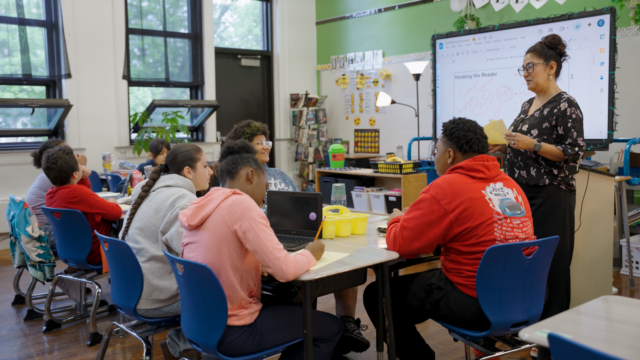



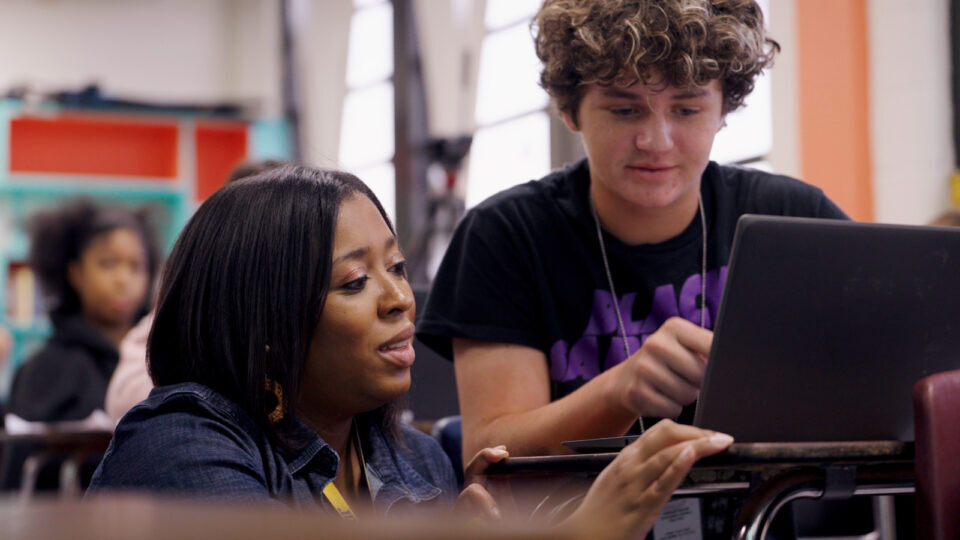
Aja Cormier, an honors English teacher at Ball High School in Galveston, Texas, confers with a student drafting a persuasive essay using the AI-powered Writable program.
Summary
Teacher-built AI chatbots offer flexibility, but educators should prioritize tools grounded in research, quality, and trust.
A teacher builds a chatbot that generates small-group instruction ideas. Within minutes, it suggests activities, discussion prompts, and differentiation strategies. Some suggestions are helpful. Others miss the mark. The teacher keeps uploading lesson materials and adjusting prompts, hoping the recommendations that come back are useful.
Educators have more AI tools than ever, many of them free, customizable, and even build-your-own. But as AI use in the classroom grows, an important question arises: Just because you can build your own AI tools, should you?
DIY chatbots come with tradeoffs. “You may get great materials out of a chatbot you built on your own, but you also may get stuff that’s not so great,” says Andrew Goldman, head of HMH Labs, a team that works with educators to develop and test new instructional technologies. Inconsistent outputs, and the time it takes to refine them, can make it harder to rely on these tools for day-to-day instruction.
The promise and pitfalls of DIY AI in education
Teacher-built chatbots and AI tools sound enticing. Educators can tailor them to their needs, experiment creatively, and respond quickly to gaps in available tools. But DIY chatbots don’t always reflect the learning sciences. The trial and error required to improve them can take significant time without clear gains in instructional quality.
“The role of AI is to apply the science of learning in a way that enables teachers to maximize their art,” says Goldman. In other words, AI should work for teachers, not the other way around.
Teacher-built AI: The pros and cons
Here are some pros:
- Customization: Teachers can design tools that fit their lessons, teaching style, and students’ needs.
- Accessibility: Many tools are free or low-cost, lowering barriers to experimentation.
- Simplicity: Many AI platforms make it easy for teachers to build custom AI tools.
- Innovation at the classroom level: Educators can quickly test ideas without waiting for product development cycles.
Here are some cons:
- Lack of instructional expertise: Generic AI pulls information from across the internet without guaranteeing that it’s accurate, grade-appropriate, or aligned to educational standards and best practices.
- Inconsistent quality: Without built-in safeguards, AI-generated resources can vary widely in accuracy and rigor.
- More work for teachers: Instead of saving time, DIY tools can require teachers to constantly validate and refine AI-generated materials.
- Data privacy concerns: Not all tools offer clear protections or zero data retention, raising real trust issues for educators and districts.
What makes curriculum-centered AI different?
Not all AI tools are created equal. The biggest difference isn’t just the features an AI tool offers. It’s the quality of the instructional materials and educational expertise behind it.
“It’s important to choose AI tools that are built specifically for education and grounded in learning science,” says Goldman, “so educators can trust that the information they’re getting is accurate and instructionally sound.”
That philosophy is reflected in HMH AI Tools, which draw on our high-quality instructional materials rather than relying primarily on information pulled from the internet. When AI is built on trusted curriculum, educators can have greater confidence in the guidance, resources, and recommendations it provides.
Key advantages of curriculum-centered AI
1. Grounded in high-quality instructional materials
Instead of pulling from a bunch of internet sources, responses are anchored in vetted, standards-aligned curriculum.
2. Built-in pedagogical integrity
AI should support instructional practices that teachers know work. The strongest classroom AI tools are designed to reinforce proven approaches like feedback, revision, differentiation, and guided instruction.
3. Trust and data protection
Curriculum-based solutions from established providers prioritize safeguards like zero data retention, so educators can use AI with confidence.
4. Designed with teachers
Tools evolve through real classroom use, not theoretical models. Teachers work within tight schedules. They’ve got curriculum requirements and the unpredictable realities of the classroom day to contend with. AI tools should be tested in classrooms to ensure they fit naturally into instruction instead of creating additional work.
The intelligence behind the AI
This isn’t just a conversation about tools. It’s about where the intelligence behind those tools comes from.
As powerful as AI can be, it doesn't automatically understand your students, your instructional goals, or the curriculum you’re teaching. Most AI platforms generate responses based on broad information sources and whatever context a user provides.
This raises an important question: What should AI know before it starts making recommendations?
Teacher-built tools can be powerful in the right hands. But they often require educators to continually provide context and verify that recommendations are accurate and aligned to instruction. Curriculum-based AI tools reduce that burden so teachers can spend less time validating AI-generated materials and more time supporting students.
“In the case of HMH AI Tools,” says Goldman, “we’ve integrated everything with our curriculum. The tools draw on HMH materials that are high-quality and designed to work cohesively across lessons, grade levels, and learning goals.”
Learn more about the design principles behind HMH AI Tools and try them for yourself.
A balanced path forward
AI in education isn’t about choosing between innovation and trust. It’s about bringing them together responsibly.
Teacher creativity will always be essential. But when it comes to scaling impact, ensuring consistency, and protecting student data, the foundation matters.
“The future of AI in education isn’t just about what tools can do,” says Goldman. “It’s about what they’re built on.”
AI that’s built on proven instructional practices
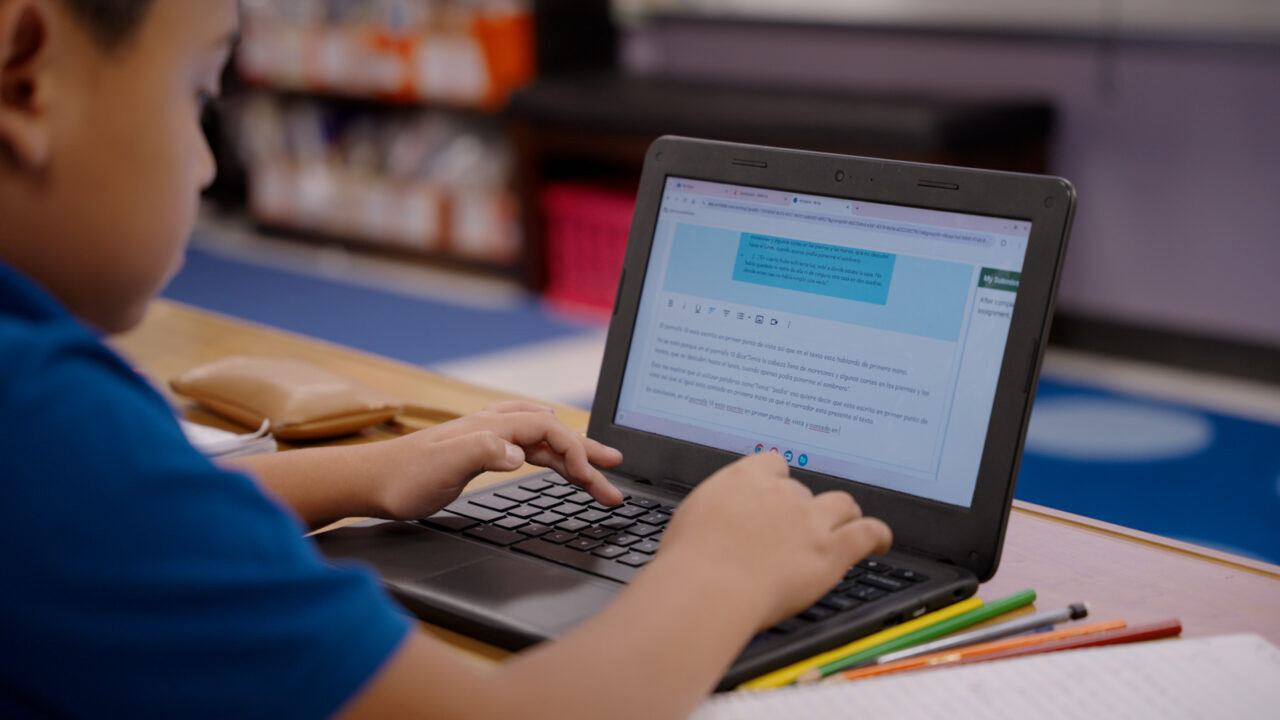
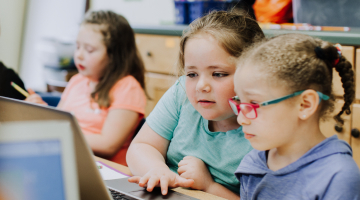
A fourth-grader at Burnet Elementary in Galveston ISD incorporates evidence into an essay based on feedback from Writable, HMH's AI-powered writing program.
What can AI do when it’s built on sound instructional practices? Writable, HMH’s AI-powered writing program, helps teachers provide individualized feedback to a classroom of students at varying skill levels. Students receive immediate comments on their writing and on how they can improve it, and teachers can revise the comments as needed.
Research has shown that timely feedback is among the most effective ways to improve student writing. “Feedback drives revision and revision drives growth,” says Goldman. “AI is giving educators exponential capacity for providing feedback to students.”
The experience of teachers in Galveston ISD illustrates what this looks like in practice. Using AI to help with feedback, teachers ended up with more time to conference with students and provide additional guidance. This created more opportunities for the kind of revision that research suggests is critical to writing growth.
“Writable supports the writing process from beginning to end but the kids own it,” says Desirée Monges, district literacy and writing specialist for Galveston ISD. “So the teacher can walk around the classroom and do that academic monitoring in the moment.”
The results were significant. Galveston schools implementing HMH solutions with fidelity saw writing growth that exceeded state and regional averages in Grades 3 and 4. Some teachers even tripled their state assessment scores.
This is the difference between AI that simply generates content and AI that’s intentionally designed to support proven instructional practices. By helping teachers provide timely feedback at scale, Writable creates more opportunities for the revision, conferencing, and one-on-one support that leads to student gains.
Key takeaways
- Customization alone does not guarantee instructional quality, making it important to evaluate how AI tools align with established learning principles.
- The greatest value of educational AI comes from helping teachers focus more time on instruction and student support.
- Schools should balance innovation with thoughtful safeguards that support effective teaching, responsible use, and data privacy.
***
Try Writable for Grades 3–12 to support your ELA curriculum, district benchmarks, and state standards. The program provides more than 1,000 customizable writing assignments and rubrics, plus AI-generated feedback and originality check that saves teachers time while boosting student skills.
Explore AI tools built on the science of learning.