






Summary
A strong school improvement plan translates data into clear priorities, measurable goals, and ongoing progress monitoring that drives meaningful, sustained improvement.
Key takeaways
- Effective school improvement planning starts with an honest data audit, since surfacing the right priorities depends on understanding both academic performance and the organizational conditions behind it.
- Plans succeed when leaders concentrate on a few high-priority goals and build in regular review, rather than pursuing many initiatives or treating the plan as a one-time compliance document.
- Lasting improvement comes from how a plan is used—turning data into shared priorities, action, and adjustment that become part of how a district operates day to day.
An intentionally designed school improvement plan, well aligned with a school’s needs, can be one of the most powerful resources in a leader’s toolkit. But what does a truly effective one look like? Because every district is shaped by its own students, data, and state requirements, there’s no single plan that works for all.
Rather than providing a one-size-fits-all plan, this article focuses on the essential components that strong school improvement plans share. You’ll also find a real-life school improvement plan example, plus a tool you can adapt to build your own.
What is a school improvement plan?
A school improvement plan is a structured, data-informed document that schools and districts create and implement to guide improvement efforts. This plan is usually grounded in an audit of current student and school data, aligned with evidence-based interventions, and designed as a meaningful tool for change rather than a compliance exercise. According to the U.S. Department of Education, a well-designed school improvement plan can act as a catalyst for transformative practices in schools.
What should a school improvement plan include?
There’s no single way to build a school improvement plan, but most effective plans include the following components:
- A clear priority: The specific area for improvement, grounded in data and evidence
- Measurable goals: What the school wants to achieve, with a defined timeframe
- Key performance indicators: The specific measures used to track whether progress is happening
- Expected outcomes: What success will look like if the plan works
- An action plan: The concrete steps, who’s responsible, and target dates
- Progress monitoring and adjustment: Regular review points to check evidence and adjust course
Grounding a plan in data
Effective school improvement plans are driven by data, usually acquired through an audit. Auditing can start small, such as through a quick scan of current practice in a single subject. A 10-minute ELA audit or a 10-minute math program review, for example, can help leaders spot where their materials and instruction are effective and where they need a closer look.
Beyond a single subject, the 5Essentials survey, a research-backed audit, measures not only academic outcomes but also organizational conditions that make improvement possible. According to UChicago Impact’s 5Essentials research, schools strong on at least three of these essentials are 10 times more likely to show substantial gains in student learning than those weak on three or more.
What makes the survey powerful is that it catches what other auditing efforts might miss. As the UChicago Impact team puts it, “Historically, school improvement efforts have primarily focused on technical factors such as grades and test scores while neglecting the social components of a school’s culture, such as trust and commitment.” The 5Essentials survey goes beyond the surface and identifies the root causes of a school’s challenges, giving leaders a foundation for data-driven decision-making.
Schools put survey data to work—translating results into a plan with clear goals, progress-monitoring methods, and an implementation timeline. Teams then evaluate and adjust over time, aiming for gains in attendance, teacher retention, test scores, and graduation rates.
While districts may use different approaches to school improvement, many of the same principles are important. Schools need good data, clear priorities, strong leadership, and a system that helps turn that information into action.
Good examples of school improvement plans
Effective school improvement plans share the same foundations, but no two look exactly alike. Each reflects its district’s unique needs, so the most useful examples illustrate how a strong plan plays out in practice.
One example of a school improvement plan comes from Moline-Coal Valley School District 40, where Deputy Superintendent Dr. Brian Prybil shared how the district built its own framework.
Moline-Coal Valley School District: Building a system for improvement
Moline-Coal Valley School District 40 in Moline, Illinois, was recognized as an Innovative District at the Model Schools Conference in both 2024 and 2025. Under the leadership of Superintendent Dr. Rachel Savage, the district has focused on creating a more consistent approach to improvement across its schools.
A big part of that work has been bringing different pieces of school improvement together into one system. The district uses its PACE framework, which stands for People, Achievement, Community, and Environment, to organize district priorities. The 5Essentials survey helps the district understand conditions within its schools, while MAP Growth and other student data help leaders see where students are making progress and where they may need additional support.
The important part is what happens with that information. Data is not collected simply to create another report or meet a requirement. District and school leaders use the information to identify priorities, have conversations about what is working, and determine where adjustments need to be made. Learning walks, coaching, PLCs, professional learning, and regular progress monitoring then help connect those priorities to what is actually happening in schools and classrooms.
The district has also worked to create greater consistency around improvement. Schools have different needs, but common language, common measures, and clear district priorities help everyone understand where the district is going while still allowing schools to respond to students’ needs.
At the 2024 Model Schools Conference, Moline-Coal Valley leaders presented on “Prioritizing Culture to Drive Student Achievement” and shared how the district has used data and a focus on culture to support personalized learning and student achievement.
The Moline-Coal Valley story shows that school improvement is not about finding the next new initiative. It is about building a system that helps people understand priorities, use the right information, take action, and keep adjusting along the way. Over time, that consistency helps improvement become part of how the district operates rather than something that happens only when a new plan is written.
Learn more about Moline-Coal Valley’s approach in HMH’s case study on the district’s leadership professional learning.
School improvement plan template
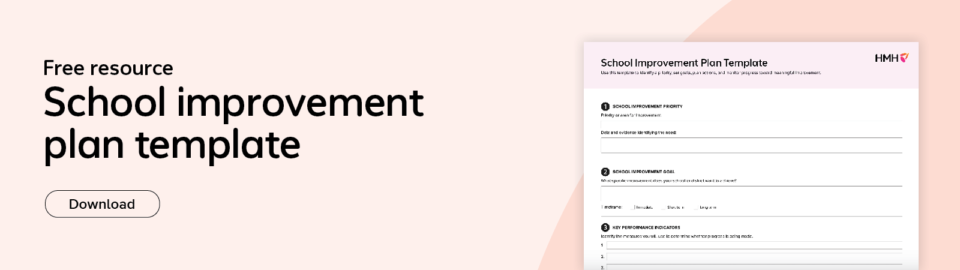
The school improvement plan template below outlines the components discussed earlier in the article: a clear priority, measurable goals, key performance indicators, expected outcomes, an action plan, and progress monitoring and adjustment. Leaders can work through each section in order, using their audit data to define the priority and then building out goals, indicators, and actions from there.
Effective school improvement begins with honest data, clear goals, and a commitment to sustained, collective action. For more school improvement ideas, explore the following resources:

Improve your student outcomes with these ideas and strategies for school improvement especially for education leaders.

Drive positive change and enhance your overall effectiveness as an administrator this year with a school improvement plan.

Get started with the school improvement planning process. Learn how to create a school improvement plan to make measurable gains in your district.
***
Learn about our nationally recognized professional learning community for access to ongoing coaching and on-demand resources.
Frequently asked questions
-
How long does it take to see results from a school improvement plan?
Results from a school improvement plan typically unfold over multiple years rather than a single one. Schools may see early signs of progress within the first year, but meaningful improvements in areas such as student achievement, attendance, and school culture usually require sustained implementation, progress monitoring, and adjustment over several improvement cycles.
-
Who should be involved in creating a school improvement plan?
Creating a school improvement plan works best as a shared effort involving district and school leaders, teachers, support staff, families, caregivers, and other stakeholders. Broad involvement builds collective ownership, helps ensure the plan reflects local needs and classroom realities, and increases the likelihood that priorities are understood, supported, and carried out. Stakeholder collaboration also strengthens trust, accountability, and long-term commitment to improvement goals.
-
How often should a school improvement plan be reviewed?
A school improvement plan should be reviewed regularly throughout the year, not only at year’s end. Regular progress-monitoring checkpoints allow leaders and teams to assess implementation, review data, identify challenges, and make timely adjustments. Ongoing review helps schools stay focused on their goals and respond to emerging needs before problems grow.
Big Ideas. Real next steps. Join us for the Annual Model Schools Conference in June.