









Writing is a versatile tool for learning. In addition to helping students communicate ideas and show what they know, writing is a way to organize thinking, develop reasoning, and create new understanding.
In the math classroom, writing takes a variety of forms, such as crafting word problems, keeping math journals, and justifying mathematical arguments. In this post, we’ll explore how to intentionally leverage the benefits of writing to support teaching and learning mathematics.
Why is writing in math important?
Writing is a concrete way for students to examine and explain mathematical thinking. Whether they are describing a pattern, explaining a strategy, or providing evidence for a claim, putting ideas into words helps students slow down and make sense of what they are doing.
In particular, writing helps students develop precise mathematical language, aligning to the Standard for Mathematical Practice of attending to precision in all areas of mathematical communication. Research shows a strong connection between language and math, with growth in one predicting growth in the other, which helps to explain why math language routines are so effective.
Writing is also generally a tool that can be used to support a wide range of students. Multilingual students can benefit from the practice of writing English, and teachers can try using writing as a strategy for students who have disabilities or in general benefit from structured scaffolds and opportunities to process before speaking.
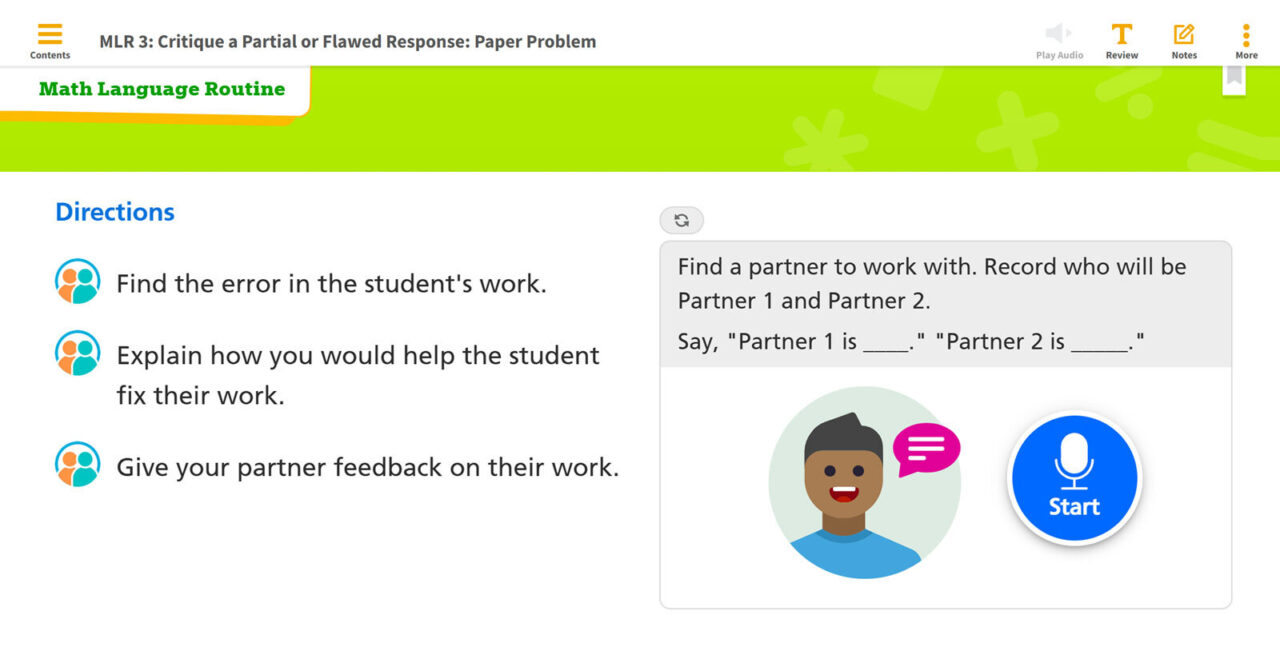
HMH Into Math includes math language routines not only to support multilingual learners but also because all learners benefit from practicing language in math class.
Ways to leverage writing in math
Writing in math serves multiple instructional purposes. When students write about math, they clarify their thinking, identify questions, and communicate with purpose. Drawing on an NWEA article on ways to engage students with writing in math class, below are four ways to leverage the benefits of writing in math instruction.
- Elicit impactful explanations. Ask students to explain how they solved a problem and why their strategy makes sense. Prompt them to justify decisions, reference definitions, and explain how they know their solution is reasonable.
- Provide a formative foundation. Review students’ written responses to identify misconceptions, partial understandings, or patterns of thinking, and use this information to guide instruction.
- Make connections. Guide students to compare strategies or connect new ideas to prior learning. Encourage them to explain similarities and differences as well as how concepts apply across problems.
- Support metacognition. Provide opportunities for students to reflect on their thinking and learning. Ask them to write about what challenged them or which strategies were most effective.
What are the four types of writing in math class?
Writing in math class can take different forms. Contrast, for instance, a fictional story about a triangle vs. a proof involving interior angles. Drawing on existing research, a task force developed a framework in 2016 that identified four distinct types of writing necessary to support students in reasoning and communicating mathematically:
Exploratory writing helps students make sense of a problem, situation, or new idea. Students write primarily for themselves to work through their own thinking. Exploratory writing supports brainstorming, identifying insights, and posing questions. The writing may or may not be shared and is especially helpful for learners who need time to process ideas before discussing them with others.
Informative or explanatory writing focuses on clearly describing and explaining mathematical ideas. It requires learners to use precise mathematical language and understand a concept well enough to explain it to others. Students communicate observations, definitions, and representations, as well as explain strategies and reasoning.
Argumentative writing is used to construct and/or critique mathematical arguments. Students make claims, support them with reasoning and evidence, and address counterarguments. The focus is on providing support for assertions, rather than simply listing procedural steps. This type of writing helps students to not only think deeply and defend their own reasoning but also to analyze and critique the mathematical claims of others.
Mathematically creative writing focuses on original ideas, questions, and flexible thinking. Students can write stories and propose novel problems. This type of writing can enhance learning by looking at a problem from a new perspective or going further in the mathematical thinking than the lesson demands. It’s important to note that an idea is “original” if it’s new to the student even when it’s not new to mathematics. This type of writing highlights math as an ongoing, dynamic process and encourages multiple approaches and solutions.
How is math used in creative writing?
Creative writing deserves a separate call-out, as it is the type of writing that may feel to many as the most distinct from the practice of mathematics. However, the disciplines of both math and creative writing require structure, imagination, and careful attention to detail. Like mathematicians, writers face problems that must be solved step-by-step, such as revising for coherence and impact, or balancing dialogue and exposition. And just as an error in notation can change the meaning of a mathematical statement, imprecise word choice or structure can alter the meaning of a piece of writing.
These connections extend into science, technology, and the workplace. The careers highlighted in HMH’s Math at Work series touch on many disciplines and rely on both mathematical reasoning and strong writing skills. Writing code, for example, requires both natural language and mathematical symbols to create meaning.
Instilling an appreciation for the relationship between math and creative writing can help students think flexibly across content areas. Incorporating activities such as the ones below can strengthen the link between math and creative writing in your classroom:
- Personalized word problems: Have students write a problem that connects a specific math topic, such as adding fractions or calculating probabilities, to general topics the class is interested in, such as sports or music.
- Descriptive writing: Have students describe a topic, such as an outdoor scene or a song they like, focusing on mathematical elements such as symmetry, patterns, or shapes.
- Process stories: Students write a proposed solution to a problem from the perspective of a character.
Writing proofs and arguments in math
A proof is a special type of writing in math that has “long been viewed as a cornerstone of mathematical activity.” A proof is a deductive argument that uses mathematical principles and theorems to show logically why a mathematical statement must be true in all cases. At higher levels of mathematics, proofs are considered one of the most fundamental parts of doing math. Writing a formal proof is a rigorous and structured process that students need support to work up to.
Informal argument writing is a bridge that gives students practice explaining their thinking, justifying solutions, and defending claims using everyday language. The act of writing arguments helps students pay attention to definitions and logical connections that are necessary for writing proofs. Many math students encounter an especially direct lesson in writing proofs in geometry, where they often learn to write two-column proofs where statements and rationales are organized side-by-side in a clear, logical structure.
How to incorporate writing into math
Writing best enhances learning in math when it is woven into the overall fabric of instruction. It can be quick, such as writing a short math exit ticket that explains a solution. Or it can also be more involved, such as a longer math journal entry that tasks students with comparing a strategy they used to one that a classmate used.
The math lesson that incorporates writing can be skill- or concept-based and potentially cover any topic. When learning math rigorously, conceptual understanding, procedural fluency, and real-world application are mutually reinforcing. Writing strengthens that balance by helping students connect representations and strategies. Look for places where writing naturally serves a lesson’s objectives, such as when students need to explain a procedure, make sense of a new concept, or reflect on a solution.
Examples of writing in mathematics
Incorporating writing in math doesn’t require an overhaul when it comes to planning. Short, consistent routines can be a great place to start. For example:
- Exit tickets with a reflection question
- Think-write-pair-share to get students sharing strategies with one another
- Compare and contrast prompts about different methods
- Error analysis to get students thinking about how others may have approached a problem and how to fix mistakes
For students who need more support with writing, math intervention strategies such as schema-based instruction for word problems, can provide additional structure for organizing thoughts and explaining reasoning in writing.
Math writing prompts and activities
Many classroom routines can motivate a writing prompt, in that the routine sets up a question or scenario for the student to write about. Below are a few routines with reasons to use them for a writing prompt and questions that can set the prompt up. Notice the overlap between this list and the previous one—writing activities can be worked into many aspects of instruction and can be adapted to fit different lessons and time constraints.
- Solve and explain: After solving a problem, students write a brief explanation describing how they solved it and why their chosen strategy works. Students may share explanations to compare approaches. How did you solve this problem, and why did you choose that strategy? Why does your solution make sense?
- Error analysis: Students analyze a worked example containing an error and write about what went wrong and how to correct it. What error was made and why do you think it happened? How could this mistake be corrected, and why does your correction work?
- Compare strategies: Students solve a problem in two different ways or examine two sample solutions and write about similarities and differences. How are these two strategies similar, and how are they different? Which strategy is clearer to you, and why?
- Reflect and respond: At the end of a lesson, students write about what was challenging, what helped them understand, or how their prior thinking changed. What part of today’s lesson was most challenging to you, and why? How has your thinking changed as a result of this lesson?
Math journal writing
Math journals help students process how they solve problems and reflect on their learning. Journaling is a great math center activity and provides both structure and independence for math writing. Consider giving students prompts such as, “How did you solve this?” or “What was tricky, and how did you work through it?” to encourage deeper thinking.
Sentence starters or sentence frames pair well with math journaling. Providing language scaffolds such as “I know my answer is reasonable because . . .” gives students a framework to guide their responses, which facilitates engagement and academic language development. Math journals are also useful as formative assessment, providing insights into reasoning and misconceptions that can be used to inform instruction.
Math writing rubrics and style guides
Rubrics are a useful tool for setting achievable expectations and providing actionable feedback. When it comes to math writing, rubrics can be adapted for the type and purpose of writing. They can be written with the teacher in mind (like the example below) to assess proficiency and monitor growth, or they can be written with students in mind so that students can use them to better understand areas for improvement.
The following sample rubric outlines expectations for an explanatory writing task where students are asked to solve a problem and explain how they got their answer.
| 1 – Beginning | 2 – Developing | 3 – Proficient | 4 – Strong | |
| Mathematical accuracy | Major errors or incomplete solution | Errors affect parts of the solution | Minor errors that do not affect the solution | All calculations are correct |
| Explanation of reasoning | Little or no explanation of reasoning | Explanation misses focuses on steps or lists them without the rather than reasons behind them | Explains most steps; reasoning may be implied rather than stated | Clearly explains each step and why it was taken |
| Math terms and symbols | Incorrect or no use of math terms and symbols | Limited or sometimes incorrect use of math terms and symbols | Uses math terms and symbols mostly correctly | Uses precise math terms and symbols correctly |
While rubrics are often used to evaluate student work after it is completed, style guides set expectations for students to follow while they are writing. They are particularly useful for math writing where clarity of reasoning and precision of language are essential for communicating mathematical thinking. Math writing style guides often outline technical conventions, such as what notation and symbols to use, in addition to broader expectations, such as how to show reasoning using definitions and mathematical justifications.
Math style guides will differ by grade and skill level, but one element that will likely be consistent is the need for guidance around showing thinking. Students are more likely to clearly explain their thinking if they have concrete steps to follow. Here could be a style guide component, for example:
Show your thinking: Don’t just write the answer. Show how you got it.
- Write your steps in order. Put one step on each line so the work is easy to follow.
- Explain in words what you did and why. Use language such as “I chose this strategy because. . . .”
- Show how you know your answer is correct. For example, “I checked my work by. . . .”
Writing in mathematics is about more than documenting steps or justifying answers; it’s about making meaning. Across the different types and purposes of mathematical writing, students learn to organize ideas, test reasoning, and communicate their ideas with clarity and precision.
In an essay in The New York Times titled “The Wondrous Connections Between Mathematics and Literature,” mathematician Sarah Hart writes about the intersections of language and mathematical thinking. “I love language; I love the way words fit together; I love the way that fiction—like mathematics—can create, play with and test the limits of imaginary worlds.” Hart quotes the Russian mathematician Sofia Kovalevskaya: “It is impossible to be a mathematician without being a poet in soul. . . . The poet must see what others do not see, must see more deeply. . . . And the mathematician must do the same.”
***
Discover how Into Math for Grades K–Algebra 1 empowers all students to deepen their understanding of mathematics and provides teachers with a real-time view of each learner’s needs.
Teach the fun of math with five hands-on activities that spark curiosity in your students.