




Summary
HMH Into Reading, a K–6 literacy program, aligns with the science of reading through structured literacy, systematic foundational skills, knowledge building, and integrated writing.
Key takeaways
- The science of reading is a broad, evolving body of research, not a single program or method, spanning word recognition, language comprehension, knowledge building, and writing, and explained by models like the Simple View of Reading, Scarborough’s Reading Rope, and the Active View of Reading.
- Into Reading puts this research into practice through a structured literacy approach, teaching foundational skills explicitly, systematically, and diagnostically with a gradual release model and a consistent daily lesson structure across Grades K–6.
- Beyond decoding, the program builds language, vocabulary, and comprehension through content-rich modules that connect reading, writing, and knowledge, and supports teachers with embedded guidance, professional learning, and coaching.
Science of reading legislation has spread rapidly across the country, with a growing number of states now calling for evidence-aligned high-quality instructional materials. That shift has made one question central to literacy curriculum evaluation: does a program truly align with the science of reading?
That question doesn’t have a simple yes-or-no answer. The science of reading is a broad and evolving body of research that extends well beyond the five pillars identified by the National Reading Panel in 2000. Alongside phonemic awareness, phonics, fluency, vocabulary, and comprehension, it encompasses language development, knowledge building, and writing.
Essentially, the science of reading tells us how we learn to read—and, therefore, how we can best teach our earliest readers.
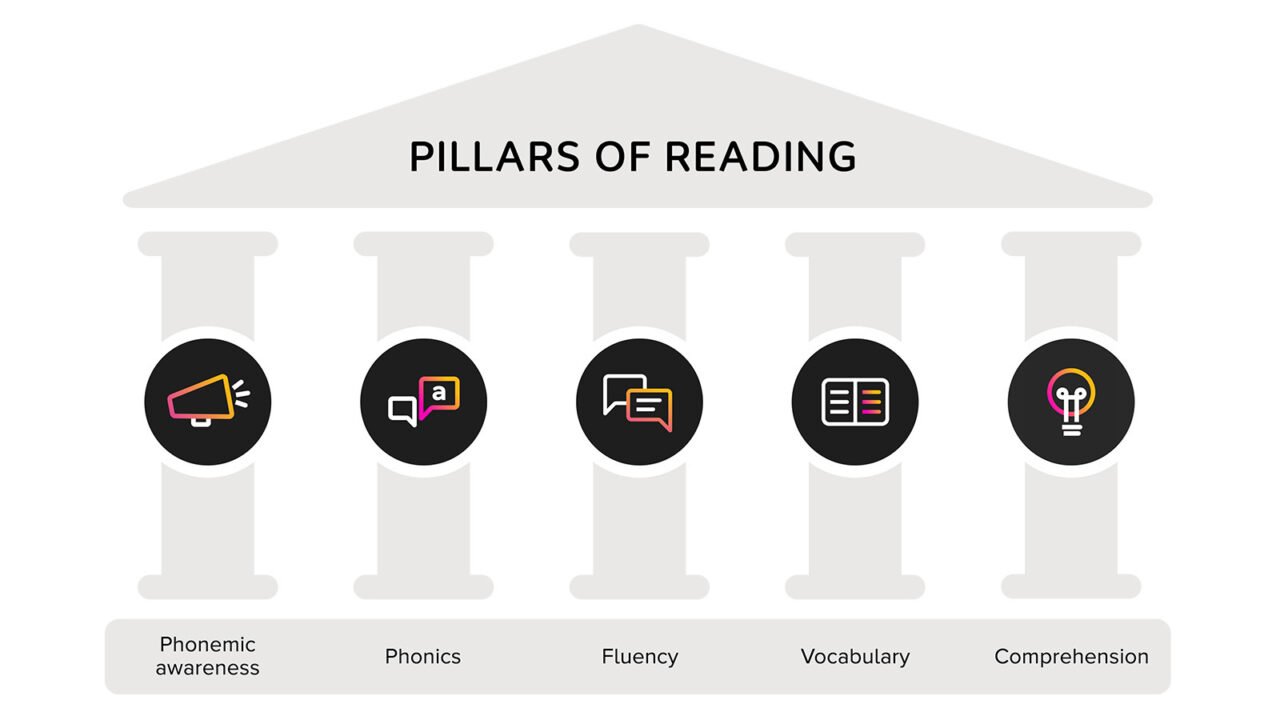
The National Reading Panel’s five pillars (2000) remain foundational, but the science of reading has since grown to include language development, knowledge building, and writing.
Because the science of reading spans so many interconnected components, determining whether a curriculum truly aligns with it often falls to administrators. While many states provide approved materials lists, some do not—leaving district and school leaders to evaluate alignment themselves.
This is where a closer look at a specific program becomes essential. HMH Into Reading, a core literacy program for Grades K–6, was developed to reflect key findings from reading research, integrating listening, speaking, reading, and writing to support literacy development.
So, let’s walk through how the curriculum aligns with the science of reading.
What is the science of reading?
The science of reading gets talked about a lot—but what does the term actually mean? The Reading League, a nonprofit focused on evidence-based literacy, describes the science of reading as “a vast, interdisciplinary body of scientifically based research about reading and issues related to reading and writing.” The science of reading isn’t a curriculum, program, or single instructional method.
A few widely used models help explain how skilled reading develops:
- Simple View of Reading: Proposed by psychologists Philip Gough and William Tunmer in 1986, this foundational model conceptualizes reading comprehension as the product of decoding and language comprehension. This relationship underscores that proficiency in one component cannot fully compensate for weakness in the other; both are necessary for successful comprehension.
- Scarborough’s Reading Rope: Introduced by Hollis Scarborough in 2001, the Reading Rope illustrates how skilled reading emerges as the strands of word recognition become increasingly automatic and the strands of language comprehension become increasingly strategic, with the two weaving together over time. The model highlights how skills such as phonological awareness, decoding, sight recognition, vocabulary, background knowledge, and verbal reasoning work together to support proficient reading. Decoding plays a central role in linking printed words to language and meaning.
- Active View of Reading: Introduced by Nell Duke and Kelly Cartwright in 2021, the Active View of Reading builds on both earlier models. It adds the role of active self-regulation—including executive function, motivation, and strategy use—and the bridging processes that connect word recognition and language comprehension.
Together, these complementary frameworks explain the components that make up skilled reading.
Structured literacy teaching puts the science of reading into practice in the classroom through explicit, systematic teaching of foundational skills in language, reading, spelling, and writing.
Does Into Reading use a structured literacy approach?
Yes. Into Reading reflects a structured literacy approach, providing explicit and systematic instruction in foundational skills shown by reading research to support reading development.
What the research says
Structured literacy is defined by three core methods of instruction:
- Explicit instruction: Teachers directly teach and model skills rather than expecting students to infer or discover them on their own. Instruction relies on clear explanation and demonstration rather than simple exposure.
- Systematic and cumulative instruction: Skills are taught in a deliberate, logical sequence that moves from simplest to most complex, with each new skill building on what students have already learned. Earlier skills are continually reviewed and reinforced so that knowledge accumulates over time.
- Diagnostic instruction: Teachers use ongoing assessment to monitor how students are progressing and adjust instruction to meet individual needs, providing more support or challenge where needed.
How Into Reading aligns
Into Reading puts structured literacy into practice through a gradual release model, systematic scope and sequence, and consistent daily instructional routines.
Program components
Gradual release model (“I Do, We Do, You Do”)
Every lesson in Into Reading follows a consistent “I Do, We Do, You Do” sequence. The teacher first models a new skill (“I Do”), then guides students through practice together (“We Do”), before students apply the skill independently (“You Do”). This gradual release of responsibility eases the cognitive load of new learning and helps students move toward independence.
Systematic scope and sequence
Into Reading follows a systematic scope and sequence that introduces foundational skills in a deliberate progression, moving from simpler skills like phonological awareness toward more complex ones like decoding multisyllabic words. Each new skill builds on what came before, and previously taught skills are reinforced along the way.
Daily lesson structure
Into Reading follows a consistent daily lesson structure across all grades. Whole-class instruction covers knowledge building, foundational skills, reading and vocabulary, and writing and grammar, with foundational skills lessons always beginning with phonics instruction and blending reviews.
Small-group rotations follow whole-class teaching within a daily instructional block. This predictable structure helps teachers deliver explicit instruction and gives students repeated opportunities to apply new skills.
Does Into Reading teach foundational literacy skills systematically?
Yes. Into Reading teaches foundational literacy skills through an explicit, systematic scope and sequence that runs across Grades K–6.
What the research says
The Simple View of Reading proposes that reading comprehension depends on two essential components: decoding and language comprehension. Decoding enables students to recognize and read words accurately, while language comprehension enables them to make meaning from what they read. Because both components are necessary for successful reading, developing strong foundational skills is critical.
Scarborough’s Reading Rope builds on this research by showing that word recognition draws on several skills, including phonological awareness, decoding, and sight recognition of familiar words. Research supports teaching these skills through explicit, systematic instruction in a deliberate sequence. As word recognition becomes increasingly accurate and automatic, students can devote more attention to understanding and interpreting text.
How Into Reading aligns
In Into Reading, foundational skills content is aligned with current research and training in early literacy. In Grades K–2, foundational skills are taught five days a week, and in Grade 3, foundational skills are taught three days a week. In Grades 4–6, word study lessons take place three days a week, following the same flow and instructional design as K–3. Across all grades, lessons always begin with phonics instruction and blending reviews. Skills are introduced in a deliberate sequence that builds from phonological awareness toward multisyllabic words and morphology (pieces of words, like prefixes) as students advance.
Program components
Stepped-out foundational skills lessons
Into Reading features stepped-out foundational skills lessons across grade levels. Each lesson begins by reviewing previously taught skills, then guides students through activities like word building, word chaining, and reading decodable high-frequency words by spelling pattern. In the upper elementary grades, this word study continues with a focus on multisyllabic words and morphology, building on the foundation established earlier. Students then apply new and previously learned skills in reading and writing.
100% decodable library
Daily lessons give students decoding practice in connected text through a 100% decodable library. These decodable readers focus only on the phonics skills and irregular words students have already learned, so early readers can successfully apply their skills. The library grows across the early grades: 80 titles in kindergarten, 85 in Grade 1, and 90 each in Grades 2 and 3.
Interactive presentations for foundational skills
Into Reading’s Interactive Presentations support explicit, systematic instruction in foundational skills through teacher-led modeling, guided practice, and opportunities for immediate feedback. Interactive tools for phonics, word building, blending, and handwriting help teachers monitor understanding and engage students as they develop critical word recognition skills.
How does Into Reading develop language, vocabulary, and reading comprehension?
Into Reading develops language, vocabulary, and reading comprehension through daily, explicit instruction aligned with the texts students read.
What the research says
Decoding alone isn’t enough for skilled reading. The Simple View of Reading pairs decoding with language comprehension—the ability to understand the meaning of words once they’re read. Scarborough’s Reading Rope breaks language comprehension into strands like vocabulary, language structures, and background knowledge. Vocabulary is especially important: the Active View of Reading identifies it as a bridging process that connects word recognition and comprehension, meaning a strong vocabulary supports both understanding text and reading the words themselves.
How Into Reading aligns
Rather than teaching skills in isolation, Into Reading builds vocabulary and comprehension in the context of each module’s texts, following a consistent lesson flow that helps students learn, practice, and apply what they’ve learned.
Program components
Daily vocabulary lessons
Daily vocabulary lessons in Into Reading help students learn academic vocabulary tied to the texts they read during whole-group instruction. Using materials like Power Words and Vocabulary Cards, teachers introduce each word, explain its meaning in student-friendly terms, and discuss how words can carry multiple meanings.
Read-alouds
In the early grades, Into Reading’s Big Books (Grades K–1) and Read-Aloud Books (Grades K–2) establish a sense of community, develop language, and build knowledge, exposing students to vocabulary and language structures they may not yet be able to read on their own.
Collaborative discussion routines
Throughout the grade levels, students build language and comprehension by talking about the Into Reading texts and topics they’re studying. Daily discussion through prompts, structured routines like Turn and Talk, and literacy centers give students repeated opportunities to express ideas, respond to peers, and deepen their understanding of what they read.
How does Into Reading build knowledge?
Into Reading builds knowledge by organizing each module around a central topic. Students strengthen their background knowledge in reading within and across grade levels by reading, writing, and talking about that topic.
What the research says
Imagine trying to read a complex article on a topic you’ve barely encountered, such as an obscure piece of legislation or specific medical material. You might be able to read the words accurately, but not necessarily understand the meaning, and certainly not quickly.
Comprehension depends not just on decoding but also on background knowledge, which provides the context needed to make sense of new information. Background knowledge is one of the language comprehension strands in Scarborough’s Reading Rope, and research consistently identifies it as essential for comprehension. The more students read about a topic, the more knowledge they build; the more they know, the more easily they can comprehend, learn from, and engage with new texts on that topic. As Dr. Anne Cunningham explains, “avid readers demonstrated much larger vocabularies, and better general knowledge about the world,” with reasoning that was “more sophisticated.”
Avid readers demonstrated much larger vocabularies, and better general knowledge about the world.
Professor, University of California, Berkeley; Scientific Advisor to the Knowledge Matters Campaign; HMH Author
How Into Reading aligns
Into Reading applies this research by organizing instruction around content-rich topics, so students read, write, and talk about connected texts that build knowledge over time.
Program components
Module launches and Knowledge Maps
Each module opens with a launch that builds interest in the topic and activates students’ prior knowledge. Knowledge Maps provide a visual overview of the ideas that students will explore, helping them see how concepts connect. Both features give students a foundation to build on before they encounter texts.
Essential Questions
Every module centers on an Essential Question that guides students’ learning. Returning to the same question throughout the module helps students connect ideas across texts and deepen their understanding of the topic.
myBook and curated text sets
Into Reading contains curated texts in the student myBook. The texts in each module connect to a shared topic, allowing students to encounter related ideas repeatedly to build knowledge over time.
How does Into Reading integrate reading and writing?
Into Reading integrates reading and writing by having students write daily in response to the texts and topics they’re studying.
What the research says
As former educator and literacy expert Julie Richardson explains, reading and writing draw on many of the same cognitive and language processes. When students write, they practice the skills that make them stronger readers. Research supports teaching reading and writing together rather than in isolation:
- Spelling a word reinforces the sound-symbol knowledge behind decoding it.
- Using a new word in writing deepens vocabulary.
- Writing in response to a text strengthens comprehension.
How Into Reading aligns
Rather than teaching writing separately, Into Reading connects it to reading at every step.
Program components
Writing process instruction
Explicit instruction supports students at each step of the writing process: prewriting, drafting, revising, editing, and publishing. Genre mentor texts and models show students effective writing techniques. Daily Write helps students apply new and previously learned grammar skills in their own writing. Older students in Grades 3–6 practice source-based writing using text evidence and rubrics.
Writable
Starting in Grade 3, Writable extends Into Reading’s writing instruction with scaffolded assignments aligned to each module. Students engage in planning, drafting, revising, and receiving feedback throughout the writing process, helping them develop stronger writing skills over time. Instructional supports, including sentence starters and model examples, are available in English and Spanish. Writing tasks are connected to module texts and topics, reinforcing the reciprocal relationship between reading, writing, and knowledge building.
Module writing and Focal Texts
Module writing bridges reading and writing by providing students with opportunities to write in response to module topics. At the center of this are Focal Texts for Grades 1–6. These high-quality trade books in each module’s topic-aligned text set anchor the writing lessons and build important reading-writing connections.
How does Into Reading differentiate instruction to support diverse learners?
Into Reading’s research-aligned support for differentiation helps educators target the diverse needs of their students and provide teacher-led small-group instruction.
What the research says
No two readers are exactly alike. Students bring different readiness levels, interests, and learning profiles to every lesson. Differentiated instruction is built on the idea that instruction works best when it accounts for those differences. For reading specifically, small-group instruction is one of the most powerful ways to do that. Studies have found that teaching in small groups of three to five students can be an effective way to target specific skills.
How Into Reading aligns
Into Reading offers research-based materials for differentiated reading instruction and embedded formative assessment to inform teaching.
Program components
Tabletop Minilessons
Into Reading Tabletop Minilessons are small-group flip charts that give teachers scaffolded instruction to reinforce and extend the comprehension skills and strategies taught during whole-group reading lessons. Because they target specific skills, the resources help teachers provide the right level of support or challenge aligned with the core curriculum.
English language development (ELD)
Into Reading embeds ELD support into daily instruction, with point-of-use scaffolds like sentence-level support and oral-language practice, informed by Dr. Kate Kinsella’s instructional routines for multilingual learners. Support happens in the moment, helping multilingual learners explicitly build language while accessing grade-level content.
Foundational Skills and Word Study Studio
For students who need additional support with foundational reading skills, the Into Reading Foundational Skills and Word Study Studio provides Tier 3 intervention with teacher-led lessons and resources aligned to whole-group instruction. This gives teachers a targeted way to reteach and reinforce the building blocks of reading for students who need more intensive practice.
Screening, diagnostic, and progress-monitoring assessments
Into Reading’s screening, diagnostic, and progress-monitoring assessments help teachers understand each student’s early literacy skills across areas like alphabet knowledge, phonological awareness, phonics and word study, and oral reading fluency. By revealing skill gaps and showing which students need support in which areas, these assessments ensure that differentiation is driven by data.
How does Into Reading help teachers deliver science-of-reading-aligned instruction?
Into Reading helps teachers deliver science-of-reading-aligned instruction through embedded guidance, professional learning, and coaching support.
What the research says
Research-based materials are critical when implementing science-of-reading-aligned instruction. However, the educator’s knowledge is crucial too. Teachers are most effective when they understand the reasoning behind their instruction and have ongoing support to refine their teaching. Research shows that reading-focused professional development produces significant, positive effects on teachers’ instructional skills, especially when teachers actively implement evidence-based methods. That’s why professional learning and coaching are part of what makes science-of-reading-aligned instruction work.
How Into Reading aligns
Into Reading provides an integrated system that aligns instruction, assessment, practice, intervention, and professional learning, along with point-of-use support built into instructional materials.
Program components
Embedded teacher support
Into Reading’s Teacher’s Guide provides point-of-use support built into each lesson, including instructional routines, background on spelling rules and language concepts, and Build Knowledge notes for guiding discussion. Because this guidance appears where teachers need it, educators can deliver research-based instruction consistently without patching together outside resources.
Professional learning
A Getting Started session facilitated by an HMH instructional coach, paired with an on-demand Teacher Success Pathway, ensures teachers begin using Into Reading with confidence. The Teacher Success Pathway provides self-paced, sequential learning within the HMH Ed platform when teachers are ready to plan lessons, administer assessments, and differentiate instruction. Teacher’s Corner and Leader’s Corner offer bite-sized, on-demand resources and live events throughout the year. This ongoing support helps teachers deepen their understanding of the research and apply it confidently.
HMH Coachly
Coachly gives teachers year-round access to a thoughtfully matched instructional coach. Teachers can chat and schedule unlimited live online sessions with their coach based on what works for them. Unlike one-time training, this personalized, ongoing coaching with an Into Reading expert coach helps teachers refine their practice over time.
A comprehensive approach to the science of reading
Into Reading was designed to reflect the broad body of research known as the science of reading, including word recognition, language comprehension, knowledge building, and writing. From explicit, systematic foundational skills instruction to embedded professional learning, each component is grounded in established reading research.
For district and school leaders, the goal is not simply to find a program that claims alignment with the science of reading but one that demonstrates that alignment through its instructional design, materials, and supports.
Read more about the science of reading and writing:

These eight elements of reading and literacy instruction can serve as the foundation of an effective literacy program.

Discover how evidence-based writing instruction, aka the science of writing, supports literacy development, expression, and academic success.

Learn how writing fits into the science of reading and why integrating reading and writing instruction supports stronger literacy outcomes for all students.
***
Learn more about our science of reading-aligned curriculum, an evidence-based approach that builds on the five pillars of reading and integrates background knowledge and writing. Plus, discover how our science of reading-aligned professional development can help you implement research-based strategies for teaching a child to read.
See how HMH Into Reading® deepens knowledge building with rich text sets and collaborative routines.
---
We want to hear from you! For questions, comments, or feedback, please contact us at shaped@hmhco.com or follow us on Instagram, LinkedIn, and YouTube.
Get actionable strategies to guide instruction with a free Science of Reading eBook.