






Summary
Science of reading lesson plan templates provide K–5 teachers with practical tools for planning research-based literacy instruction that strengthens foundational reading skills and supports student learning.
Key takeaways
- Science of reading–aligned lesson plans focus on clear instructional goals and explicit teaching practices that support reading development.
- Effective literacy instruction combines teacher modeling with guided practice and feedback to help students develop reading skills.
- Small-group reading instruction uses assessment data and classroom observations to provide targeted support based on student needs.
Lesson planning can feel like one more thing on an already full plate. But when your plan is grounded in what research says about how students learn to read, it can make instruction clearer, more consistent, and easier to adjust when students need something different.
Here we will provide four downloadable templates for science of reading lesson plans:
- One small-group template you can use across grade levels
- Three grade-band templates (K–1, 2–3, and 4–5) that model instruction focused on a single literacy component
Each template is designed to be an illustrative example, not a complete literacy block or a one-size-fits-all lesson. Think of them as planning tools you can adapt to your students, your standards, and your instructional goals.
What is the science of reading?
The science of reading is a broad body of interdisciplinary research on how people learn to read and write. It draws on decades of study from fields such as cognitive psychology, neuroscience, linguistics, and education. In this post, science of reading lesson plans means lesson plans that are aligned with these research-based principles.
Here’s the key clarification: the science of reading is not a curriculum, program, or set of lesson plans. It is research that helps explain:
- How reading skills develop
- Why some students need additional support
- Which instructional practices best support learning
This research (Dehaene S.) consistently shows that reading does not develop automatically the way spoken language does. Students benefit from explicit, intentional instruction that supports both word recognition and language comprehension.
What makes a lesson plan science of reading–aligned?
A lesson plan aligned with the science of reading is less about following a specific format and more about reflecting research-based instructional principles in your daily decisions.
1) Focused
A strong plan starts with a clear instructional objective. That objective might target:
- Phonemic awareness
- Phonics and decoding
- Fluency
- Vocabulary and language development
- Comprehension and knowledge building
Science of reading–aligned instruction provides explicit, systematic teaching of individual literacy components—particularly when introducing new skills or addressing specific areas of need—while also integrating these components through regular application in connected reading and meaning-making.
2) Explicit and systematic
Science of reading–aligned lessons make learning visible. Every step of the learning process is supported through a plan that includes:
- Direct modeling
- Guided practice with feedback
- Structured opportunities for students to apply the skill
Science of reading instruction is also cumulative, giving students regular opportunities to review and apply previously taught skills alongside new learning.
3) Supports all literacy strands over time
A common misconception is that science of reading instruction is only about foundational skills. In reality, research supports coordinated instruction that strengthens decoding and meaning-making. Over time, students need intentional instruction that develops accuracy, fluency, vocabulary, language structures, background knowledge, and comprehension.
4) Responsive
Science of reading–aligned planning is not rigid. Your plan leaves room for adjusting based on what students show you through:
- Observation and checks for understanding
- Screening and diagnostic data
- Work samples
This is where planning can become really powerful. You can use a consistent structure while still responding to real student needs.
For practical classroom moves that support this kind of instruction, explore these science of reading strategies.
Core components of a science of reading lesson plan
Research-based reading instruction includes multiple components that work together. You will not address every component in every lesson. Instead, strong instruction ensures these components are intentionally taught and revisited across weeks, units, and school years.
One research framework that captures this idea is Gough & Tunmer’s Simple View of Reading (SVR), which emphasizes that skilled reading depends on both decoding and language comprehension.
When you are planning instruction aligned with the science of reading, you will typically see these core components show up across your lesson plans:
- Clear objective tied to a specific literacy component
- Explicit modeling of the skill or strategy
- Guided practice with feedback
- Structured student practice or application
- Opportunities to connect skill practice to reading and writing
- Checks for understanding and notes for next steps
The templates later in this post are built around those common elements so you can plan more consistently and adjust more easily.
What should a science of reading whole group lesson include?
Whole group instruction is often the best place to build shared routines, introduce new learning, and ensure all students have access to core instruction.
A whole group lesson plan aligned with the science of reading typically includes:
- A clear focus on one literacy component (for example, a decoding pattern, a fluency routine, or a comprehension strategy)
- Teacher modeling that makes thinking and skill use visible
- Guided practice that includes quick feedback
- A short, structured opportunity for students to apply the learning
- A plan for monitoring understanding and deciding what comes next
Whole group instruction tends to work best when it is consistent and repeatable. When your lesson structure stays steady, students spend less energy figuring out the routine and more energy practicing the skill.
If you want additional whole-class routines and moves, explore these free science of reading activities you can use alongside core instruction.
What should a science of reading small group lesson include?
Small group instruction is where you can get more targeted. It is especially helpful when students need additional support, more practice, or instruction that is better matched to their current skill development.
A science of reading small group lesson plan is typically:
- Driven by assessment data and observation
- Focused on a specific skill students are ready to learn next
- Short, explicit, and highly interactive
- Designed to provide immediate feedback and plenty of practice
A strong small group plan often includes:
- A quick review or warm-up tied to the skill
- Explicit teaching and modeling
- Guided practice with prompts and corrective feedback
- Application in connected reading or writing
- A note about what you will look for next time
For more guidance on grouping, pacing, and instructional moves, see these strategies for small group instruction.
Key principles to creating science of reading lesson plans
Even experienced educators may find themselves balancing research-based practices with the realities of day-to-day classroom instruction.
Here are some key principles to keep in mind when creating lesson plans.
The science of reading is more than phonics
Foundational skills are essential, but effective instruction also develops vocabulary, background knowledge, and comprehension.
Keep lesson plans focused
A single, clear instructional goal supports stronger modeling, practice, and feedback.
Explicit modeling is essential
Students need to see and hear what successful use of the skill looks like before practicing independently.
Include structured practice and feedback
Students benefit from repeated, supported opportunities to apply new learning and receive immediate feedback.
Match lesson structure to the goal
A decoding lesson will look different from a comprehension lesson. Instruction should always align to the purpose.
Use data to guide small-group instruction
Assessment and observation should shape targeted instruction so students receive what they need most.
Science of reading lesson plan template and structure
A planning template is not meant to turn teaching into a script. It is meant to make your thinking clearer and your instruction easier to deliver consistently.
A helpful template supports you in planning:
- What students are learning and why it matters
- How you will model and teach the skill
- How students will practice and apply it
- How you will check understanding and decide next steps
The templates below are designed to help you plan instruction aligned with research while staying flexible for your classroom realities. Each example focuses on a single literacy component to keep the planning manageable and the instructional purpose clear.
Science of reading small group lesson plan template
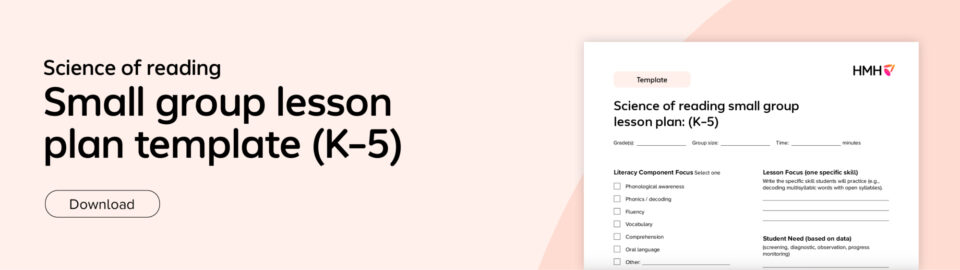
Use this science of reading small group lesson plan template when you are planning targeted instruction for a specific group of students. It is designed to work across grade levels, with a structure you can repeat while adjusting the content and texts.
Download: Science of reading small group lesson plan template (PDF)
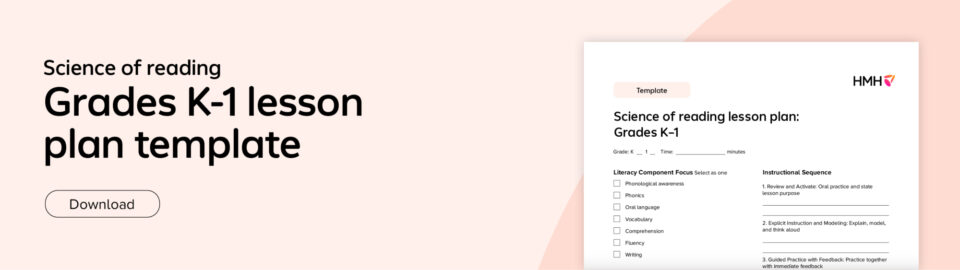
Science of reading lesson plans: K–1st grade
In kindergarten and first grade, instruction often emphasizes early literacy foundations while also building oral language and comprehension through rich read-alouds and discussion.
Common instructional focus areas include:
- Phonemic awareness (hearing and working with sounds)
- Letter–sound correspondence
- Early phonics patterns and decoding
- Oral language development and vocabulary
- Building comprehension through listening and discussion
At this level, lesson planning often works best when you target one primary component at a time and build routines students can practice daily.
Download: Science of reading lesson plan template for kindergarten–1st grade (PDF)
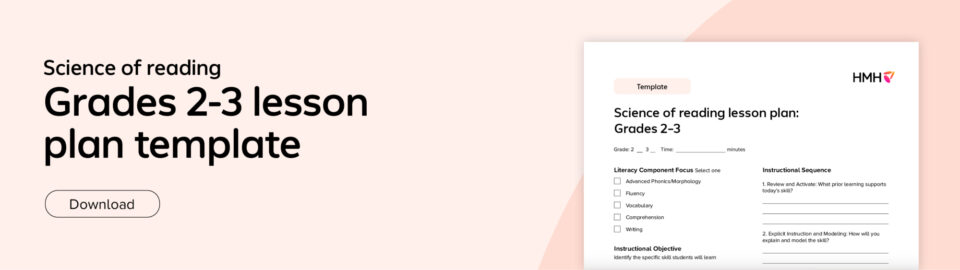
Science of reading lesson plans: 2nd–3rd grade
In second and third grade, students expand their decoding and word reading skills while increasing fluency and building the language comprehension needed for more complex texts.
Common instructional focus areas include:
- Expanded phonics knowledge and spelling patterns
- Multisyllabic decoding
- Fluency development (accuracy, rate, expression)
- Introduction to morphology (prefixes, suffixes, base words)
- Strengthening vocabulary and comprehension routines
Planning at this stage benefits from clear goals and explicit teaching moves, especially when students are transitioning to longer, more complex texts.
Download: Science of reading lesson plan template for 2nd–3rd grade (PDF)
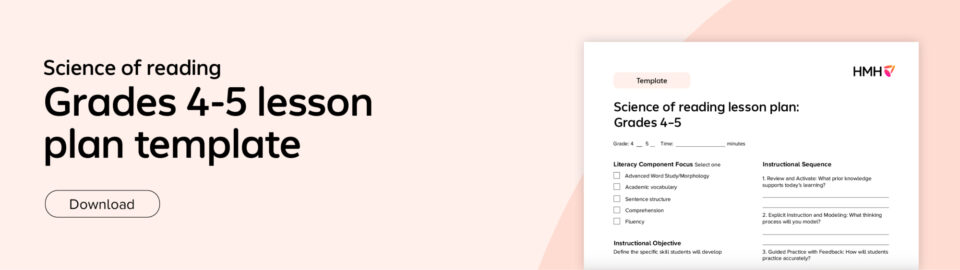
Science of reading lesson plans: 4th–5th grade
In fourth and fifth grade, instruction often includes deeper word study and language work, alongside comprehension and knowledge-building with increasingly complex texts. Some students may still need targeted support for unfinished decoding skills, so planning may include both grade-level instruction and intervention routines.
Common instructional focus areas include:
- Advanced word study and spelling patterns
- Morphology and academic vocabulary
- Complex sentence structure and language comprehension
- Fluency support for complex texts
- Targeted intervention for unfinished learning in decoding or language
At this level, a strong lesson plan helps you stay focused on the goal while matching instruction to text complexity and student needs.
Download: Science of reading lesson plan template for 4th–5th grade (PDF)
For more ideas and support, check out these five science of reading activities.
Bringing it all together
Planning aligned to the science of reading does not require a single “perfect” lesson format. It requires clarity about your instructional focus, explicit teaching and practice, and a plan for responding to what students need next. The templates in this post are designed to help you plan consistently while staying flexible.
As you adapt each science of reading lesson plan template for your classroom, keep your objective specific, build in modeling and feedback, and look for ways to strengthen both word recognition and language comprehension over time.
***
Dive deeper into the science of reading. Learn more about our science of reading-aligned curriculum, an evidence-based approach that builds on the five components of the science of reading, plus integrates background knowledge and writing.
---
We want to hear from you! For questions, comments, or feedback, please contact us at Shaped@hmhco.com or follow us on Instagram, LinkedIn, and YouTube.
Get actionable strategies to guide instruction with a free Science of Reading eBook.