







A student solves a problem correctly but can’t explain why. Another student has the reasoning but not the vocabulary to share it. Moments like these happen every day in math classrooms, and they highlight why mathematical discourse matters. Educators strive to honor the language students bring with them while expanding their ability to reason, explain, and justify their mathematical thinking. By intentionally implementing research-based strategies that support discourse, teachers can create opportunities for all students to listen, speak, read, and write about mathematics regardless of their language proficiency.
For multilingual learners, integrating language development with content learning is essential. Effective instruction leverages students’ home languages as assets to teach English through math content. Academic language, formal language that is found in textbooks and tests, is one of the many language registers students use, and the math classroom is a powerful place for expanding that repertoire. Multilingual learners benefit from intentional, supportive opportunities to practice academic English alongside everyday language they use with peers, because both serve real purposes in their mathematical lives.
Research shows that prompting students to explain their thinking produces measurable gains in mathematics learning, improving procedural knowledge, conceptual understanding, and transfer to new problems (Rittle-Johnson et al., 2017). Yet students spend relatively little classroom time engaged in this kind of talk, and multilingual learners often have even fewer chances to participate in it (Ardasheva et al., 2016). When teachers explicitly name and model academic discourse, students gain the agency to choose the register that fits the moment, whether they are reasoning aloud with a partner, writing a justification, or presenting their thinking to the class.
The importance of math discourse
Why is math discourse important? At its core, discourse develops adaptive reasoning, which the National Research Council defines as the, "capacity for logical thought, reflection, explanation, and justification" (2001). Adaptive reasoning moves students beyond simply knowing how to solve a problem to understanding why a solution works. It requires students to analyze problems, explain their reasoning, evaluate whether a solution makes sense, and revise their thinking as new ideas or evidence emerge, taking them beyond just getting the "right answer." Engaging in this kind of thinking demands linguistic tools; students need language to express logic and determine whether a solution holds up. Without discourse to articulate and justify their thinking, students cannot fully demonstrate adaptive reasoning.
The importance of discourse is reflected in the Principles to Actions (Leinwand et al., 2014), published by the National Council of Teachers of Mathematics (NCTM). It identifies “facilitate meaningful mathematical discourse” as one of its eight mathematics teaching practices. This publication established a clear connection between rigorous mathematics standards and the instructional practices that help students meet them. It emphasized that discussion is not simply an instructional strategy; it is essential to learning math. Mathematical discourse gives students opportunities to explain their thinking, ask questions, justify their reasoning, and make sense of the ideas of others. In classrooms where discourse is prioritized, students are active participants in a community of mathematical thinkers, not passive recipients of procedures.
Since the publication of Principles to Actions, our understanding of mathematical discourse has continued to grow. Today, discourse is viewed as more than one teaching practice; it supports all aspects of effective mathematics instruction. By helping students explain their thinking, make sense of others’ ideas, and engage with mathematical concepts, discourse has become an essential component of mathematics learning for every student.
English language development and math instruction
Language develops across four interconnected domains: listening, speaking, reading, and writing. These domains are often grouped into two categories: interpretive language, which includes listening and reading, and expressive language, which includes speaking and writing. Students strengthen all four domains as they engage with mathematical discourse, making the math classroom an important setting for both language development and content learning.
For multilingual learners, language development is most effective when it is integrated with academic content. Many states use the WIDA English Language Development Standards Framework to guide this work. The framework breaks down English language development (ELD) standards statements that provide broad framing of content and language integration. Standard 3, titled “Language for Mathematics,” specifically addresses how students use language to engage with math concepts. In math instruction, WIDA emphasizes that language acquisition isn’t just about vocabulary. It’s about helping students explain reasoning, interpret problems, and construct arguments using discipline-specific language.
As teachers, we want to intentionally develop both students’ interpretive and expressive language skills during mathematics instruction. This means moving beyond what we, as teachers, are saying and doing to create opportunities for students to do the talking. When students discuss, read, write, and explain their mathematical thinking, they deepen both their mathematical understanding and their language proficiency.
Supporting multilingual learners with math language routines
One way to intentionally support language development in mathematics is through mathematical language routines (MLRs), developed by researchers at Stanford University (Zwiers et al.). Designed with multilingual learners in mind, MLRs reflect goals similar to those of WIDA by integrating language instruction into daily mathematics learning. These routines help students move from the informal language they use in everyday conversations to the more precise academic language needed to explain reasoning, justify solutions, and communicate mathematical ideas. Rather than treating language development as a separate activity, MLRs provide practical strategies that embed listening, speaking, reading, and writing into mathematics instruction so all students can access, discuss, and express mathematical thinking.
4 math language routines examples
The four math language routines highlighted below provide structured, but adaptable strategies that support both interpretive and expressive language development. These routines provide opportunities for students to listen, speak, read, and write about mathematical situations with practices that are appropriate and effective for all language proficiency levels. They can be found within HMH’s Into Math.
1. Three reads
This routine supports reading comprehension, mathematical sense-making, and an awareness of the language used in mathematics. It also encourages students to discuss and negotiate the meaning of a problem with a partner, promoting both language development and mathematical discourse. During the routine, students read the same situation or problem three times, with each reading serving a different purpose and helping them build a deeper understanding of the task. Here’s how the routine works:
| First read | Students read or listen to the problem with the goal of comprehending the text. |
| Second read | Students read or listen to the situation with the goal of comprehending the mathematics. |
| Third read | Students read the situation and brainstorm possible mathematical questions related to the problem. |
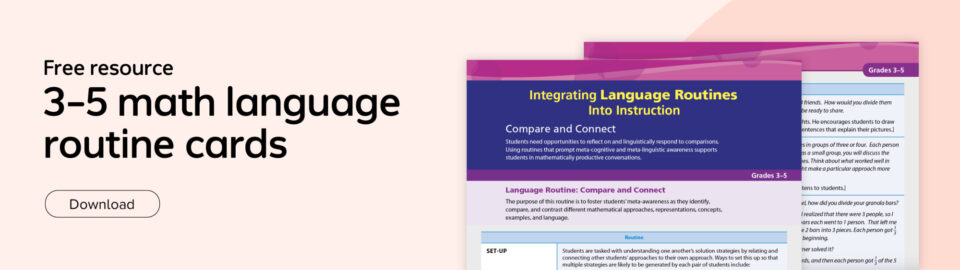
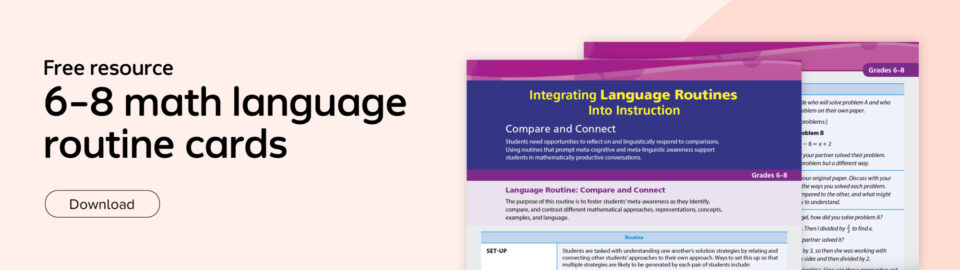
2. Compare and connect
The purpose of this routine is to help students develop an awareness of mathematical language and thinking by identifying, comparing, and contrasting different approaches, representations, concepts, examples, and ways of communicating mathematical ideas. One way the routine can look is like this:
| Set-up | Students are tasked with understanding one another’s solution strategies by relating and connecting other student’s approaches to their own approach. Ways to set this up so multiple strategies are likely generated by each pair of students include:
|
| What is similar, what is different | After solving, students will identify what is similar and different about the approaches. Students can discuss what worked well in one approach or which approach was easier to understand. |
| Mathematical focus | Students focus on specific mathematical relationships, operations, quantities, and values. Support students in making mathematical comparisons and connections with the following prompts:
|
3. Stronger and clearer each time
This routine works best when students are asked to construct a mathematical argument or defend their reasoning. As students engage in multiple conversations with different partners, they build on and borrow ideas, strategies, and mathematical language from each discussion. With each exchange, students refine both their thinking and their ability to communicate it. Here’s how the routine works:
| Preset | Present a problem or question to students. |
| Prepare | Students pre-write. Students study the problem individually, writing down any ideas or reasoning about how to solve the problem, using complete sentences if possible. Provide students with scaffolding tools, like sentence frames, to support with language structures. Provide think time. Give students a minute to think about what they will say to their partner, considering what they did to solve the problem. |
| Partner | Place students in structure pairings. Each person in the pair will take turns being the speaker and the listener. As the speaker, they will explain what they did to solve the problem. As the listener, they will ask clarifying questions like, why did you do that? Students will then rotate to other partners, strengthening and clarifying their ideas each time. Meanwhile, you’ll circulate and listen to partner discussions and help when needed. |
| Process | Students post-write. Students will return to their seats to write down their final explanations, using complete sentences. Compare. Students then compare and analyze their pre-write and post-writes, noticing how their ideas were strengthened and clarified during partner discussions. |
4. Critique, correct, and clarify
In this routine, students analyze, reflect on, and revise a piece of mathematical writing that is intentionally incorrect, incomplete, or ambiguous, giving students an opportunity to identify errors, clarify ideas, and strengthen the mathematical explanation. As they improve the writing, students deepen their own mathematical understanding while developing their ability to communicate mathematical thinking clearly and precisely. Here’s how it works:
| Present | Present a partial or flawed mathematical explanation, argument, or solution. Introduce the response as if it came from a student and ask the class to help improve it. The response might include an ambiguous phrase, informal mathematical language, or a common misconception. |
| Prompt | Prompt students to identify errors, unclear language, or missing reasoning. Ask them to compare the response with their own understanding of the problem and work independently or with a partner to revise the explanation. |
| Share | Pairs present their improved responses, explaining the changes they made and why those revisions make mathematical thinking clearer and more precise. |
| Refine | Students use ideas from the class discussion to revise their own written explanation, strengthening both their mathematical reasoning and their use of mathematical language. |
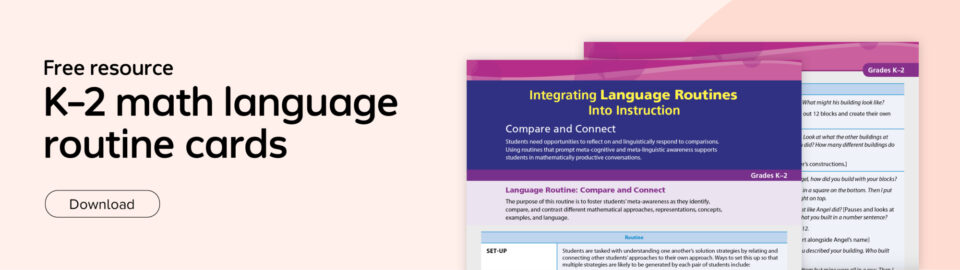
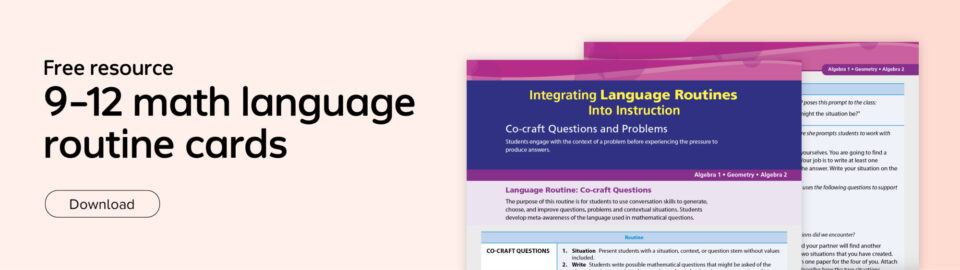
Use the following downloadable MLRs cards from Into Math to implement these routines in your class. Below you'll find cards for grades K–2, 3–5, 6–8, and 9–12.
Tips for using math language routines in the classroom
How do we ensure that mathematical language routines have the greatest impact in our classrooms? Start by introducing one routine at a time and intentionally selecting tasks that make the chosen routine especially fruitful. Just as importantly, create a classroom environment where students feel comfortable taking risks with language. After each routine, take time to reflect as a class on what went well, what was challenging, and how communication can continue to improve.
As you plan instruction, look for opportunities to embed mathematical language routines throughout the lesson. Choose or adapt tasks that promote both interpretive language (listening and reading) and expressive language (speaking and writing), giving students multiple ways to process and communicate mathematical ideas. As educators, we should continually reflect on how our instructional practices support students’ ability to think, reason, and communicate mathematically. Remember, change doesn’t happen all at once. Begin with one routine, use it consistently, and build students’ confidence and participation over time.
Empowering all learners through math discourse
When we use math language routines and give students opportunities for discourse, collaboration, and adaptive reasoning in the math classroom, they are better able to justify their thinking and reach deeper levels of mathematical understanding. These experiences encourage students to reason through problems, work together, and clearly explain their solutions when they face new challenges. When we intentionally support all students with language, we strengthen their ability to express their thinking and determine whether a solution makes sense.
References:
Ardasheva, Yuliya, et al. "Accessing the Classroom Discourse Community Through Accountable Talk: English Learners’ Voices." TESOL Journal, vol. 7, no. 3, 2016, pp. 667-699.
Leinwand, Steven, Daniel Brahier, DeAnn Huinker, Robert Q. Berry, Frederick L. Dillon, Matthew R. Larson, Miriam A. Leiva, W. Gary Martin, and Margaret S. Smith. Principles to Actions: Ensuring Mathematical Success for All. National Council of Teachers of Mathematics, 2014.
National Council of Teachers of Mathematics. Principles to Actions: Ensuring Mathematical Success for All. National Council of Teachers of Mathematics, 2014.
National Research Council. Adding It Up: Helping Children Learn Mathematics. National Academies Press, 2001.
Rittle-Johnson, Bethany, et al. "Promoting Self-Explanation to Improve Mathematics Learning: A Meta-Analysis and Instructional Design Principles." ZDM Mathematics Education, vol. 49, no. 4, 2017, pp. 599-611.
Zwiers, Jeff, et al. “Principles for the Design of Mathematics Curricula: Promoting Language and Content Development.” Understanding Language/Stanford Center for Assessment, Learning and Equity, Stanford University Graduate School of Education, 28. Feb. 2017 ell.stanford.edu/content/mathematics-resources-additional-resources
***
For high-quality math tasks and support for rigorous teaching, try HMH Into Math, a core mathematics curriculum for kindergarten through Algebra 1.
Get our FREE guide “Optimizing the Math Classroom: 6 Best Practices.”