






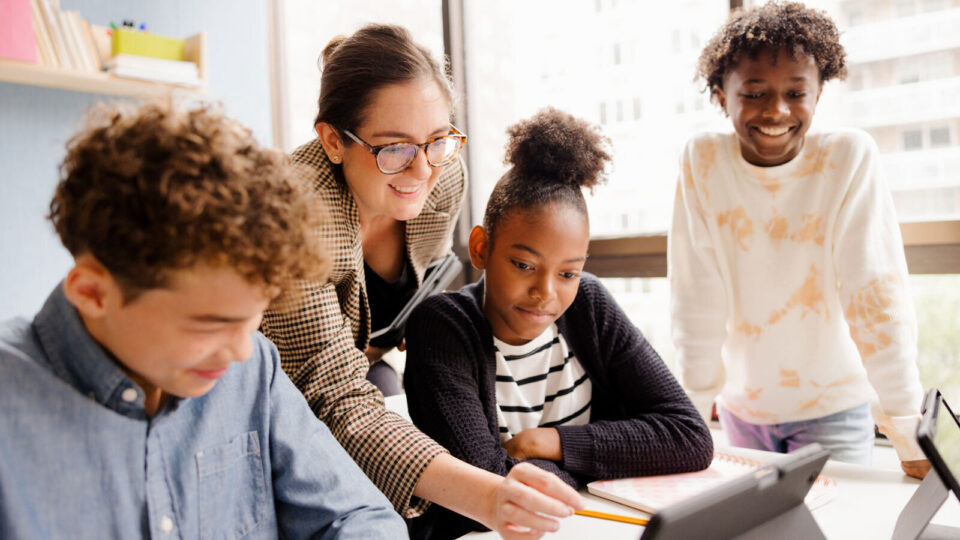
Middle school years are marked by developmental changes that shape how students learn and engage in the classroom. Recognizing these changes can help you create a learning environment where students feel supported and understood. Here, we’ve tapped into brain science and highlighted strategies to inform your classroom management for middle school students. (If you’re teaching online, try these virtual classroom management strategies.)
How to create a middle school classroom management plan
A middle school classroom management plan serves as a guide for how your classroom will operate day to day. It helps students understand what is expected of them while giving you a framework for supporting positive student behaviors and addressing challenges constructively. Consider the following when developing your classroom management plan.
Establish clear expectations
Start by defining what you want your classroom to look and sound like throughout the day, but don’t feel like you have to do this alone. Invite students into the process and have them brainstorm what participation and collaboration look like in the classroom. Use their ideas to shape your expectations together. When students have a voice in creating classroom norms, they are more likely to take ownership of them. Once expectations are established, write them in student-friendly language and display them clearly in your class. Afterwards, take time to model what they look like in practice.
Teach routines and procedures
Like academic content, routines and procedures should be taught intentionally. Take time to demonstrate expectations and provide opportunities for practice. This may include showing students what to do when they enter the classroom, how to transition between activities, or how to submit assignments. When routines become familiar, it can help reduce confusion and keep your classroom running smoothly, so you can focus on instruction, and students can focus on learning.
Respond to behavior
As you develop your classroom management plan, it’s helpful to think through how you will respond when students have difficulty meeting expectations. Having a clear response plan can create consistency and help students understand what to expect when challenges arise. Depending on the situation, your approach might include a private conversation, an opportunity for reflection, or time for a student to reset before rejoining an activity. In some cases, involving families and caregivers or providing additional support may also be appropriate. Whatever responses you choose, consistency is important. When students know what to expect and trust that expectations will be applied fairly, it helps build a classroom culture of respect and accountability.
Incorporate positive reinforcement
Alongside your response plan, consider how you will recognize students when they meet expectations. Positive reinforcements can help draw attention to the behaviors you want to encourage while reminding students that their efforts matter. A middle school classroom management reward system can provide simple opportunities for recognition, whether through privileges, positive feedback, or other forms of acknowledgment. When students know their efforts are noticed, they are often more motivated to continue making positive contributions to the classroom.
Review and adjust classroom management plan
Your classroom management plan should evolve as you get to know your students. Take time to reflect on what is working and where adjustments might help. Checking in with students and making small changes along the way can strengthen your approach. This ongoing reflection ensures your plan stays responsive, supportive, and effective throughout the year.
Classroom management for middle school
Effectively employing middle school classroom management strategies requires some understanding about the adolescent brain—and what a marvel the adolescent brain is!
During adolescence, the front part of the brain (the prefrontal cortex) is still being developed. This is the area of the brain responsible for performing executive functions, such as decision-making, emotional regulation, and cognitive flexibility. The adolescent brain is malleable; it can change and adapt to its environment, and certain activities can aid in its healthy development well into adulthood. And while the adolescent brain can also be impulsive and vulnerable, it’s quite responsive to positive feedback.
Let’s think of this plasticity as an opportunity for us as middle school educators to use classroom management strategies to meet our students where they are and help them develop into healthy and happy adults. While every middle school classroom is different, these approaches can be adapted for 6th, 7th, and 8th grade classrooms to support students at every stage of adolescence.
1. Greet students at the door
We all know that transitions from one class to another in middle school can be chaotic. This is where some middle school behavior management know-how comes in handy. One way to help students regulate their behavior and get themselves into a learning mindset as they transition into your class is to greet them individually at the door. In fact, a 2018 study found that positive greetings at the classroom door produced significant improvements in academic engagement and reductions in disruptive behavior. When greeting your students, be sure to:
- Make eye contact with the student.
- Say the student’s name.
- Use a nonverbal greeting like a wave, handshake, fist bump, or high-five.
- Say a few words of encouragement to the student (e.g., “I am so happy to see you today,” “I can’t wait to hear what you thought about last night’s reading,” or “I know you had a rough morning, so please let me know if you need anything”). Or simply ask how they’re doing.
2. Have a “Do Now” ready
This is a proactive classroom management strategy that sets the tone from the get-go. Students know from the start exactly what to do, eliminating confusion that can lead to distractions and misbehaviors. This can be avoided by having a “Do Now” that’s either written on the board or is already on your students’ desks before they enter the classroom. An effective “Do Now” adheres to these criteria:
- It can be completed in 3–5 minutes.
- It is a written product.
- It doesn’t require any explanation from you as the teacher. Explaining the “Do Now” defeats the purpose of having your adolescents develop their self-management and self-direction skills.
3. Conduct empathy interviews
Classroom management issues can sometimes stem from a lack of positive relationships and trust between teachers and their students. Empathy interviews are a way to build trusting relationships.
In empathy interviews, teachers schedule 20-minute blocks of time to ask individual students the following questions:
- “What are your hopes and dreams?”
- “What is one thing I (teacher)/school should continue doing?”
- “What is one thing I (teacher)/school should stop doing?”
- “What is one thing I (teacher)/school should start doing?”
Our students say empathy interviews make them feel that their opinion is valued, and they enjoy the opportunity to get to interact with their teachers on an individual basis to talk about their experiences at school. Teachers may find that empathy interviews allow them to slow down, focus, and truly listen and learn about the student experience at their middle school. Empathy is a crucial part of relationship building.
4. Serve as a “learning guide”
When we talk about classroom management, images of quiet adolescents sitting in rows with the teacher at the front of the class may materialize in our minds as the “gold standard” of classroom management. In our experience, to best meet the needs of the adolescent brain, teachers have to view themselves as “learning guides” who manage through observation. As teachers, we must always have positional awareness that takes us to different parts of the class—not just the front—to observe the students completing tasks or interacting with one another. Resist the temptation to sit at your desk and grade papers!
Positioning yourself in different parts of the class and observing students also provides you with specific information to use when praising students who are engaging in positive behaviors in class. We have found that, along with empathy interviews, observing student learning provides us with crucial information to inform our practice and our collaboration with colleagues. Many improvements to our instruction have come about while teachers were observing their students as they learn.
5. Let students make choices
Middle school students are faced daily with a barrage of situations where they have to make decisions. Given that their prefrontal cortex is still developing, we must provide them with many opportunities to make decisions to ensure they do not engage in poor choice-making into adulthood. When developing academic tasks in class or school-wide, we ensure that our students are provided with choices to demonstrate their learning by giving homework options, using project-based learning, soliciting independent study project ideas, collecting their feedback on school-wide issues, and conducting student polls that lead to rich and productive debates. All of these strategies provide our middle schoolers with opportunities to express their learning and creativity in a safe space.
6. Use nonverbal interventions
Imagine this scenario: You’re modeling a strategy, demonstrating a lab, or explicitly teaching a skill to your students. You want to redirect a student’s behavior in the moment, but you don’t want to break the flow of your lesson. What do you do?
In this case, try using a nonverbal intervention like:
- Make eye contact with the student and deliver your “teacher look.”
- Shake your head indicating “no.”
- Use a gesture that expresses your desired behavior (e.g., sitting up, putting a cell phone away).
- Walk in the direction of the student and stand near them.
7. Address student behavior anonymously
Inevitably, there will be times when student behavior needs to be addressed. Rather than singling out students, respond to the behavior anonymously. Here are some examples:
- “Two pairs of eyes are wandering. I’d appreciate all eyes on me, please.”
- “I’m noticing some side chatter. For this part of the activity, we need silence for the next couple minutes.”
- “If your head is on the table, please sit up and show me that you’re ready to proceed with the lesson.”
8. Establish classroom routines
Routines are not only important for effective classroom management, but they also matter for growing adolescent brains because they aid in executive function skills.
Effective classroom management begins with explicitly teaching, modeling, and consistently reinforcing routines. While 6th grade classroom management may require more frequent modeling and practice of routines, 7th and 8th grade students often benefit from greater independence and leadership opportunities. Here are some examples of classroom routines:
- Putting backpacks away and organizing desks
- Sharpening pencils
- Turning in a homework assignment
- Asking to use the bathroom using a nonverbal signal
- Checking out a book from the classroom library
- Writing down homework in an academic planner/agenda
- Performing classroom jobs
Remember to talk with your students about the rationale behind various routines. Cultivate a greater sense of ownership and community in your classroom by inviting students to create some routines and procedures with you.
Zaretta Hammond, author of Culturally Responsive Teaching and the Brain, explains how classroom routines can be reimagined so respond to students’ cultural backgrounds. In other words, they emphasize interdependency and social connection—they're tied to collectivist values as opposed to individualistic ones. Try these:
- Recite a common poem or verse with your students that highlights your school’s or classroom’s values. Do this every day. Honor your students’ languages by reciting the poem or verse in each of their languages.
- Employ “call and response” or play music when transitioning from one activity to another.
9. Breathe
Much research points to the benefits of mindfulness-based techniques for all ages, but in particular for adolescents. In our experience, taking the first 2–3 minutes of class to engage with your students in mindfulness-based activities allows middle schoolers, and even adults, to become focused and ready for the classroom tasks at hand. One of our favorite and easiest techniques to engage our middle schoolers in mindfulness is guided breathing. This practice has been shown to reduce stress and lead to increases in self-regulation and quality of sleep, which is so important for the adolescent brain’s development.
10. Do a “child study”
The adolescent brain is complex and can cause educators to experience both wonder and frustration. Lean on your teaching team to engage in a process we call "child study." At our public Montessori middle school, child study is an approach that allows our teaching team to productively discuss students using a wide range of data to understand their development and give them the support they need. Most of the students discussed in a child study are demonstrating academic or social behaviors that may put them at risk. Child study is a holistic approach to understand each student’s development at the intellectual, physical, emotional, and social levels. It also allows us, as the adults, to develop a plan of action to support students’ success at school.
Child study has the power to change a school’s culture from deficit-based to one rooted in curiosity around each student’s strengths. In some schools, the child study process is held at the school-site level and may involve a cross-functional school team, but we’ve also found that the process can be successfully applied by grade-level teams.
Middle school teaching is a special calling. Dr. Maria Montessori said it best: “Adolescents must never be treated as children, for that is a stage of life that they have surpassed. It is better to treat adolescents as if they had greater value than they actually show…”
11. Create a classroom reward system that motivates students
A middle school classroom management reward system is one way to recognize students for meeting expectations and reinforce behaviors that support learning. In middle school grades, where students are building independence and navigating social dynamics, positive reinforcements like reward systems can boost motivation and strengthen classroom culture.
A reward system can take many forms. For example, you could use a classroom points system or classroom dollars that students earn for demonstrating expected behaviors. Students can then exchange their points or cash for privileges or other incentives. You could also have the whole class work toward shared goals to encourage collaboration.
The key to any reward system is to keep incentives connected to what your students value. For some students, that may mean earning flexible seating or the opportunity to listen to music during independent work time. Others may be motivated by opportunities for choice, like selecting a preferred way to demonstrate their learning. And some students may find leadership roles rewarding, such as serving as the teacher’s assistant. You can offer a variety of reward options to meet your students’ needs.
12. Use classroom management games to build engagement
Classroom management games can help turn everyday routines and expectations into interactive experiences that feel fun and collaborative. There are many ways to incorporate classroom management games into the school day. For example, a team challenge might involve groups earning points for demonstrating collaboration during a group project. Similarly, a transition game can challenge students to move from one activity to the next within a set amount of time while following classroom expectations.
You can also use friendly classroom competitions, such as having table groups earn points throughout the week for being prepared or participating in discussions. Additionally, routine practice activities, like a beginning-of-year classroom procedures scavenger hunt, can help students learn routines and reinforce expectations in an engaging way.
Whether you’re teaching in-person or online, we hope that these classroom management strategies—rooted in brain science—create a learning environment that meets your students’ needs and ultimately helps them succeed in school and life.
More middle school classroom management strategies
Do you have creative ways of keeping your middle schoolers engaged and learning? Maybe you have ideas about how to improve the techniques we’ve shared here. We’d love to get your thoughts. Share your strategies with us at Shaped@hmhco.com.
The views expressed in this article are those of the authors and do not necessarily represent those of HMH.
***
Explore our evidence-based solutions, which include opportunities for intervention, assessment, and differentiated instruction.
Be the first to read the latest from Shaped.
Related Reading
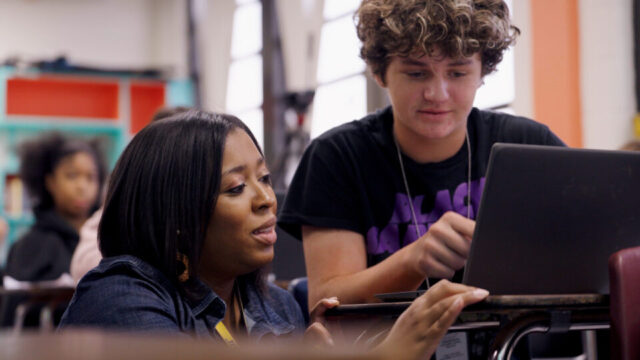
Aja Cormier, an honors English teacher at Ball High School in Galveston, Texas, confers with a student drafting a persuasive essay using the AI-powered Writable program.

