


Summary
Hands-on math activities use manipulatives, models, and other approaches to help students explore concepts actively, building deeper understanding and reasoning.
When I first started teaching upper elementary math intervention, I noticed something frustrating almost immediately: Many students could repeat procedures without actually understanding the numbers behind them.
Fractions made this especially obvious.
I could model equivalent fractions on the board over and over again. Students could copy the examples, repeat the steps, and even pass a quick practice page. At first, it looked like they understood the concept, but many were really imitating a process rather than thinking about the size and relationships of the fractions. The understanding fell apart the moment the numbers changed.
Everything shifted when we started building fractions with fraction strips and tiles.
Instead of memorizing that 1/2 and 2/4 were equivalent, students could physically see that they covered the same space. The conversations changed too. Students stopped asking, “Is this right?” and started asking questions like, “Wait . . . so these are the same amount?”
That experience changed the way I approached math instruction. Whether I was teaching place value or algebraic thinking, I found that students developed stronger understanding when they could model and explore ideas for themselves instead of only watching procedures being demonstrated. Hands-on learning is not about making math cute or entertaining. It helps students make abstract ideas visible.
In this post, we’ll explore:
- What hands-on math activities are
- Why they are important
- The benefits of hands-on learning in math
- Examples across grade levels and skill areas
- Practical implementation strategies for the classroom
- Fun hands-on math activities you can use with students
What are hands-on math activities?
Hands-on math activities are tasks that give students opportunities to actively explore mathematical ideas. There are many ways to explore math ideas actively, such as using movement, manipulatives, visual models, educational games, discussion, and real-world problem solving. What these approaches to math learning have in common is that instead of only listening to instruction or completing worksheets, students interact directly with math concepts.
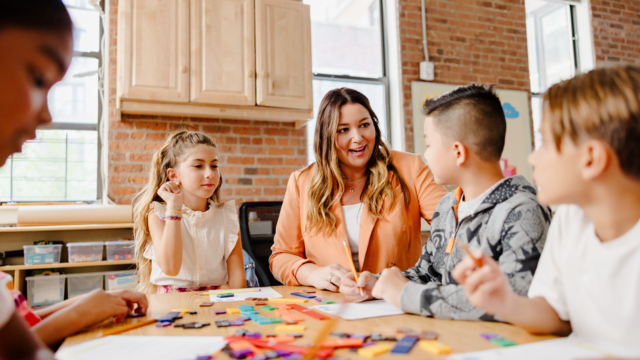
Hands-on math activities often involve manipulatives that allow students to make physical mathematical models. This can include:
- Base-ten blocks
- Fraction strips
- Algebra tiles
- Measuring tools
- Number cubes and cards
- Graph paper
- Geometric models
Hands-on learning can extend beyond traditional manipulatives. Activities might involve classroom materials like sticky notes, craft sticks, or paper clips. The goal is for students to connect concrete experiences to mathematical reasoning using exploratory environments like investigations, games, and collaborative problem-solving tasks.
Hands-on learning can occur throughout instruction. It can happen during:
- Whole-class lessons
- Intervention groups
- Math centers
- Collaborative investigations
- Independent exploration
Contrary to what some people assume, hands-on learning is not only for younger students. Older students can benefit just as much from opportunities to model and investigate abstract concepts in tangible ways. Much like adults, they often develop deeper understanding when they can actively engage with ideas rather than simply observe them.
The importance of hands-on math activities
Students can arrive at correct answers without fully understanding the mathematics behind them because they are mimicking procedures rather than reasoning about the underlying concepts. For example, a student may successfully regroup during subtraction while still feeling unsure how to explain place value. Or a middle school student may solve an equation correctly but not fully understand what the equal sign represents.
Hands-on activities slow the learning process down in productive ways. Students model mathematical relationships, test ideas, make mistakes, and explain their thinking instead of only repeating procedures. I also found that manipulatives could reveal misconceptions that worksheets hid. Students who appeared successful during independent practice were sometimes stuck when asked to physically represent the same concept. That information is valuable for teachers because it shows where understanding actually breaks down.
Hands-on learning can also change the emotional experience students have with math. Students who are otherwise hesitant may become more willing to participate when math feels interactive and exploratory instead of based on test results.
I noticed that students were often more willing to share unfinished thinking when they had something concrete to point to or manipulate. Rather than worrying about whether an answer was right, they focused on explaining what they observed. Those conversations frequently revealed misconceptions, and they also created opportunities for students to clarify ideas, learn from one another, and build confidence in their mathematical reasoning. As a result, students tended to explain their thinking more naturally, leading to stronger mathematical communication and deeper understanding.
Benefits of hands-on activities in math
Hands-on math instruction supports engagement and deeper understanding. Across grade levels, students are encouraged to think about math instead of simply completing it.
Benefit 1: Increased participation
Students are more invested when they can interact with ideas instead of only watching procedures demonstrated. Learners develop a deeper understanding when they actively explain, justify, and discuss ideas rather than simply receive information. Once students are invested, you can try thinking routines to find out what they’re thinking.
Benefit 2: Stronger visualization
Hands-on activities also help students visualize mathematical relationships that are difficult to understand abstractly. Fraction models, algebra tiles, and geometric constructions, for example, make abstract concepts more concrete and easier to reason through.
Benefit 3: Better retention
Students are more likely to remember concepts they have physically explored, discussed, and modeled themselves.
Benefit 4: Support for diverse learners
Hands-on learning experiences can provide practice with speaking and collaboration and offer a range of contexts and tactile experiences. This diversity of approaches can help multilingual learners and students who need additional scaffolding to access grade-level concepts. Structured opportunities for discussion and explanation, like using sentence starters, can be especially powerful because they allow students to develop mathematical language while making their thinking visible to others.
Hands-on math activities by grade level
No matter what grade a student is in, the core goal remains the same: helping students build understanding through active exploration. Just what a hands-on math activity looks like, however, along with how a teacher uses it, changes as students advance in their math learning.
Hands-on math activities for elementary students
Elementary students benefit from concrete learning experiences because they are still developing foundational number sense. I noticed that many younger students could count or follow procedures without understanding how numbers compare in size and value. Activities that involved physically building numbers or comparing quantities often revealed misconceptions that worksheets missed.
For example, some students could identify the larger number between 302 and 320 but found it hard to explain why. Using base-ten blocks helped students physically see how hundreds, tens, and ones worked together. Those concrete experiences built the foundation students later needed for visual models and abstract problem solving.
One geometry investigation you can try around Grade 4 is to ask students to search for angles in real-world environments like playgrounds or classrooms. Students sketch, measure, compare, and organize angles while discussing geometric relationships and defending their reasoning. Activities like this help students connect geometry vocabulary and measurement concepts to the world around them. Other effective elementary hands-on activities might involve measuring classroom objects, building arrays with counters, or exploring fractions using visual models.
Hands-on math activities for middle school students
Middle school students benefit as well from tactile and collaborative learning experiences, even as mathematical concepts become more advanced and less reliant on concrete representations. Many middle school students learn to hide misunderstandings by memorizing procedures. Hands-on math activities for middle school can expose those gaps in a productive way by encouraging students to test ideas, analyze results, and explain their reasoning aloud.
One activity you can try around Grade 7 is an investigation based on Buffon’s Needle, a famous probability experiment in which students drop toothpicks onto a set of parallel lines and use the results to approximate the value of pi. As students collect data and combine class findings, they explore connections between probability, geometry, and statistics in an interactive way. What makes the activity powerful is that students experience math as experimentation rather than memorization. Instead of simply being told the value of pi, students investigate how mathematical constants can emerge through repeated trials and data analysis.
Middle school students tend to respond well to activities that involve curiosity and real-world application. At this stage, hands-on learning often becomes less about simple manipulatives and more about investigation and mathematical discussion.
Hands-on math activities for high school students
Hands-on learning remains valuable in high school, especially when students are applying concepts to authentic situations and real data. By this time, many students have developed strong beliefs about whether they are “good at math.” Applied and investigative activities can help shift that mindset by giving students opportunities to analyze and defend mathematical decisions instead of simply memorizing procedures. Experiences like these can help students see mathematical ability as something that develops through persistence and problem solving rather than something they either do or do not have.
One example of a high school hands-on activity is a modeling investigation in which students analyze vehicle stopping distances using braking data. Students compare the stopping distances of different vehicles at different speeds, build regression models, and predict whether a collision will occur under certain conditions. As students test assumptions and interpret results, they connect quadratic modeling and data analysis to real-world safety questions.
What makes activities like this powerful is that students experience math as a tool for investigation and decision-making. Instead of viewing equation solving as following isolated procedures, they see it applied to realistic scenarios and used to justify conclusions. At the high school level, hands-on learning leans heavily toward strategic modeling and real-world problem solving.
Examples of hands-on math activities by skill area
Hands-on math instruction can also look different depending on the mathematical domain being taught. Some concepts naturally lend themselves to physical models while others benefit more from investigation and discussion, though both approaches can make math learning more hands-on.
Number sense and operations
Hands-on activities for building number sense help students develop a stronger understanding of quantity, place value, numerical relationships, and ultimately, number operations.
Activities like counting collections, number line walks, or building numbers with manipulatives encourage students to reason about value instead of memorizing procedures. These experiences are important in early grades because they help students develop flexibility with numbers before moving into more abstract computation.
Fractions and rational numbers
Fractions are often one of the clearest examples of why hands-on learning matters. Students may memorize fraction procedures while still struggling to understand the size of fractions or relationships between them. Fraction models become powerful when students move beyond equivalence activities and begin modeling operations. Area models and number lines can help students reason through fraction multiplication and division in ways that procedural instruction alone often does not. Number lines are especially valuable because they help students see fractions as numbers that can be compared, ordered, and operated on. Over time, students can begin visualizing these relationships mentally, giving them a powerful tool for reasoning about fractions beyond memorized procedures.
A common example is fraction division. Students may memorize “keep-change-flip” but run into difficulties when trying to explain why the procedure works. Visual models help students connect the procedure to the underlying mathematical relationship.
Geometry and measurement
Geometry naturally lends itself to hands-on exploration because students can physically build, compare, rotate, and measure shapes. Activities involving topics like area, perimeter, or symmetry can become more meaningful when students manipulate models instead of only looking at diagrams.
For example, students might design floor plans on grid paper to investigate area and perimeter relationships or build three-dimensional figures to explore surface area and volume.
Algebraic thinking and functions
Hands-on algebra activities help students visualize relationships, patterns, and equations that might otherwise feel abstract. Algebra tiles, balance models, and pattern investigations allow students to physically represent equations and variables while discussing how operations affect relationships.
The downloadable modeling activity shared later in this post is one example of how high school students can connect algebraic reasoning to real-world data and decision-making.
Tips for implementing hands-on math activities
Hands-on learning works best when activities are intentional and clearly connected to mathematical goals. Below are some tips for structuring your hands-on learning.
Tip 1: Use in small groups and centers
Math centers and small-group math activities create excellent opportunities for differentiated hands-on instruction. Teachers can rotate students through collaborative games, skill-based investigations, intervention activities, or teacher-led instruction. Clear modeling and routines are especially important so students can focus on mathematical thinking instead of managing materials.
Small-group settings also create more opportunities for students to explain reasoning, ask questions, and learn from peers.
Tip 2: Differentiate instruction within the activities
One of the strengths of hands-on math instruction is that it naturally supports differentiation. Teachers can adjust the complexity of numbers, provide visual supports, offer multiple solution pathways, or incorporate structured discussion and movement into activities.
Hands-on activities can be especially effective for multilingual learners and students who need additional scaffolding because they provide multiple ways to access mathematical ideas.
Tip 3: Use manipulatives strategically
Manipulatives are most effective when they are directly connected to mathematical understanding. Students also benefit from opportunities to explain their reasoning while using manipulatives. Teachers should explicitly model:
- How to use the manipulative
- What it represents mathematically
- How students can transition from concrete models to visual and abstract thinking
Tip 4: Establish clear routines
One reason some teachers hesitate to use hands-on learning regularly is that it can initially feel unstructured. Strong classroom routines and procedures make a huge difference and can make hands-on learning one of the most productive parts of the math block. Helpful strategies include:
- Modeling procedures before activities begin
- Assigning student roles during group work
- Setting clear time limits and expectations
- Organizing materials in labeled bins
- Practicing cleanup routines
Free printable hands-on math activities and resources
Throughout this post, we’ve explored how hands-on learning can support understanding across grade levels and mathematical domains. If you’re looking for ways to bring more hands-on learning into your classroom, the printable resources below provide examples that you can adapt and use with your students right away. These types of resources work especially well when paired with classroom discussion and opportunities for students to explain their reasoning.
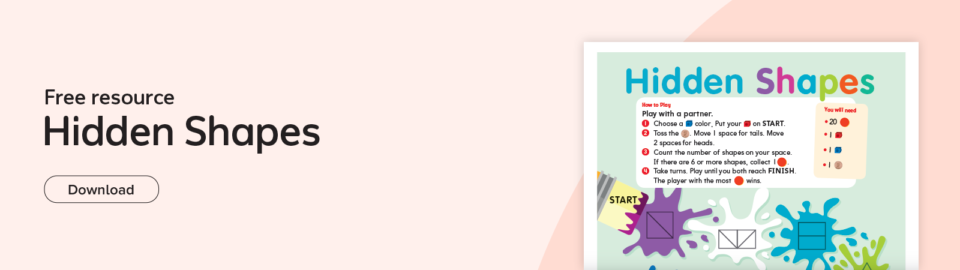
Elementary geometry: Hidden Shapes
This Grade 2 geometry activity sends partners along a game board, counting the shapes hidden inside the figure on each space they land on. Because players score by identifying figures that contain six or more shapes, students have to break a composite figure all the way down into its parts rather than name the one shape they see first.
This activity supports the following standards:
- Identify triangles, quadrilaterals, pentagons, hexagons, and cubes (Grade 2)
- Look for and make use of structure (Grades K–12 mathematical practice)
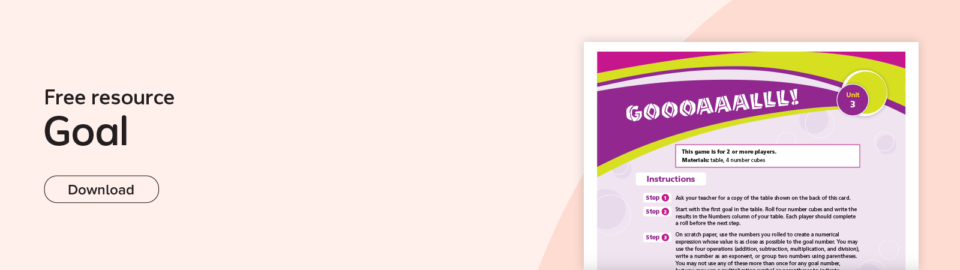
Middle school expressions and equations: Goal
This Grade 6 activity challenges students to roll four number cubes and build a numerical expression—using the four operations, exponents, and parentheses—that lands as close as possible to a goal number. A player’s score is the distance between the expression’s value and the goal, so students keep testing combinations to see how each choice moves the result.
This activity supports the following standards:
- Use numerical expressions involving whole-number exponents (Grade 6)
- Look for and make use of structure (Grades K–12 mathematical practice)
High school modeling and data: Which Job Offer Should You Take?
This high school activity encourages students to analyze and interpret real-world data while applying algebraic thinking and mathematical modeling skills. Students make predictions and justify conclusions using mathematical reasoning.
This activity supports the following standards:
- Compare and interpret exponential models (High school – functions)
- Interpret key features of functions in context (High school – functions)
- Model with mathematics (Grades K–12 mathematical practice)
- Construct viable arguments and critique the reasoning of others (Grades K–12 mathematical practice)

Final thoughts on hands-on math activities
Hands-on math activities help students see math as something they can explore, discuss, build, and understand—not just memorize. Across all grade levels, interactive learning experiences encourage curiosity, persistence, and deeper mathematical thinking. Whether students are using counters in first grade or modeling real-world data in Algebra 1, active learning creates opportunities for meaningful engagement and deeper understanding.
The most effective hands-on activities for math are not necessarily the most complicated. Often, the strongest math moments come from simple materials, purposeful questions, and opportunities for students to reason through ideas together.
***
HMH Into Math for Grades K–8 is a core math curriculum that includes whole-group, small-group, and partner work and encourages mathematical discourse.
We want to hear from you! For questions, comments, or feedback, please contact us at Shaped@hmhco.com or follow us on Instagram, LinkedIn, and YouTube.
The views expressed in this article are those of the author and do not necessarily represent those of HMH.
Get our FREE guide “Optimizing the Math Classroom: 6 Best Practices.”