







Summary
Building Thinking Classrooms practices can work alongside a high-quality math curriculum to foster deeper student thinking and greater ownership of learning.
Key takeaways
- Thinking classrooms shift the focus toward students actively reasoning through mathematical tasks instead of simply mimicking a demonstrated solution.
- High-quality curriculum can support thinking classrooms by providing rich mathematical tasks that give students different ways to approach problems and extend their thinking.
- Visibly random groups encourage students to collaborate, while vertical nonpermanent surfaces can help students discuss mathematics, persist through challenging tasks, and make their thinking visible.
The book Building Thinking Classrooms in Mathematics, Grades K–12, by Peter Liljedahl (pronounced “LILL-yuh-doll”) , challenges common classroom structures and routines in favor of practices designed to foster deeper student thinking.
As enthusiasm for Liljedahl’s work grows, many teachers find themselves facing a practical challenge: How do you embrace the principles of a thinking classroom when your curriculum isn’t specifically designed for it? The principles include moves as drastic as taking away furniture or removing the entire front of a classroom. Surely the curriculum doesn’t support that . . . or does it?
In this article, we show how the framework of thinking classrooms can work together with a high-quality curriculum to help ensure students not only think more, but think more productively. We quote Building Thinking Classrooms frequently throughout this article, with page numbers referring to the first edition published by Corwin in 2020.
What are thinking classrooms?
In the book, Liljedahl looked at not only teaching but also “studenting,” which is “what students do in a learning setting” (p. 7). He found that students aren’t doing a lot of thinking in the classroom, and in response, teachers are planning their instruction around the (often subconscious) assumption that students won’t try to think.
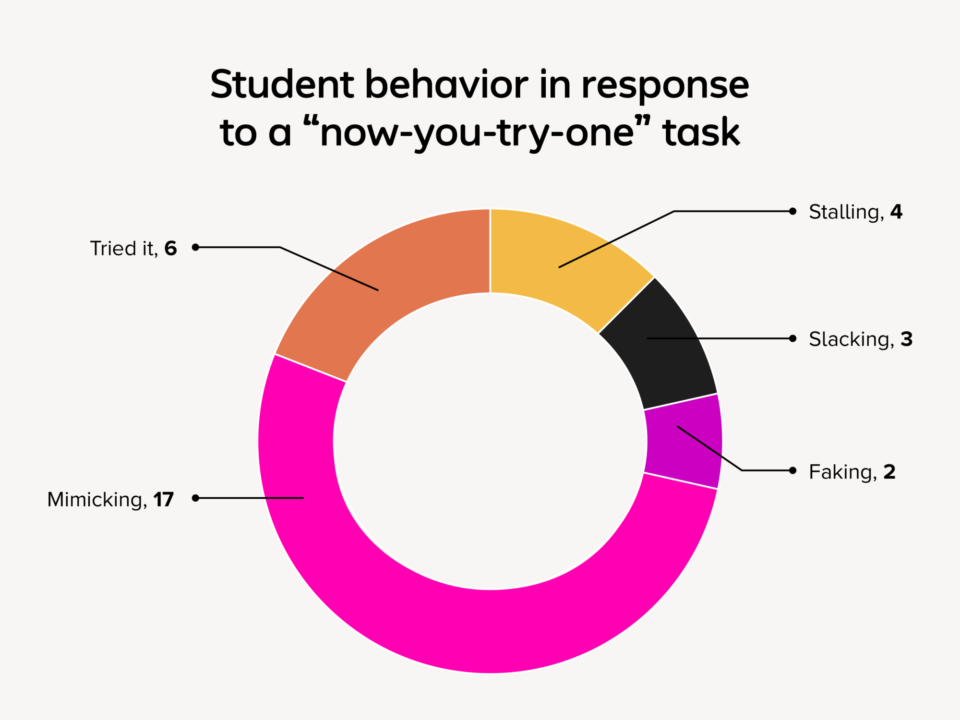
An example of this is a standard approach that Liljedahl calls a “now-you-try-one” task: The teacher first solves a few similar math problems for students and then asks them to try one on their own. Liljedahl was able to observe a classroom of students who were given a “now-you-try-one” task, and he documented and classified what they did as follows (pp. 9–10):
- Stalling: Some students put off attempting the problem through under-the-radar actions such as sharpening their pencil or getting a drink of water. This happened about 13% of the time (n = 4).
- Slacking: Some students didn’t attempt the problem but instead spent time looking at their phones, talking to other students, or doing nothing. This happened about 9% of the time (n = 3).
- Faking: Some students “pretended to do the task but were, in reality, doing nothing,” such flipping idly through textbook pages. This happened about 6% of the time (n = 2).
- Mimicking: Most students solved the problem by “trying to recreate the pattern of the solutions that had just been demonstrated on the board.” This happened about 53% of the time (n = 17).
- Tried it: Some students ultimately did what was asked of them, trying “to reason their way through the task based on their understanding.” This happened about 19% of the time (n = 6).
This issue of students not engaged in productive, mathematical thinking is core to what Liljedahl investigates throughout his research. “The bottom line with all of this is that the goal of building thinking classrooms is not to find engaging tasks for students to think about,” writes Liljedahl (p. 159). “The goal of thinking classrooms is to build engaged students that are willing to think about any task.”
The practices of Building Thinking Classrooms
Liljedahl’s work outlines 14 practices—including task selection, note-taking, and performance assessment—that break down how teachers can get students thinking in math class. Plenty of teachers and schools have stepped up and embraced these practices. “It would be rare to find a math department in America that hasn’t been touched by it,” writes teacher and education writer Ryan Hooper.
Yet implementing all 14 practices represents a significant instructional shift for most teachers. It involves moves as dramatic as changing the furniture layout and “defronting” the classroom so there’s no obvious board or screen that students face. The practices also include less dramatic changes such as changing how and which questions to answer or changing when, where, and how tasks are given to students.
The first toolkit
To ease the burden of adopting all 14 practices at once, Peter Liljedahl groups them into three toolkits that allow teachers to implement a few practices at a time. The first toolkit offers just enough disruption of student and classroom norms to instigate a change in student behavior, and it does so in a manageable way.
Teachers are invited to incorporate three new practices in the first toolkit: (1) use thinking tasks, (2) form visibly random groups, (3) and use vertical nonpermanent surfaces. Ideally, these practices should be implemented simultaneously with the support of high-quality instructional materials. In the final sections of this article we look at how Into Math can support you—the teacher—as you put these three practices into action.
Practice 1: Use thinking tasks
Liljedahl begins with the kinds of problems we put before our students: “If we want our students to think, we need to give them something to think about,” writes Liljedahl (p. 19). “Something that will not only require thinking but will also encourage thinking.” This is where a high-quality curriculum is essential.
Consider, for instance, the Spark Your Learning task that begins each Into Math lesson. These are often non-curricular tasks designed to be rich and engaging. They get students thinking about the curricular content that follows. Designed to engage all levels of students, these are scripted curriculum tasks that “get more of your students thinking, and thinking for longer periods of time, within the context of curriculum” (p. 30).
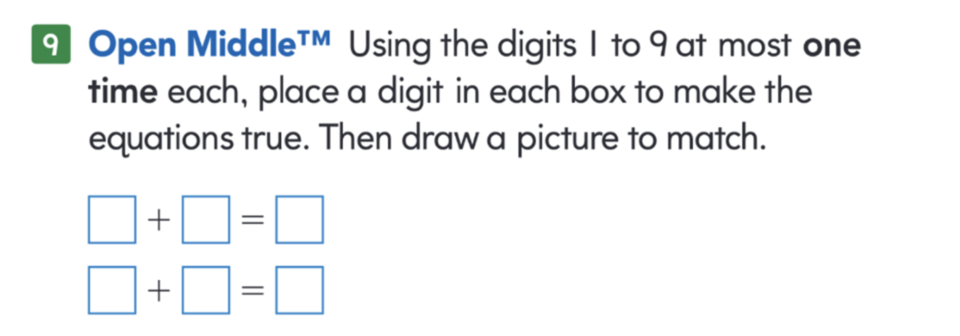
Some lessons also incorporate Robert Kaplinsky’s Open Middle math problems. These tasks encourage deeper thinking by giving students multiple ways to approach a problem, and many can also have more than one possible solution. Teachers can extend the thinking by adjusting the constraints of a problem for students who are ready for more. For example, changing the numbers students can use or adding a new condition can encourage students to revisit their strategies, test new ideas, and continue thinking through the mathematics.
Practice 2: Form visibly random groups
Collaborative groups have been used in the classroom for some time now. But are all students in these groups engaged in the collaborative effort?
Liljedahl found that for a group to be successful and engaged, the students had to be selected 1) obviously and 2) randomly. In other words, students had to see that the selection was random—there could be no doubt that the teacher was pulling any strings. The payoffs in terms of student thinking are immediate and clear in Liljedahl’s research: “Once we were implementing frequent and visibly random groupings, we saw an immediate uptick in the amount of students’ engagement and thinking” (p. 45).
You can demonstrate groups being formed randomly by using a digital tool such as the Classcraft student picker, or you can draw names from a jar or have students draw cards. A high-quality curriculum then supplies teachers with activities for the groups to do. In Into Math, teachers can leverage discourse-rich tasks embedded throughout each lesson that follow a purposeful progression, helping students collaboratively build understanding, deepen mathematical thinking, and develop new learning together.
Practice 3: Use vertical nonpermanent surfaces (VNPS)
In the last few years, we’ve watched “VNPS” (short for vertical nonpermanent surfaces) become a staple acronym within the math education world. The reason for such general language (as opposed to, say, “class whiteboards”) is that it better accommodates the present-day diversity of classroom setups out there. Classroom writing surfaces don’t have to be whiteboards—and in fact, covering the walls of a classroom with whiteboards may be practically unfeasible—but so long as students have something vertical that they can write on and erase, that’ll do. Liljedahl found that after enabling a classroom to engage in this way, “students were thinking longer, discussing more mathematics, and persisting when the tasks were hard” (p. 59).
As students gather in their randomized groups and prepare to tackle a task at their low-stakes VNPS, the teacher is left with supplying a problem worth thinking about. A high-quality curriculum like Into Math contains many options that vary in length, complexity, and the math skills required. Classcraft is a tool, for instance, that gives teachers the ability to project tasks for students to reference while working on VNPS.
Getting students thinking
In a thinking classroom, the focus is shifted away from the teacher, and the classroom is rebuilt in a way that promotes student ownership of their thinking and learning. But that doesn’t mean the teachers’ work is any less vital. “As a teacher, you will be required to be ever present and ever active in a thinking classroom,” writes Liljedahl (p. 112). Your judgment will be needed all year long to establish routines, select tasks, and facilitate conversations that stay on track and remain meaningful.
As students become more interested in thinking and less interested in performing or mimicking, you might just find a few more moments to witness some brilliance unfold.
***
HMH’s core math solution Into Math for Grades K–Algebra 1 includes a variety of routines, real-world connections, and problem-solving strategies that deepen students’ mathematical understanding.
Watch the recorded webinar “Students as the Drivers of Math Learning: Flipping the Script” to explore practical strategies inspired by Building Thinking Classrooms that encourage students to take an active role in their mathematical learning.
Teach the fun of math with five hands-on activities that spark curiosity in your students.