








Summary
Milwaukee Public Schools unified literacy instruction through a shared literacy vision, strong implementation support, and districtwide consistency.
Milwaukee Public Schools did not have time to wait for the next school year to begin changing literacy instruction.
Serving across 145 schools and about 60,000 students, Milwaukee is Wisconsin’s largest school district. An academic audit had identified significant challenges across the district, and student achievement data reinforced the need to act. Superintendent Brenda Cassellius says district students were performing about three and a half grade levels below their peers nationally, while 91% were not reading at grade level according to National Assessment of Educational Progress data.
“There just isn’t any time to wait,” Cassellius says, who joined the district in March 2025. “When students are scoring the way that our students are scoring in Milwaukee Public Schools, there is a tremendous amount of urgency.”
That urgency led Milwaukee to make an uncommon decision. After selecting HMH Into Reading, the district introduced the new high-quality instructional materials in the middle of the school year rather than waiting until the following fall. The strength of the HMH partnership, including professional learning, classroom coaching, and implementation support, helped make that accelerated rollout possible across a large and complex school system.
Finding the right literacy solution
Before choosing new instructional materials, Milwaukee leaders examined what could be preventing stronger literacy outcomes. They reviewed the academic audit, studied student data, and gathered feedback from educators throughout the district.
The findings pointed to several connected challenges. Reading and writing were often taught separately, and instructional practices varied among schools and classrooms. Teachers wanted resources aligned to science of reading research, stronger connections among foundational skills, reading, and writing, and more support to put those practices into action.
Milwaukee was also developing a broader literacy vision built on the belief that every student should have access to high-quality instruction. To make that vision practical across many schools, the district needed a common curriculum and a partner capable of supporting changes in instructional practice at scale.
Milwaukee selected HMH Into Reading because district leaders believed it could help bring greater consistency to literacy instruction across schools. The program aligned with the district’s science of reading priorities, connected key components of literacy instruction, and gave teachers across the district a shared instructional foundation.
The relationship with HMH also helped address a challenge that curriculum adoption alone could not solve. Teachers and principals would need to learn new instructional routines, understand the research behind them, and receive support as they began using the program with students. Milwaukee found a partner with HMH prepared to remain involved throughout that process rather than stepping away once materials arrived.
With the program and partnership in place, Milwaukee leaders decided there was no reason to postpone the work.
Launching Into Reading midyear
Curriculum changes are typically approved months in advance, introduced through summer professional learning, and launched at the beginning of a school year. Milwaukee compressed much of that work into a matter of weeks.
The district received board support in November, and Into Reading materials arrived before winter break. In January, Milwaukee’s academic team began unpacking resources and preparing professional learning. Principals were learning the program’s instructional routines while teachers prepared to shift their literacy instruction midway through the academic year.
“We did something that we were told was impossible to do,” says Deputy Chief Academic Officer Gabriela Bell Jiménez. “We updated materials in the middle of a school year.”
The unusual timing created real implementation challenges. Teachers already had established classroom routines and pacing. Principals needed enough familiarity with the program to answer questions and support instruction. District leaders had to coordinate materials, training, and follow-up across 139 schools while teaching and learning continued without interruption.
Educators were understandably cautious. Abiola Adebayo, a second-grade teacher at Browning School, remembers feeling nervous when she heard that the district would introduce a new literacy program in the middle of the year. Once she attended the training and explored the resources, however, she understood why Milwaukee was moving ahead.
“When we went for the training, I felt this is what the kids needed,” Adebayo says. “It was a huge shift, but we were consistent.”
That consistency was possible because Milwaukee and HMH treated the January training as the start of implementation, not the conclusion. As teachers began using Into Reading, they could ask questions, see lessons modeled, collaborate with colleagues, and receive support informed by what was happening in their classrooms.
Making implementation a shared effort
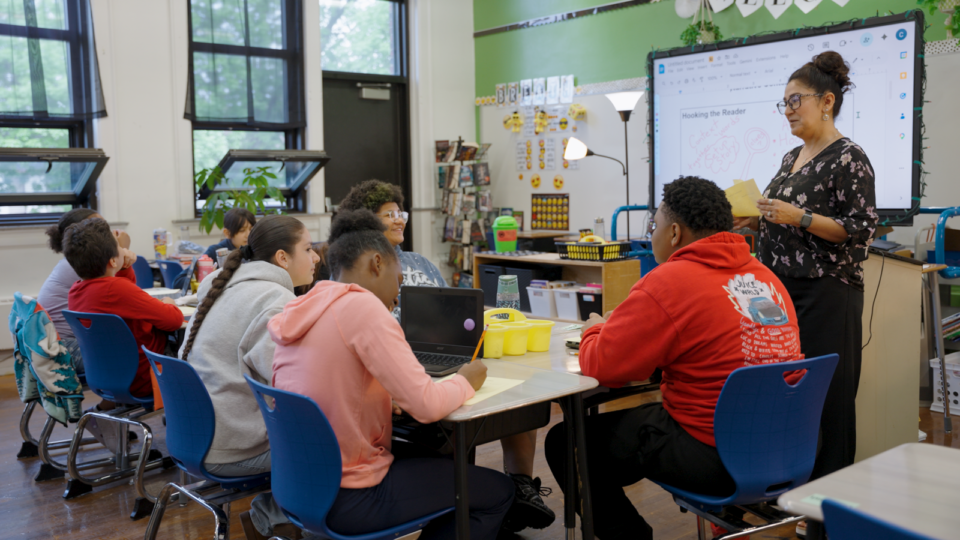
HMH worked with Milwaukee and an implementation partner, MGT, to build support around the district’s rollout. Teachers participated in professional learning and received classroom-based coaching. HMH coaches prebriefed with educators, modeled lessons with their students, and debriefed afterward. Through Coachly, teachers could also virtually connect with a coach when they needed help locating resources, differentiating instruction, or working through a new routine.
Teachers were learning the program while actively using it. They did not have to wait for a future training session to address a question that had surfaced during a lesson. Support could respond to immediate classroom needs and evolve as educators became more familiar with Into Reading.
At Browning School, kindergarten teacher Aleta Heath found that watching lessons modeled with her own students made the transition easier to navigate. Teachers could see how a routine worked in the context of their classroom, then discuss the instructional choices with a coach.
The district gave principals a similar opportunity to learn. Through the Principals’ Learning Institute, school leaders studied Into Reading routines, practiced parts of lessons, and developed a clearer understanding of what effective implementation should look like during classroom visits. At Browning School, Principal Raymond Unanka visited classrooms and modeled lessons himself. At Anna F. Doerfler School, Principal Rhode Marquez-Feliciano worked through the materials with her leadership team before supporting teachers.
Milwaukee, MGT, and HMH continued meeting as implementation progressed, using educator feedback to identify challenges and adjust support. Schools did not all need the same assistance at the same time. Some benefited from additional coaching, while others needed more professional learning or help from school leaders.
This sustained involvement helped Milwaukee turn a compressed rollout into a shared learning process. Teachers were not expected to master a new program on their own, and principals were not left to oversee instruction they had not experienced themselves.
Establishing consistency across schools
As implementation took hold, Into Reading began addressing one of the central concerns identified at the start of Milwaukee’s work: inconsistent literacy experiences across the district.
Previously, instructional approaches could differ by school or classroom, with some teachers drawing from multiple curricula. With Into Reading, educators began working from common high-quality materials, lesson structures, and instructional routines. Teachers at the same grade level had a stronger basis for discussing lessons, examining student work, and planning support together.
“Everyone is teaching out of the same book,” says Chief Academic Officer Jennifer Mims-Howell. “That hasn’t happened in so long.”
A shared foundation is especially valuable in a district where students may change schools during the year. Instead of encountering an entirely different literacy approach, students can find more familiar content, routines, and expectations. Teachers still respond to the needs of the students in front of them, but they do so within a more coherent districtwide framework.
The greater consistency also gives principals and district leaders a clearer view of implementation. Because schools are working toward the same instructional goals, leaders can more readily identify where educators need support and direct coaching or professional learning accordingly.
Seeing early signs of change
Milwaukee’s literacy transformation remains in its early stages, and the district is not treating a few months of implementation as proof of long-term outcomes. Teachers are, however, reporting encouraging changes in student skills, participation, and confidence.
Educators describe students who are more willing to tackle unfamiliar words, read aloud, and persist when a text becomes difficult. Some students who had needed additional help with foundational literacy skills are blending and decoding more confidently. Teachers are also seeing students apply their literacy skills across subjects, including math, science, and social studies.
For Adebayo, one of those moments involved a second-grade student who knew letter sounds but needed additional support with blending and segmenting words. Later in the year, the student stood and read an entire decodable text aloud. At Doerfler School, fourth-grade teacher Melina Braeger reports that several students have gained one to two reading levels based on assessments, including one student who moved from a kindergarten reading level to a second-grade reading level.
Across Milwaukee, students are participating more readily, working through mistakes, and approaching reading with greater confidence. Teachers, meanwhile, are becoming more comfortable with the program and the instructional practices behind it.
What other districts can learn
Milwaukee Public Schools is still early in its literacy transformation, but its experience offers several lessons for district leaders facing similar challenges:
- Start with a shared instructional vision. Milwaukee began by establishing a clear districtwide commitment to literacy and aligning teams around common goals.
- High-quality instructional materials are only part of the solution. Selecting resources aligned to science of reading research created a strong foundation, but implementation required much more than a curriculum purchase.
- Invest in professional learning and coaching. Teachers, principals, and district leaders benefited from training, classroom modeling, collaboration, and ongoing support.
- Build partnerships that extend beyond adoption. Milwaukee, MGT, and HMH worked together throughout implementation, using feedback to refine supports and respond to challenges as they emerged.
- Act with urgency on behalf of students. Rather than waiting for a new school year, district leaders chose to begin strengthening literacy instruction as soon as possible.
Milwaukee did not wait for ideal timing or perfect conditions. District leaders responded to the needs in front of them and built the support systems necessary to help educators move forward together.
The work is far from finished, but early signs suggest that greater consistency, focused professional learning, and strong implementation support are beginning to change what literacy instruction looks and feels like across the district.
For students reading a full passage independently, blending sounds with confidence, or raising their hand to answer a question they once might have avoided, that change is already making a difference.
Key takeaways
- Districtwide consistency can help create more equitable literacy experiences for students while giving educators a shared foundation for instruction.
- Strong implementation depends on supporting teachers and school leaders throughout the transition, not just during initial training.
- When student needs are urgent, districts may benefit from acting quickly even when conditions aren’t ideal, provided strong implementation supports are in place.
Discover leadership strategies that drive stronger reading outcomes.