



Summary
Through an outcomes-based partnership with HMH, Hillsborough County Public Schools achieved significant literacy gains among striving high school readers by implementing Read 180.
An intensive reading challenge in Hillsborough County
Hillsborough County Public Schools is the nation’s seventh largest school district, serving thousands of families along Florida’s Gulf Coast. It’s a district where families can choose from more than 100 magnet and specialized programs, so to stand out, schools need to show that their instruction gets results. This is the challenge that the district faced when it looked to improve literacy outcomes among some of its most at-risk ninth and tenth graders.
Addressing a reading gap at the high school level presents a special challenge. Curricular solutions for those students are limited, and teachers need training to use them.
“We knew we were struggling with what to do with our intensive reading students,” says Tracie Bergman, the assistant superintendent of curriculum and instruction. “We weren't seeing the growth we wanted, and we knew our teachers weren’t really well-trained in terms of what does reading instruction look like for striving readers at the high school level.”
After partnering with HMH for the 2025-26 school year, the district saw significant gains. The percentage of participating students reaching proficiency increased by 18 percentage points, and nearly half achieved full-level growth on the FAST Achievement Levels scale. Those results reflect a shared focus on implementation, support, and accountability, alongside a strong literacy intervention.
increase in reaching proficiency for students enrolled in Read 180 (referring to percentage points)
of students achieved full level growth (referring to FAST Achievement Levels)
Read 180: A solution that works
Read 180 is an evidence-based reading intervention solution that combines teacher-led instruction with adaptive technology and independent practice to support striving readers for over 25 years and has a staggering body of evidence supporting its effectiveness. HMH, the provider behind Read 180, has a rich history of knowing how to get literacy results from striving students. When a school or district is equipped with the program, leaders work with HMH to build an implementation plan, facilitate teacher buy-in and training, and monitor student data throughout the year. When everyone uses the program with fidelity, success feels inevitable.
Bergman, along with other district leaders, were ready to try Read 180 with its striving high schoolers. However, they knew that a successful adoption meant that teachers had to learn how to use the program and use it with fidelity. Too often, a district makes a purchase and then forgets about it. “We tend to see a shiny thing, and we buy it, and then we hope for the best,” laments Bergman. A program may be capable of providing powerful results—but it doesn’t matter if teachers and students aren’t using it.
Bergman’s observation is borne out by research around how teachers use new resources provided to them. According to research from the nonprofit organization RAND, across all subjects, only around a quarter of teachers regularly use any new curricular materials provided to them. Nearly one-half of teachers ditch them altogether and create the materials themselves. Along these lines, a recent report from Digital Promise shows that around two-thirds of all purchased edtech licenses aren’t even used.
Developing an outcomes-based contract
Both Hillsborough and HMH were interested in a contract that didn’t simply put the program in the school. Hillsborough wanted a guarantee that students’ reading scores would improve, and likewise, HMH wanted to know that the program was being used as intended. They both saw promise in outcomes-based contracting, or OBC, where payment is partially contingent on student outcomes.
Maximum success hinges on the district working side-by-side with the provider to ensure that teachers use the program and do so effectively. Entering an OBC is a way to clearly lay out the goals for both parties, with the Center for OBC listing five domains that are all part of an effective implementation.
- Clearly defined population: Narrow down exactly who the contract is intended to serve.
- Clearly defined outcomes and metrics: Have the district define exactly what the achievement goals are for the population and how they’ll be measured.
- Contingent outcomes payment: Develop a financial structure that includes payments only earned if the targeted outcomes are achieved.
- Mutual accountability: Both the district and provider are responsible for the achievement of student outcomes.
- Continuous improvement: Determine a systematic approach to collecting and analyzing data.
A partnership for success
Interest in outcomes-based contracting is growing among K–12 leaders. Hillsborough was already familiar with the approach, having explored previous outcomes-based partnerships, and saw potential to apply the model to support high school readers who needed the most intervention. The hope was that the contract would lower the risk of launching a large initiative while creating accountability for both parties.
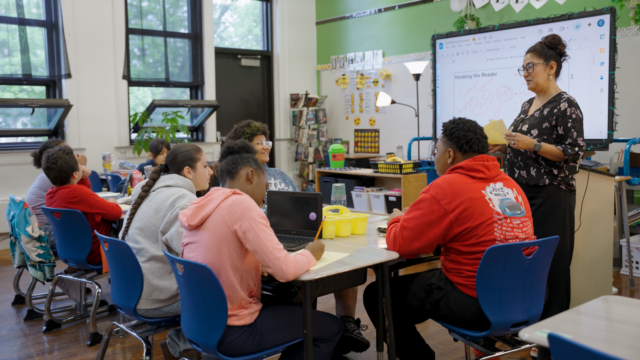
A critical early step was aligning around implementation. High school teachers are not necessarily trained in how to teach early literacy skills such as phonics, and care needed to go into how the program was put into effect. Hillsborough assembled school leaders, instructional coaches, and district staff to evaluate readiness, discuss schedule changes, and ensure schools could commit to using Read 180 with fidelity. The district launched the initiative as an intensive intervention for ninth and tenth graders across 14 high schools.
Participating schools committed to the program’s evidence-based model for implementation, and received support from the outset. At the district level, HCPS leaders partnered with HMH on a detailed implementation plan that included onboarding, on-site coaching visits and implementation walks, weekly leadership meetings, and shared reviews of student data. Through coaching visits, HMH specialists worked directly with teachers to strengthen instructional practices and support effective program use. During implementation walks, HMH coaches partnered with school and district leaders to observe classrooms, identify best practices, and pinpoint areas for additional support. Teachers received ongoing professional learning.
“Professional learning is that key piece,” says Bergman. “We can’t do the work if we don’t train the people.” That training extended to everyone involved, from classroom teachers to school and district leaders.
Successful outcomes depended not only on the quality of the intervention but also on a strong partnership between Hillsborough and HMH. Throughout the year, both teams reviewed implementation and student outcome data and adjusted supports based on what they were seeing in classrooms. The district brought deep knowledge of its schools, teachers, and culture, while HMH provided guidance and implementation support.
These complementary perspectives helped ensure the program was implemented effectively and remained responsive to the needs of educators and students.
The intention was never to set Read 180 up in a few schools then walk away. It was always about forming a partnership. Crafting an OBC helped by setting clear goals: student outcome goals for the district, and dosage goals for the provider, referring to the time that students engaged with the program. Program implementation included HMH continuing to support Hillsborough throughout the year and making sure teachers were given everything they needed to succeed.
“Any time you’re implementing, you’ve got to look at your [provider] as a partner,” says Bergman. The district and solution provider don’t work for one another, but they both work in service of student outcomes. “If we’re not working together,” explains Bergman, “the program will fail.”
Seeing the results
According to the Center for OBC, the industry standard for students meeting the recommended dosage of a new edtech program is just 5%, perhaps not surprising given how many programs aren’t used at all. Simply entering an OBC has shown to increase that over 14 times to 69%. The experience at Hillsborough surpassed that, with 86% of students achieving the recommended dosage. Already a success! The school is trying out a new program, and the students are using it.
Meeting usage expectations fulfills Hillsborough’s end of the bargain, but of course student outcomes are the ultimate goal. The results surpassed expectations here, too. The percentage of students enrolled in Read 180 who reached proficiency on the ELA FAST assessment increased by 18 percentage points, from 5% in 2023–24 to 23% in 2025–26.
Bergman was thrilled by the growth. “It’s all where you start from,” she says. In particular, the district kept an eye on how many students made at least one full level gain, according to FAST Achievement Levels. In this sense, the growth was especially impressive. Nearly half of the students (49%) achieved full level growth, meaning they went from either Level 1 to Level 2 or Level 2 to Level 3, compared with just 18% in 2023–24. “In the end, the data spoke for itself,” says Bergman.
What’s next for Hillsborough
As far as Hillsborough is concerned, it’s clear that strong implementation, ongoing support, and shared accountability can drive better outcomes for students. Teachers voted to expand Read 180 to all district high schools, with some middle schools piloting the program this year.
HMH also takes pride in the success. Read 180 has long been studied and is shown to be one of the most effective intervention solutions in the market. Districts that use the program with fidelity can expect great outcomes—something that, as a vendor, we’re willing to stand behind contractually.
Of course, the biggest success of all is found among those who lived the outcomes. Thousands of students who have long struggled to read can now finally see themselves as on track to walk across the graduation stage.
Key takeaways
- Strong partnerships create stronger results. Shared accountability between the district and HMH helped ensure educators had the tools, training, and support needed to help students succeed.
- Implementation fidelity and professional learning drive student growth. Consistent use of Read 180, combined with ongoing coaching and educator support, helped teachers strengthen literacy instruction and accelerate student growth.
- Data-informed collaboration fuels continuous improvement. Regular reviews of student performance and implementation data enabled the district and HMH to identify challenges and adjust support in real time.
***
Unlock whole-brain reading through Read 180, the leading reading intervention program for Grades 3–12.
We want to hear from you! For questions, comments, or feedback, please contact us at Shaped@hmhco.com or follow us on Instagram, LinkedIn, and YouTube.
Get reading intervention strategies and resources for your classroom.