











In recent years, the science of reading has become a central topic in conversations about literacy instruction. As awareness grows around how students learn to read—and why some struggle—educators are looking closely at the research to better understand which instructional practices are most effective.
This post serves as a guide to what the science of reading is, what decades of research tells us about reading development, and how these insights can be applied in classrooms to support all learners. Whether you are new to the science of reading or looking to deepen your understanding, this overview provides a foundation for aligning instruction with research.
Science of reading: Definition
The science of reading is a broad, interdisciplinary body of research focused on how people learn to read and write. It draws on decades of findings from fields such as cognitive psychology, neuroscience, linguistics, and education to explain how the brain processes written language and develops reading skills.
Importantly, the science of reading is not a curriculum, instructional program, or set of lesson plans. Instead, it provides a research-based foundation that helps educators understand which instructional practices are most effective—and why.
In the simplest terms, the science of reading explains how students learn to read, from recognizing sounds and words to understanding and analyzing text.
A clear understanding of the science of reading helps educators translate research into effective classroom practice.
Science of reading research
Science of reading research is grounded in decades of interdisciplinary study spanning cognitive psychology, linguistics, neuroscience, and education. Together, this research explains how the brain processes printed language, how reading skills develop over time, and which instructional approaches most effectively support students.
Early research established that reading is not a natural process like spoken language—instead, it must be taught explicitly. More recent advances have deepened understanding of how students move from learning foundational skills, such as recognizing sounds and letters, to becoming fluent readers who comprehend, analyze, and engage with complex texts.
Several key findings consistently emerge, including the importance of structured instruction that supports both word recognition and language comprehension.
Across decades of study, science of reading research has shown that:
- Reading proficiency develops through the interaction of decoding skills and language comprehension, rather than through exposure alone.
- Foundational skills, including phonemic awareness and phonics, are essential for accurate word recognition.
- Explicit and systematic instruction is more effective than implicit or incidental approaches, particularly for beginning readers and students who struggle.
- Skilled reading requires increasing automaticity, allowing students to devote more cognitive energy to comprehension.
- Ongoing assessment and responsive instruction help ensure that teaching meets students’ individual needs.
One influential framework supported by research is the Simple View of Reading, introduced by Philip Gough and William Tunmer. This model explains that skilled reading is the product of decoding and language comprehension, both of which must be developed.
Building on this foundation, the 2000 report from the National Reading Panel represented a major milestone by synthesizing research and identifying five key components of effective reading instruction. These findings continue to inform instructional design, professional learning, and curriculum development as research evolves.
More recently, Gough and Tunmer’s work has informed the development of the Cognitive Foundations Framework, which expands on the Simple View by describing how a broader network of cognitive processes supports skilled reading. This framework highlights the integration of language, executive function, and processing systems that contribute to reading development
Learn more in the blog, “The Science of Reading Explained.”
How students learn to read
Learning to read involves developing two intricately connected abilities: word recognition and language comprehension. Word recognition allows students to accurately identify written words, while language comprehension enables them to understand and make meaning from what they read.
Both abilities must develop together for students to become skilled readers. Effective reading instruction intentionally supports both processes, helping students move from accurate word reading to fluent, meaningful engagement with text.
The science of reading helps clarify the specific skills students need to develop along this path. These skills are often described as a set of core components that work together to build strong reading proficiency.
Science of reading pillars
Science of reading research identifies a set of core skills or components that work together to support reading development. These components help students build both word recognition and language comprehension, enabling them to read accurately, fluently, and with understanding.
When taught through explicit, systematic instruction, these components reinforce one another and support students as they move from learning how to read to reading to learn.
What are the five components of the science of reading?
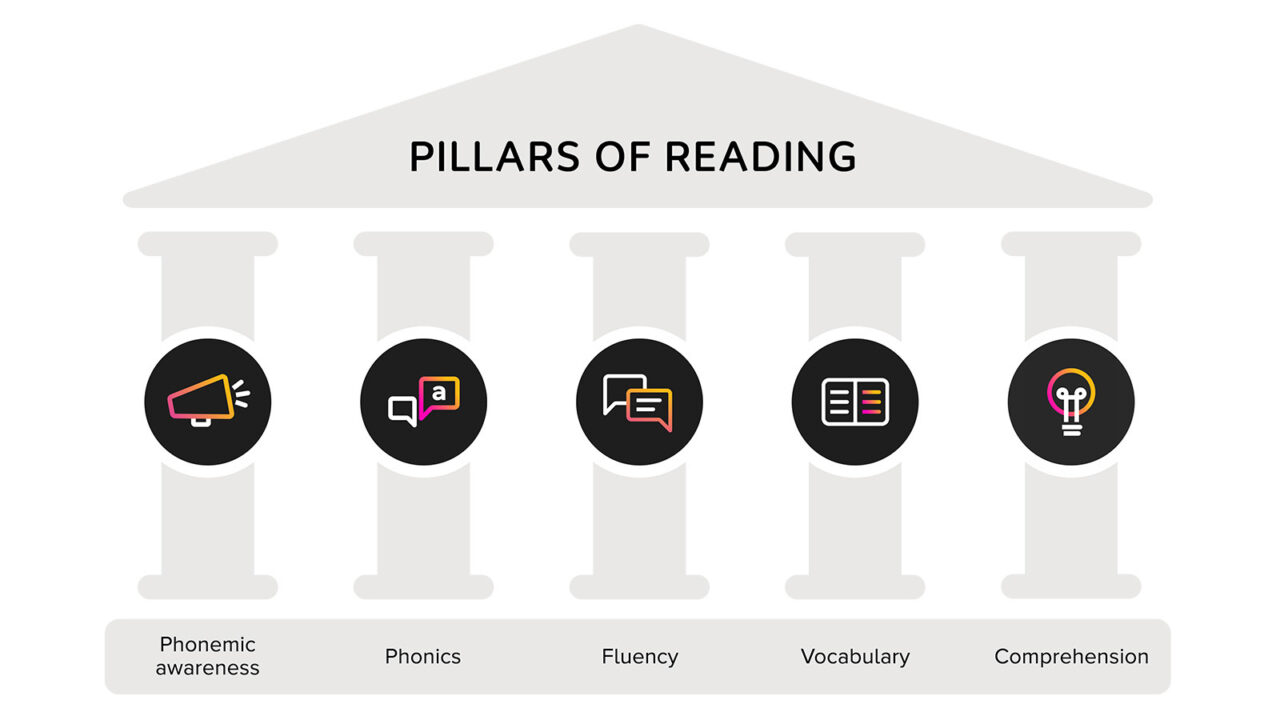
The National Reading Panel identified five essential components of effective reading instruction. Each plays a distinct role in helping students become skilled readers.
Phonemic awareness: The ability to hear, identify, and manipulate individual sounds (phonemes) in spoken words. It is a subskill of phonological awareness and focuses entirely on sound—not print.
- Instructional focus: Students practice blending, segmenting, and manipulating sounds within words.
Phonics: The relationship between letters (graphemes) and the sounds (phonemes) they represent. Phonics instruction helps students use this knowledge to decode written words.
- Instructional focus: Instruction includes explicit modeling of letter–sound relationships and guided practice reading and spelling words.
Fluency: The ability to read text accurately, smoothly, and with appropriate expression. Fluent reading allows students to focus more on meaning and less on decoding.
- Instructional focus: Students engage in repeated reading, guided oral reading, and other structured practice opportunities to build accuracy and pacing.
Vocabulary: Knowing the meanings of words and how to use them in speaking, listening, reading, and writing. Strong vocabulary supports both language comprehension and building background knowledge.
- Instructional focus: Instruction intentionally builds word knowledge through reading, discussion, and direct teaching of word meanings and relationships.
Comprehension: The ability to understand, interpret, and analyze text. It involves making sense of what is read and connecting ideas across sentences and texts.
- Instructional focus: Students practice skills such as summarizing, identifying main ideas, making inferences, and drawing conclusions.
Scarborough’s Reading Rope
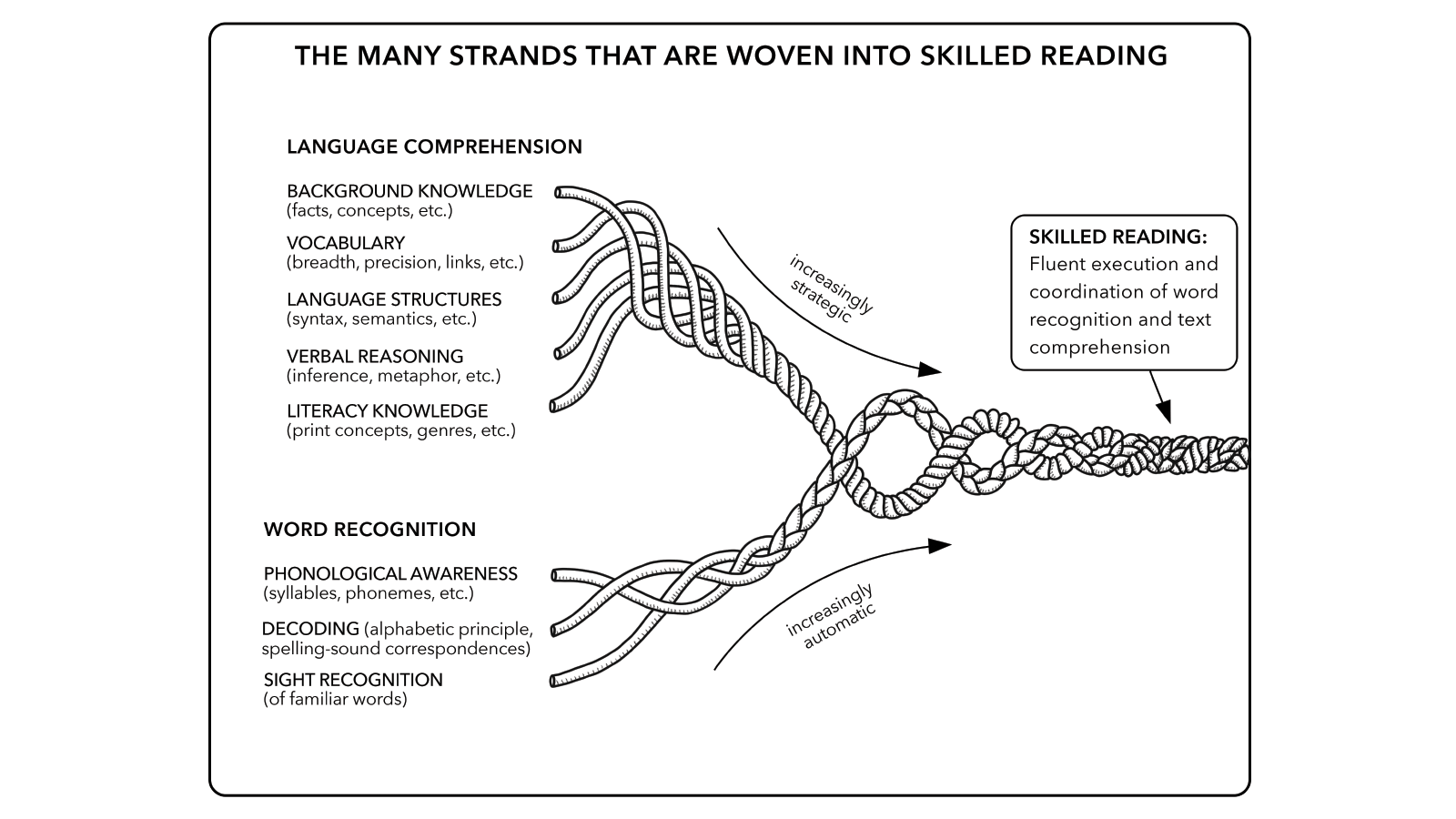
Scarborough’s Reading Rope is a widely used research-based model that illustrates how the many skills involved in reading work together over time to produce skilled reading. Developed by literacy researcher Hollis Scarborough, the model helps make visible how reading development is both complex and cumulative.
The model organizes reading development into two main areas:
- Language comprehension, which includes background knowledge, vocabulary, language structures, verbal reasoning, and literacy knowledge
- Word recognition, which includes phonological awareness, decoding, and sight recognition
As these strands strengthen and become more efficient, they form a sturdy “rope” that supports fluent, meaningful reading.
In practice, Scarborough’s Reading Rope reinforces a key message from the science of reading: effective instruction must intentionally support both word recognition and language comprehension.
Why is the science of reading important?
The science of reading is important because it provides a research-based foundation for understanding how students learn to read—and for aligning instruction with that understanding.
When reading instruction reflects the science of reading, teaching becomes more intentional and more responsive to student needs. Research shows that students benefit when foundational skills and meaning-making are taught in purposeful, connected ways.
Grounding instruction in the science of reading helps educators:
- Use explicit, systematic approaches to teach essential skills
- Provide structured opportunities for practice and application
- Monitor progress and adjust instruction to support growth
This research-based approach supports reading accuracy, fluency, and comprehension while helping ensure that all students—including those who struggle—have access to effective literacy instruction.
Supporting diverse learners
Aligning instruction with the science of reading supports all students by making reading instruction more explicit, systematic, and responsive to individual needs. Because this research helps clarify how reading skills develop—and where breakdowns often occur—it is especially helpful for supporting students who need additional instructional support.
The science of reading does not prescribe a single approach for all learners. Instead, it provides a framework that helps educators make informed decisions about instruction, scaffolding, and intervention.
For example, research by Carol Connor has shown that students with different ability levels benefit from different types of instruction. In a first-grade study, students who needed more support made stronger gains with explicit, teacher-directed instruction, while more advanced readers benefited from opportunities for independent reading and application.
The science of reading and dyslexia
Instruction aligned to the science of reading is particularly effective for supporting students with dyslexia. Research shows that students with dyslexia often experience difficulty with word recognition, which can make decoding printed words challenging.
The science of reading emphasizes:
- Explicit instruction in phonemic awareness and phonics
- Systematic teaching of sound–symbol relationships
- Structured practice to build accuracy and automaticity
These approaches directly address the foundational skills needed for accurate and fluent reading.
The science of reading and English language learners or multilingual learners (MLs)
Approaches grounded in the science of reading also support English language learners and multilingual learners by strengthening the connection between language development and literacy instruction.
Research-aligned reading instruction supports MLs by:
- Explicitly teaching sound–symbol relationships in English while connecting to students’ home languages, including attention to cognates and sounds that may differ across languages
- Building on students’ existing linguistic and cultural knowledge by connecting new vocabulary and content to their background knowledge and experiences
- Integrating listening, speaking, reading, and writing through structured opportunities for language use, discussion, and meaning-making to strengthen comprehension
When instruction makes language structures and word meanings clear, multilingual learners can apply their growing language knowledge to reading.
What the science of reading says about writing
Reading and writing are closely connected and draw on many of the same cognitive and language processes. Research shows that writing instruction supports reading development by reinforcing phonics, vocabulary, and comprehension.
Providing regular, purposeful opportunities for students to write helps them:
- Apply and strengthen phonics and spelling knowledge
- Develop and extend vocabulary
- Improve sentence construction and language clarity
- Deepen comprehension through reflection and response to text
Rather than treating reading and writing as separate skills, research supports integrating them to build stronger literacy skills.
Learn more in the blog, “How Does Writing Fit Into the Science of Reading?”
Misconceptions about the science of reading
As interest in the science of reading has grown, so have misconceptions about what it does—and does not—represent. Clarifying these misunderstandings is essential for applying research thoughtfully and effectively in the classroom.
Below are some of the most common misconceptions, along with what research shows.
Misconception: The science of reading focuses only on phonics
What research shows: Phonics is an important part of reading development, but it is only one component. The science of reading emphasizes a comprehensive set of skills, including phonemic awareness, fluency, vocabulary, and comprehension, which work together to support reading success.
Misconception: The science of reading is new
What research shows: While the term has gained greater visibility in recent years, the research behind the science of reading spans decades of foundational findings—such as the importance of explicit instruction and the role of phonological processing—that are well established and continue to be refined through ongoing research.
Misconception: The science of reading is a one-size-fits-all curriculum
What research shows: The science of reading is not a curriculum, product, or instructional program. It is a body of research that explains how reading develops and helps educators make informed instructional decisions based on student needs.
Misconception: The science of reading limits creativity or reading for enjoyment
What research shows: Research-based instruction helps students become proficient readers. As their skills grow, they are better able to engage deeply with texts and develop a genuine enjoyment of reading.
Misconception: The science of reading is only for early grades or striving readers
What research shows: While foundational skills are especially important in early literacy, the principles apply across grade levels. Vocabulary development, background knowledge, and comprehension remain critical for all learners.
Understanding these misconceptions can help educators move beyond oversimplified narratives and focus instead on applying research in ways that support strong, inclusive literacy instruction.
How to implement the science of reading in the classroom
Because the science of reading is a body of research, implementation focuses on how instruction is designed and delivered.
In practice, science of reading–aligned instruction includes:
- Explicit instruction in a clearly defined skill, such as a sound–spelling pattern or vocabulary concept
- Teacher modeling, so students see and hear how the skill is applied
- Guided practice, where students work with support and immediate feedback
- Application in connected text, such as reading decodable or increasingly complex passages
- Opportunities for discussion and understanding, supporting comprehension and language development
These instructional routines are repeated and refined over time, helping students build skills systematically and meaningfully.
Using data to guide instruction
Teachers use assessment data to monitor progress and adjust instruction. This may include:
- Informal checks for understanding during lessons
- Targeted small-group or individual instruction
- Revisiting or re-teaching skills that students have not yet mastered
Using data in this way helps ensure instruction remains responsive and aligned to students’ needs.
Beyond materials: Instructional decision-making
While a strong curriculum can support implementation, the science of reading is applied through instructional decisions. Educators use research to adjust pacing, integrate literacy skills, and coordinate instruction across areas.
Collaboration and professional learning also support effective implementation.
Selecting a science of reading curriculum
A well-designed curriculum can support instruction aligned with the science of reading by bringing research into daily classroom practice.
When selecting a curriculum, it is important to look beyond labels and consider how well the materials support explicit, systematic instruction across foundational skills and language comprehension. A science of reading–aligned curriculum should make the research visible in both lesson design and instructional routines.
When evaluating programs, educators may look for materials that include:
- Explicit, systematic instruction in foundational skills with clear lesson progression
- Built-in opportunities for guided practice and application in connected text
- Ongoing assessment and progress-monitoring tools to inform instruction
- Integrated writing opportunities that reinforce reading development
- Content-rich texts that help build background knowledge and vocabulary
A curriculum alone does not ensure effective instruction. Teacher expertise and responsiveness to student needs remain essential, but aligned materials can support consistency and clarity across classrooms.
To explore deeper, see "How K-12 Administrators Can Run a 10-Minute ELA Audit."
What science of reading instruction looks like
Instruction informed by the science of reading is grounded in explicit, systematic teaching of foundational skills while also supporting language comprehension. It reflects how reading skills develop and helps to ensure students receive the instruction and practice they need at each stage of learning.
Rather than assuming students will infer reading skills through exposure, science of reading–aligned instruction makes learning visible. Teachers clearly model skills, guide practice, and provide structured opportunities for students to apply learning in increasingly complex texts.
The table below highlights key characteristics of instruction aligned with the science of reading compared with less structured approaches.
Instructional area |
Science of reading–aligned instruction |
Less structured approaches |
Phonics instruction |
Explicitly taught in a clear, systematic sequence |
Introduced more implicitly or inconsistently |
Word recognition |
Students learn to decode words using sound–symbol relationships |
Students may rely more on context, pictures, or prior knowledge |
Skill development |
Skills build cumulatively from simple to complex |
Skills may be addressed without a defined progression |
Instructional approach |
Teacher modeling followed by guided practice and gradual release |
Greater emphasis on independent discovery |
Practice opportunities |
Frequent, structured practice with feedback |
Practice may be less targeted or less consistent |
Assessment |
Ongoing, data-informed instruction and progress monitoring |
Assessment may be less systematic or less frequent |
When these instructional characteristics are consistently in place, students are better supported as they develop accuracy, fluency, and comprehension. This approach strengthens foundational skills while building knowledge, vocabulary, and understanding.
Structured literacy vs. the science of reading
The terms science of reading and structured literacy are often used together, but they refer to different—though closely related—ideas.
The science of reading refers to the body of interdisciplinary research that explains how reading skills develop and which instructional practices are most effective. It provides the evidence base for reading instruction.
Structured literacy, on the other hand, describes an instructional approach that puts this research into practice. It emphasizes explicit, systematic teaching of foundational skills aligned with key findings from the science of reading.
In other words, the science of reading explains how students learn to read, while structured literacy reflects how that research is applied in the classroom.
Structured literacy instruction typically includes:
- Explicit teaching of sound–symbol relationships
- A systematic progression of skills from simple to more complex
- Multisensory learning opportunities
- Ongoing practice and review to build accuracy and automaticity
Many educators view structured literacy as a practical application of the science of reading, particularly for foundational skills instruction. For a more detailed comparison, see “Structured Literacy vs. Science of Reading.”
Science of reading strategies
Instruction aligned with the science of reading includes a range of classroom strategies that support the five components of reading. These strategies are most effective when used intentionally and matched to students’ instructional needs.
Below are examples of strategies commonly used to support each component.
Phonemic awareness
Instruction at this stage focuses on helping students recognize and manipulate individual sounds in spoken words. It is important to use letters to represent sounds during activities once students have been introduced to their letter-sound correspondences.
- Word play activities, such as sound matching or phoneme deletion
- Oral blending, where students combine individual sounds to form words
Phonics
Phonics strategies help students connect sounds to letters and decode words.
- Explicit teaching of vowel and consonant sounds, often supported by visual or articulatory cues
- Sound-by-sound decoding, where students blend phonemes from left to right to read words
Fluency
Fluency instruction supports accuracy, automaticity, and expression.
- Guided oral reading, where teachers provide feedback and modeling
- Repeated reading, which allows students to practice reading text smoothly over multiple attempts
Vocabulary
Vocabulary strategies support word knowledge and background knowledge.
- Explicit instruction in word meanings, including morphology and word relationships
- Knowledge-building activities, such as topic-based reading and discussion
Comprehension
Comprehension strategies help students understand and engage with text.
- Making connections, drawing on prior knowledge to support understanding
- Synthesizing information, including summarizing, inferring, and analyzing key ideas
For step-by-step examples, see “10 Science of Reading Strategies for Reading Instruction.”
Instructional approaches that support multiple components
Many instructional approaches support more than one component of reading and help reinforce skills across lessons.
Literacy activities and routines
Structured daily routines can support phonics, fluency, vocabulary, and comprehension when aligned to instructional goals.
Explore science of reading activities that support daily instruction.
Small-group instruction
Provides targeted support based on assessment data.
See science of reading small-group instructional strategies.
Decoding-focused instruction
Supports both phonics and fluency while contributing to comprehension.
Learn more about science of reading decoding strategies.
Instructional tools
Tools such as sound walls, can reinforce connections between sounds and print and support foundational skills.
Science of reading professional development and teacher training
Professional learning plays a critical role in effective science of reading implementation. Because this research represents a shift in understanding for many educators, ongoing support is essential.
Effective professional learning often includes:
- Coaching and collaborative planning
- Opportunities to examine student data and instructional practices
- On-demand resources that support continuous learning
When educators have time and support to deepen their understanding of the research, they are better equipped to apply it thoughtfully in their classrooms.
Learn more about science of reading professional development.
Science of reading resources
Whether educators are seeking a refresher or looking for practical classroom guidance, science of reading resources can provide valuable support. Research summaries, professional texts, and classroom-focused tools all play a role in deepening understanding and strengthening instruction.
Explore recommended science of reading books and resources or learn more from NWEA literacy experts.
The science of reading helps align literacy instruction with decades of research on how students learn to read. By using this knowledge to guide instruction, educators can better support students as they develop the foundational skills needed for long-term reading success.
***
Dive deeper into the science of reading. Learn more about our science of reading-aligned curriculum, an evidence-based approach that builds on the five components of the science of reading, plus integrates background knowledge and writing.
---
We want to hear from you! For questions, comments, or feedback, please contact us at Shaped@hmhco.com or follow us on Instagram, LinkedIn, and YouTube.
This blog, originally published in 2025, has been updated in June 2026.
Get actionable strategies to guide instruction with a free Science of Reading eBook.