





Summary
Translanguaging is an equity-centered approach that recognizes the full range of resources students bring to learning. By intentionally incorporating translanguaging into grade-level instruction, teachers can help multilingual learners deepen understanding and participate confidently while affirming their linguistic identities.
Key takeaways
- Translanguaging begins with an asset-based stance that values the full repertoire students bring to the classroom and uses those resources to support learning.
- Effective implementation requires intentionally designing tasks that allow students to use their linguistic resources while maintaining high expectations for learning.
- Clear routines and purposeful use of available language resources can help make translanguaging part of everyday instruction.
As a child, there were times when I knew exactly what I wanted to say, but the word came to me in Spanish instead of English or in English instead of Spanish. Either way, I naturally used the words, gestures, and examples I had available to communicate my ideas. Only later did I learn there was a name for this way of making meaning: translanguaging.
Many multilingual learners make meaning by drawing on everything they know and use to communicate: language, cultural knowledge, visuals, gestures, prior experiences, family knowledge, and community ways of speaking. These resources do not work in isolation. They work together as one connected repertoire that helps students understand ideas, participate in learning, and express what they know.
In the classroom, translanguaging pedagogy builds on this natural meaning-making practice. It is an equity-centered framework that helps teachers create learning spaces where students’ full repertoires are treated as assets for rigorous academic learning. This framework supports not only multilingual learners but also students who use language varieties often minoritized in schools, including African American Language, Chicano English, Indigenous English varieties, regional dialects, and other community-based ways of speaking.
In this article, we explore what translanguaging means in education, why it matters, and how teachers can make translanguaging practices part of grade-level instruction.
What is translanguaging in education?
Translanguaging can be understood in three connected ways. First, translanguaging is a natural discourse practice. This means multilingual people already do it when they use their full language as well as cultural, visual, and community knowledge to make meaning. For example, a student may read a text in English, talk through the idea in Spanish, and connect the concept to a family experience to write a strong response using their full repertoire.
Second, translanguaging is a pedagogical framework. In the classroom, this means teachers intentionally design instruction so students’ full repertoires are treated as assets, not barriers. Students’ languages, dialects, identities, cultural knowledge, and lived experiences become part of how they access, discuss, and build academic understanding.
Third, translanguaging becomes classroom practice when teachers create routines that allow students to think, discuss, read, write, compare languages, collaborate, and show understanding using all the resources they bring. This distinction matters because translanguaging is not simply a temporary support used until students can work only in English. It is a way of designing instruction that treats linguistic diversity as an essential and valuable part of rigorous learning.
Translanguaging as a language equity practice
Schools have often treated English, or one standardized form of English, as the main language for academic thinking. This can send the message that students’ home languages, dialects, and community ways of speaking do not belong in rigorous classroom work. Translanguaging challenges that assumption. It creates space for students to use the full range of resources they bring to learning, including home languages, dialects, gestures, visuals, cultural references, family knowledge, and community experiences as they engage with complex ideas.
When students use these resources, they draw on a full repertoire of tools that help them reason, communicate, and participate. This approach also helps students understand that language varies by audience, purpose, context, identity, and power. They learn to communicate flexibly in academic settings without being taught that the language practices of their communities is less valuable.
What are translanguaging practices?
Translanguaging practices are the routines, tasks, and learning structures that help students use their full repertoires as part of learning. For example, a teacher might invite students to discuss a new concept using the language resources that best support their thinking before sharing with the class, research a topic using multilingual sources, annotate a text with words and sketches, or explain an idea through a combination of speech, writing, visuals, and gestures.
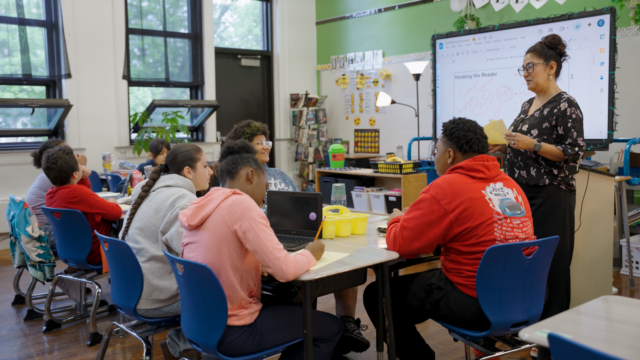
Teachers do not need to speak every language represented in the classroom. Their role is to create learning environments where students feel safe using their linguistic and cultural resources purposefully. Bilingual texts, visual supports, collaborative discussion, flexible language use, sentence frames, and translation tools can all contribute. These supports become translanguaging practices when students use them to construct knowledge, make connections, collaborate, and demonstrate understanding.
Why translanguaging practices matter
Translanguaging helps students understand more, participate more, and feel more connected to learning. It supports several important dimensions of student growth, such as:
- Comprehension and knowledge building. Students can connect new ideas to what they already know and process challenging content using the resources that best support their thinking.
- Identity and belonging. Students see their languages, dialects, cultures, and experiences treated as valuable in academic spaces.
- Confidence and engagement. Students are more likely to ask questions, collaborate, and contribute when they can use the tools that help them communicate ideas.
- Language awareness. Students can compare how language works across languages, dialects, contexts, audiences, and purposes.
- Academic progress. Students can engage with rigorous grade-level content while continuing to develop academic English, disciplinary language, and flexible communication practices.
- Stronger community-school connections. Students can bring family knowledge and community experiences into classroom learning and share academic ideas across settings.
7 translanguaging practices for the classroom
The following research-aligned practices help teachers move beyond isolated multilingual supports and create learning spaces where students use their full repertoires to think, collaborate, build knowledge, and demonstrate understanding. These practices are most effective when they are planned as part of grade-level instruction, not added only when students need extra support.
1. Start with a translanguaging stance
Translanguaging begins with how teachers see students. A translanguaging stance recognizes students as whole language users whose languages, dialects, gestures, cultural practices, family knowledge, and experiences are resources for learning. Teachers position themselves as co-learners who are curious about students’ repertoires and who use that knowledge to design more meaningful learning experiences.
In practice this looks like:
- Inviting students to create language portraits, language maps, or “my language story” reflections.
- Asking when, where, and with whom students use different languages, dialects, gestures, or communication styles.
- Using what you learn to plan partnerships, texts, discussions, and opportunities for students to contribute expertise.
2. Create spaces for meaningful inquiry
Translanguaging is most powerful when students are investigating meaningful topics connected to their identities, communities, questions, and lived experiences. The goal is not simply to let students use another language when they are stuck. It is to invite them to use their full repertoire to build knowledge.
In practice this looks like:
- Allowing students to research a topic using sources in any language.
- Inviting family knowledge, oral histories, community examples, photographs, music, or videos into a unit.
- Asking students to connect new content to something they know from prior schooling, media, or community life.
3. Use collaborative language mediation groups
Peer collaboration can help students become meaning-makers and language mediators for one another. Students do more than translate. They explain, question, clarify, compare, draw, gesture, and connect ideas so the group can develop a shared understanding.
In practice this looks like:
- Creating roles such as evidence finder, visual explainer, language connector, question asker, and group reporter.
- Allowing students to discuss ideas in any language before sharing with the class.
- Encouraging students to explain concepts using words, drawings, gestures, examples, and digital tools.
4. Support full-repertoire reading
Multilingual readers draw on language, visuals, background knowledge, emotions, prior experiences, and other resources as they make sense of text. A full-repertoire reading routine makes those processes visible and gives students multiple entry points into challenging material.
In practice this looks like:
- Before reading, letting students preview the topic through images, videos, short texts, or discussion in any language.
- During reading, inviting students to annotate in any language, sketch ideas, mark confusing sections, write questions, or use translation tools strategically.
- After reading, asking students to explain which language, visual, connection, or tool helped them understand.
5. Make multilingual and multimodal meaning-making visible
Translanguaging includes more than moving between named languages. Students also make meaning through images, symbols, gesture, movement, tone, music, performance, and digital media. Offering multiple ways to communicate can reveal content understanding that an English-only written response may not capture.
In practice this looks like:
- Letting students show understanding through writing, oral explanation, diagrams, skits, slides, bilingual captions, audio recordings, or visual timelines.
- Inviting students to combine languages, images, symbols, and movement when explaining complex ideas.
- Using drawing or visual representation as a bridge into discussion and formal writing.
6. Build critical language awareness across contexts
Translanguaging can help students notice how language changes across contexts, audiences, identities, and purposes. This includes comparing cognates and word parts as well as examining tone, grammar patterns, idioms, dialects, and the social judgments attached to different ways of speaking.
In practice this looks like:
- Asking students to compare how a concept is expressed in different languages or dialects.
- Inviting students to notice cognates, morphology, sentence patterns, idioms, tone, and audience expectations.
- Discussing questions such as: “When and why do people change how they speak or write?” and “How can we adapt language for different audiences without treating home language as wrong?”
7. Use formative assessment to capture full-repertoire learning
Formative assessment can help teachers see student thinking as learning happens. It separates content understanding from English-only performance and provides a fuller picture of how students use language and other resources to make meaning.
In practice this looks like:
- Using multilingual portfolios, oral explanations, diagrams, project drafts, peer-discussion notes, student reflections, and teacher observations.
- Asking students: “What language or tool helped you understand today?” or “How did your group use different resources?”
- Using rubrics that value content understanding, evidence, collaboration, language awareness, and strategic use of resources.
Best practices for implementing translanguaging
These best practices can help you create a classroom where multilingual learners feel supported using all their language resources.
Honor the languages students bring
Successful implementation begins with a classroom culture that treats linguistic diversity as an enduring asset. Make it clear that students’ languages, dialects, and communication practices can support learning, problem-solving, collaboration, and creative expression. When students know their linguistic identities are respected, they are more likely to take academic risks and participate confidently.
Design translanguaging opportunities intentionally
Build flexible language use into the task from the beginning, and maintain high expectations for content, reasoning, evidence, and participation. Translanguaging is not a reduction in rigor; it expands the pathways students can use to reach rigorous goals.
Remain responsive to students’ evolving needs
Observe which language practices and tools help students engage with content, contribute to discussion, and demonstrate understanding. Invite student feedback, reflect on whose voices are heard, and adjust instruction so multilingual and language-minoritized students have meaningful roles in the classroom community.
Common questions and misconceptions about translanguaging
Do teachers need to speak multiple languages to support translanguaging?
No. Teachers are not expected to understand every language students use. They can design tasks that welcome multilingual discussion, annotation, research, reflection, peer collaboration, and multimodal expression. Students can also use dictionaries, translation tools, visuals, and one another as resources. The teacher’s responsibility is to establish purposeful routines and assess the quality of students’ thinking and learning.
Will translanguaging slow English language development?
Translanguaging can support English development, but its purpose is broader than English acquisition. It helps students understand content, participate in discussion, build confidence, develop language awareness, and connect learning to their identities and communities. As students continue developing English, they add English to the repertoire they use to learn and communicate; they do not need to abandon the other resources that support their growth.
What if teachers have limited multilingual resources?
A fully translated curriculum is not required. Teachers can begin with student-generated resources and flexible routines: multilingual notes, collaborative discussion, labeled diagrams, personal glossaries, family or community examples, digital translation tools, and opportunities to research or brainstorm in any language. The most important shift is not the amount of translated material available but whether students are invited to use their full repertoires to construct meaning.
How can teachers manage multiple languages in one classroom?
Establish clear routines and learning goals. Students might discuss ideas in any language during small-group work, record key thinking in multilingual journals, use visuals or gestures to clarify meaning, and then decide how best to share their understanding with a broader audience. Teachers can ask students to explain their process, point to evidence, and reflect on which resources supported their learning.
Will students become too dependent on their primary language?
Translanguaging is not dependence on one language. It is the flexible use of a full repertoire. Students learn to choose resources strategically based on the task, audience, and purpose. They can develop academic English while continuing to strengthen and use the languages and language practices that support their identities, relationships, and learning.
Creating classrooms where every language resource matters
Translanguaging invites educators to see students not as learners divided among separate languages, but as whole people who bring rich and interconnected resources to the classroom. When teachers create space for students to draw on those resources, they gain a clearer view of what students know, how they think, and how they can contribute to learning.
By treating translanguaging as an equity-centered framework teachers can expand access to rigorous learning, strengthen language awareness, affirm student identities, and create classrooms where linguistic diversity is valued as a source of knowledge, connection, and possibility.
Further reading
García, O. (2017). Translanguaging in schools: Subiendo y bajando, bajando y subiendo as afterword. Journal of Language, Identity & Education, 16(4), 256–263.
García, O. (2019). Translanguaging: A coda to the code? Classroom Discourse, 10(3–4), 369–373.
García, O. (2020). Translanguaging and Latinx bilingual readers. The Reading Teacher, 73(5), 557–562.
García, O., & Nuonsy, S. (2024). Actionable translanguaging love in education and research. Critical Inquiry in Language Studies, 21(4), 414–428.
García, O., & Sarroub, L. K. (2025). Beyond puntos y rayas: Translanguaging pedagogy for language minoritized students. Literacy Research: Theory, Method, and Practice, 74, 76–91.
García, O., & Uysal, H. (2024). A conversation with Ofelia García: Critical perspectives on translanguaging and adolescent English learners. RELC Journal, 55(1), 274–284.
Wei, L. (2024). Transformative pedagogy for inclusion and social justice through translanguaging, co-learning, and transpositioning. Language Teaching, 57(2), 203–214.
***
Address the range of English learners’ needs with our English language development programs.
Download our free guide to using response frames with multilingual learners.