




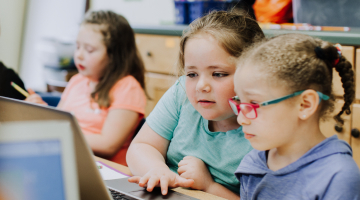


Students in today’s classrooms may find it difficult to imagine a world without technology. For many, digital tools have been a constant presence throughout their lives.
As for educators, technology has increasingly become part of everyday practice, shaping classroom instruction and assessment over time. But how did we get here? Let’s take a look back at the history of technology in education.
A brief history of educational technology
Over the years, we’ve gone from treating digital technology as an isolated novelty to seamlessly integrating a variety of edtech tools into the classroom. How did this change occur?
Early instructional technologies (pre-1950s)
Long before computers, schools experimented with instructional technologies such as radio, film projectors, television, and mechanical teaching machines designed to automate practice and feedback. These early tools laid the groundwork for later digital innovation.
Cold War influences and early computing (1950s–1970s)
Technology entered the U.S. education system more formally during the Cold War (1947–1991), driven by the need to prepare students for a scientific and technological future. After the Soviet Union launched the Sputnik satellite in 1957, American education shifted its focus toward math, science, and technical skills.
In 1963, the Vocational Education Act helped fund technology use in schools. Over the following decades, students, particularly in vocational and higher education settings, began learning early programming languages like BASIC, and computers slowly appeared in classrooms. Instruction focused on accessible programming and the development of logical thinking and problem-solving skills.
Personal computers and the internet (1980s–1990s)
By the 1980s, personal computers had gained a foothold in schools. Technology was often housed in dedicated computer labs, and educational software emphasized drill, practice, and recall.
In the 1990s, the spread of the internet connected computers worldwide. Email, instant messaging, and access to online information enabled new forms of communication and learning beyond the classroom walls.
Digital learning goes mainstream (2000s–2010s)
This connectivity reshaped education in the early 2000s. Online courses, digital content, and data-driven assessment tools became more common, alongside a growing emphasis on STEM (science, technology, engineering, and mathematics) education.
By the 2010s, mobile devices, learning management systems, cloud-based collaboration tools, and 1:1 device initiatives became widespread. Digital learning environments evolved from optional add-ons to core components of daily classroom life.
Generative AI era in education (2020s–Present)
In late 2022, the widespread availability of generative artificial intelligence introduced another major shift, bringing AI directly into the hands of students and educators. Unlike earlier adaptive systems, generative AI tools support real-time explanation, feedback, and content creation, enabling new approaches to brainstorming, writing, problem-solving, and instructional design.
Today, the history of educational technology continues to unfold as new tools like AI reshape what teaching and learning can look like in the decades ahead.
Technology in education today
Technology integration in education today extends beyond technical skills to include the thoughtful use of digital and AI-powered tools to support student learning, agency, and responsible participation. In this context, educators and policymakers emphasize technology as a tool for learning, not an end in itself. The ISTE Standards for Students highlight this approach through an emphasis on creativity, communication, collaboration, critical thinking, problem-solving, and digital citizenship.
The Partnership for 21st Century Skills reflects a similar approach, emphasizing information, media, and technology skills as essential for student success. These skills help students develop the adaptability and mindset needed to learn and work in an increasingly complex, online world.
In practice, educational technology integration has become embedded in daily instruction. Many schools now use 1:1 devices alongside AI-powered tools to support personalization, accessibility, and feedback. In classrooms today, this often includes:
- AI-powered programs that personalize instruction, provide real-time feedback, and support students with writing, research, and problem-solving
- Collaborative digital environments where students co-create documents, multimedia projects, and presentations in real time
- Blended and flexible learning models that combine in-person instruction with digital content and self-paced learning
- Data-informed instruction, using digital assessments and analytics to guide differentiation and instructional decisions
- Authentic, real-world learning experiences, such as simulations, virtual labs, and virtual field trips
- Explicit instruction in digital citizenship, helping students use technology responsibly, ethically, and critically
The future of technology in the classroom
In many classrooms, access to technology is no longer the primary challenge. As 1:1 device programs and digital infrastructure have become more widespread, attention is shifting from whether technology is available to how it can meaningfully transform teaching and learning.
Looking ahead, future-focused classrooms will prioritize deeper learning, increased student agency, and more adaptive instructional models. Educators will increasingly use technology not just to digitize traditional tasks, but to redesign learning experiences that support inquiry, creativity, and authentic problem-solving. Emerging tools, including AI, will continue to reshape how learning is personalized, how feedback is delivered, and how students demonstrate understanding in ways that extend beyond traditional assessments.
The lasting impact of technology
As the history of technology in the classroom demonstrates, technology integration in education teaches students the skills they’ll need in the future, including creativity, collaboration, and communication. Access to technology can lead to students taking more initiative and engaging with the content in every class they take.
Embedding technology in today’s classrooms, including the thoughtful use of AI, creates opportunities for students to become self-directed, adaptable learners both in school and beyond.
This blog, originally published in 2023, has been updated for 2026. The views expressed in this article are those of the author and do not necessarily represent those of HMH.
***
Find more lesson plans and classroom resources on Shaped.
Discover best practices for integrating AI in the classroom.