





Meaningful learning happens when individual pieces come together like a puzzle to form a complete picture. The jigsaw method takes this idea and turns it into a powerful classroom structure, where each student is responsible for mastering one part of the content and helping their peers understand it. In this blog, we’ll explore what the jigsaw method is, how it works, and how to use it in the classroom.
What is the jigsaw technique in education?
The jigsaw method is a cooperative learning strategy where students become ‘experts’ on one piece of a larger topic and then teach that piece to their peers.
In a jigsaw lesson, students are first placed into small “home” groups. Each member of the home group is assigned a different subtopic. For example, in a unit on animal habitats, one student might focus on the desert habitat, another on the rainforest habitat, and another on the ocean habitat.
Next, students meet in “expert” groups with peers who are studying the same subtopic. In these expert groups, students work together to deepen their understanding and prepare to teach the material.
Once students have developed expertise, they return to their original home groups. Each student then teaches their subtopic to their group members. In this way, each student in the home group brings a piece of the bigger learning puzzle.
How can the jigsaw strategy be used to differentiate instruction?
The jigsaw strategy provides a flexible framework for differentiating instruction to meet each student’s individual needs while maintaining shared learning goals. Teachers can tailor resources and tasks based on students’ readiness and interests. For example, one group might analyze a primary source, while another works with a scaffolded summary or visual representation of the same concept. Teachers can further differentiate by providing guiding questions, graphic organizers, or extension challenges to specific expert groups.
Jigsaw also allows for varied product options, giving students multiple ways to demonstrate their understanding. Learners might share their expertise through slide presentations, visual representations, oral explanations, multimedia projects, or written reports. Additionally, teachers can intentionally design expert and home groups that support the needs of all students, including multilingual learners and students with special needs. For example, a multilingual learner working alongside peers in an expert group provides opportunities to hear academic vocabulary and practice responses in a supportive setting. The smaller expert group serves as a low-risk environment where students can rehearse ideas before sharing with their home group, building confidence and encouraging participation.
Advantages and disadvantages of the jigsaw method of teaching
Like any instructional strategy, the jigsaw method comes with both strengths and challenges. Understanding its advantages and potential drawbacks helps educators implement the approach thoughtfully and effectively. By examining both sides, teachers can better determine when and how to use jigsaw to maximize student learning and engagement.
Benefits of the jigsaw learning method
The jigsaw method offers numerous benefits by creating a classroom culture centered on collaboration and shared responsibility. With jigsaw, each student is assigned a specific role which promotes teamwork while increasing engagement. Every learner has a clear, purposeful contribution to make, and students learn to recognize the value of every group member. As students become experts on one portion of the material, they build ownership over their learning and develop confidence in their ability to teach others. The structure also strengthens communication skills, as students learn to explain ideas clearly, ask questions, and actively engage in discussion.
Potential challenges and how to address them
While the jigsaw method offers many benefits, like any collaborative strategy, it can present challenges that require proactive planning and support. If students do not fully understand their assigned section, it can be challenging for them to teach their peers. So this strategy works best with careful planning, clear expectations, and structured accountability to ensure both accuracy and depth of learning. Without intentional scaffolding and teacher monitoring, participation can sometimes be uneven, with some students taking a more active role while others may hesitate to contribute.
However, these challenges can also serve as valuable opportunities for growth. With proactive planning and ongoing guidance, teachers can turn potential obstacles into moments that strengthen student confidence, collaboration, and content mastery. Below are some common challenges and support strategies to address them.
Common challenge: Students may need additional support to confidently teach their section.
Support strategy: Identify an appropriate scaffold you can implement, such as giving a leveled texts, guiding questions, structured notes, and teacher check-ins, before students return to their home groups. These supports help ensure clarity, build confidence, and strengthen the accuracy of peer teaching.
Common challenge: Groups may need support staying focused and productive.
Support strategy: Assign clear roles, such as facilitator, timekeeper, notetaker, and presenter, and use visible timers or checkpoints. Structured roles and time boundaries promote accountability and keep discussions purposeful.
Common challenge: Participation levels may vary among students.
Support strategy: Incorporate accountability tools such as exit tickets, reflection sheets, participation trackers, or quick informal assessments. These measures reinforce that every student is responsible for both learning and contributing.
Steps to implement the jigsaw method
The jigsaw method can transform a lesson into an engaging, student-centered learning experience. The following steps outline how to effectively implement this collaborative strategy in the classroom.
1. Identify the learning goal and select a topic
Start by clearly defining what students need to learn and be able to do by the end of the lesson. Choose a topic that can be divided into related subtopics, each contributing to the overall objective.
2. Gather and prepare expert materials
Next, gather materials students will use in their expert groups. These might include articles, curricular resources, primary sources, videos, or visuals. Consider differentiating resources by offering varied text complexity levels, vocabulary supports, or guiding questions to ensure all students can access and master their portion of the content.
3. Form home groups
Organize students into small home groups, typically consisting of four to five students. Intentionally compose these groups to promote balanced participation and peer support. Each member of the home group will be responsible for learning and teaching a different portion of the material.
4. Convene expert groups
Assign each student a specific subtopic and move students into expert groups with peers who share the same focus. In these groups, students read, analyze, discuss, and deepen their understanding of their assigned section. Provide structured supports such as graphic organizers, vocabulary guides, or discussion prompts to ensure accuracy and comprehension.
5. Return to home groups and teach
Students return to their home groups and take turns teaching their assigned sections. Peers listen actively, take notes, and ask questions. As students share, the teacher circulates to monitor understanding and ensure equitable participation.
6. Assign a synthesis task
Once all members have shared their expertise, home groups should complete a task that requires group understanding of the entire topic. This might include solving a complex problem, creating a collaborative product (like a poster), responding to an essential question, or completing a graphic organizer that integrates all sections. This step ensures students move beyond isolated pieces of information and develop a comprehensive understanding.
7. Assess learning
Conclude by assessing both individual and group learning. This may include an exit ticket, written reflection, quiz, or performance task. Individual accountability is essential to ensure that each student has mastered not only their expert section but also the full scope of the lesson.
Jigsaw classroom strategy examples by subject
The jigsaw method can be adapted across grade levels and subject areas. Whether students are analyzing literature, exploring scientific concepts, or investigating historical events, jigsaw encourages collaboration, accountability, and deeper understanding. Below are examples of how the jigsaw method can be implemented in different subject areas.
English language arts (ELA)
- Each expert group analyzes literary elements in a story or novel, such as foreshadowing, symbolism, and metaphor.
- When reading a novel or book, each expert group can be assigned a specific character for a character jigsaw. Students would track the character’s development and motivations throughout the story.
Math
- Each expert group explores a different strategy to solve a math problem.
- Ask each group to explore different geometric shapes. For example, when learning about 3D shapes, each expert groups could explore a particular shape, like cylinders, spheres, and cubes, and learn about the key elements of their assigned shape.
Science
- Assign each expert group a different part of a science system, such as the solar system. For example, groups might study the sun, the inner rocky planets, the outer gas giants, or the dwarf planets.
- Break down the different stages of a scientific process and have expert groups focus on one stage. For a jigsaw activity on the water cycle, one expert group would focus on the evaporation stage, another on the condensation stage, and the other on the precipitation stage.
Social studies
- Ask students to research different countries in a region. For example, if studying South America, one student could become an expert on Colombia, while another on Brazil, and another on Argentina.
- Divide students to research key historical figures during a particular time period.
Jigsaw strategy activity and lesson plan ideas
The jigsaw strategy can support full lessons or smaller classroom activities, including introducing new content, reinforcing key concepts, and guiding students through deeper analysis. Consider the following ideas for using jigsaw in the classroom.
1. Research mini-projects
Use jigsaw to organize short research assignments. Assign each expert group a specific subtopic to investigate. Students gather important information, identify key details, and prepare a short presentation. When they return to their home groups, students combine their learning into a shared product such as a slide deck, infographic, poster, or written summary.
2. Vocabulary and concept development
For units packed with new terms or foundational ideas, assign expert groups key vocabulary words or essential concepts. Students can define terms in their own words, identify examples and non-examples, and explain how each concept connects to the overall unit. After teaching their peers, home groups might complete a concept map, apply terms in context, or solve a related task to deepen understanding.
3. Problem-solving workshop
In math or science, use jigsaw to explore different strategies for solving a complex problem. Each expert group focuses on a specific method or step. After teaching their home group, students apply all strategies together to solve a new multi-step problem.
Jigsaw strategy graphic organizer template
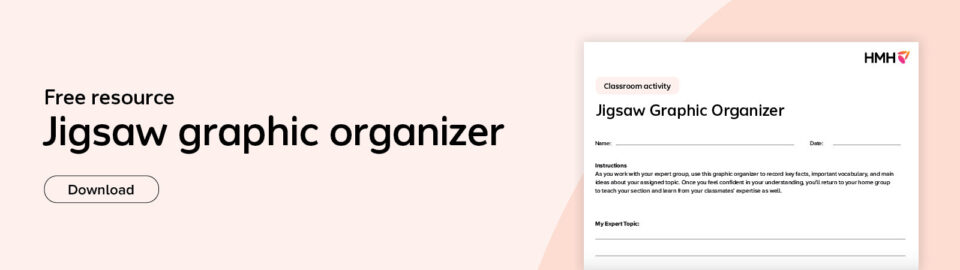
Because students are responsible for becoming experts and teaching their peers, they may need a clear way to organize their thinking. Download this graphic organizer template to help students focus on key ideas, identify essential vocabulary, and prepare for meaningful discussion.
How assessment should be used with jigsaw
Assessment in a jigsaw lesson should measure both individual understanding and group collaboration. Consider the following when assessing students during the jigsaw process.
Provide clear criteria and rubrics
Students perform better when expectations are explicit. Provide students with a rubric that clarifies expectations for participation and collaboration.
Use formative assessment during expert groups
Assessment should happen while students are learning, not just at the end. Circulate and listen to group discussions and ask questions to check for misconceptions. Then, ask expert groups to get teacher approval before teaching their home group.
Evaluate how students connect the pieces
After teaching is complete, include a task that requires students to apply and integrate all sections of the content. This can be through a shared product, like a poster or slide deck, or a collaborative problem-solving task.
Check for individual understanding
Even though jigsaw is collaborative, every student should demonstrate their own understanding. Use quick exit tickets at the end of the lesson or ask students to complete an individual written reflection or summary. This ensures students learn the full scope of the content, not just their expert section.
Jigsaw empowers students to take ownership of their learning all while strengthening collaboration, communication, and comprehension. When teachers use this method to break content into meaningful pieces and give each learner a purposeful role, the classroom can become a place where every student contributes to the bigger picture.
…
For even more strategies to implement in the classroom, check out our differentiated instruction articles and resources.
Be the first to read the latest from Shaped.