



Summary
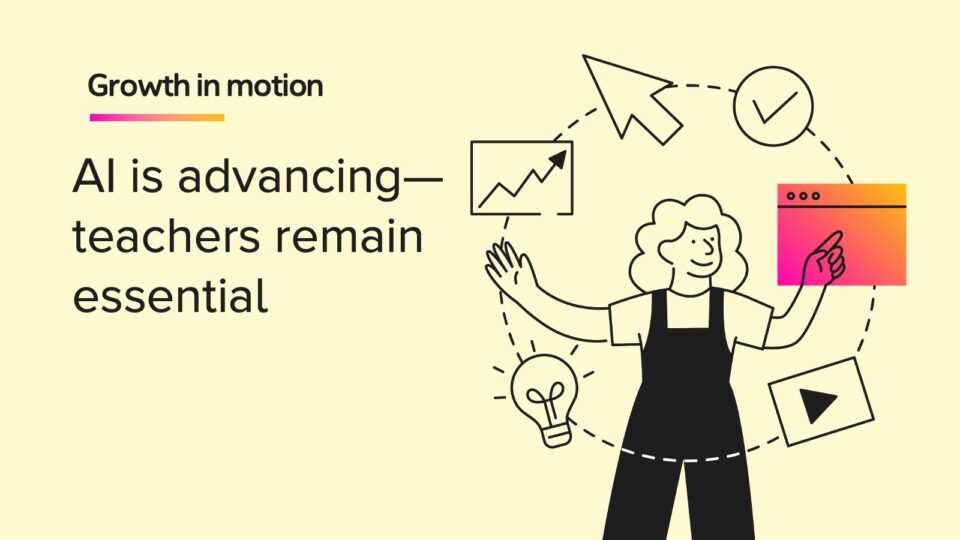
As AI adoption grows in schools, teachers remain essential for building relationships, guiding learning, and making instructional decisions.
Recently, I hosted an EdWeek webinar focused on what AI means for teaching and learning. I was joined by Francie Alexander from HMH, Andrew Rotherham from Bellwether and Jean-Claude Brizard from Digital Promise. We covered a lot of ground, from teacher confidence to curriculum coherence to the very real risks and possibilities AI presents for schools right now. You can watch the full conversation here.
What has really stayed with me from this discussion is how often we kept circling back to the same point: in this AI moment, what matters most hasn’t changed as much as we sometimes think. Here’s what I mean by that:
Teachers want AI to give them time back, and they’re using that time to build relationships and personalize instruction
Francie shared research from HMH’s Educator Confidence Report showing that when teachers use AI well—to help with things like planning, workflow, and analysis—they are saving one to five hours a week. Then, they are intentionally reinvesting that time in their students.
In other words, that reclaimed time isn’t pulling teachers away from students, it’s doing the opposite. Teachers report using it to build stronger relationships and to better personalize and differentiate instruction, reinforcing that the real value of AI lies in giving educators more space to do the work only humans can do.
In this AI moment, what matters most hasn’t changed as much as we sometimes think.
President of Core and Supplemental Solutions, HMH
High-quality instructional materials matter more, not less, when AI enters the picture
One of Andy’s cautions during the conversation also stuck with me: the risk of disjointed instruction grows as AI tools proliferate. He shared an example of asking an AI tool to generate an image of the U.S. Supreme Court, only to receive versions with 13 justices, then 11, then 10—but never the correct number, which is nine. This is a telling error that underscores the importance of subject-matter knowledge, critical thinking, and human judgment.
Without a strong curricular foundation, it becomes easy for AI to turn into just another disconnected solution—something that adds noise instead of clarity. HQIM gives teachers a coherent backbone, and AI should be augmenting that, not pulling classrooms in a dozen different directions.
Leadership decisions will shape whether AI strengthens classrooms or fragments instruction
On this point, Jean-Claude pushed us to think beyond tools and toward responsibility, with a reminder that leaders can’t afford to be passengers right now. Whether AI strengthens teaching and learning—or undermines it—will depend on the choices states, districts, and systems make. Coherence, guardrails, and professional learning aren’t side issues. They’re the difference between AI becoming an ally for teachers or yet another layer of complexity they’re forced to figure out alone.
It’s clear that AI is changing the context around teaching and learning, but it doesn’t change the core of it. As Jean-Claude said, “Every child is a work of art.” In this moment of rapid technological change, that idea matters more than ever. AI may help teachers work more efficiently or surface new insights, but it cannot replace the human relationships at the heart or learning. When leaders make intentional choices—grounded in coherence, high-quality materials, and trust—AI has the potential to support teachers in doing their best work and students in becoming their best selves.
Key takeaways
- The most valuable use of AI is creating more time for educators to focus on relationships, instruction, and student support.
- High-quality instructional materials become even more important as schools integrate AI into teaching and learning.
- Strong leadership, clear guardrails, and professional learning help ensure that AI strengthens rather than fragments instruction.
***
Built on learning science, HMH AI Tools help educators drive meaningful progress for every learner, every day. Simplify planning, differentiation, and follow-up and create responsive, standards-aligned instruction that boosts student outcomes.
Protect student data with help from our AI privacy guide.