





Returning to school can be exciting for some students but nerve-wracking for others. (Or a mixture of both!) Kids will encounter so much, from gaining knowledge to getting accustomed to unfamiliar spaces. Plus, they’ll more than likely meet new classmates. To help kids get to know their classmates on their first day of class, we’ve come up with a range of back-to-school getting-to-know-you activities for all ages.
First day of school get-to-know-you activities
Use these classroom get-to-know-you activities on the first day of school or anytime during that first week. Though we’ve categorized based on school level, feel free to adapt these ideas to use across grade bands. Your students will feel engaged while getting to know their classmates!
Activities for elementary school students
1. Learn about each other with bingo
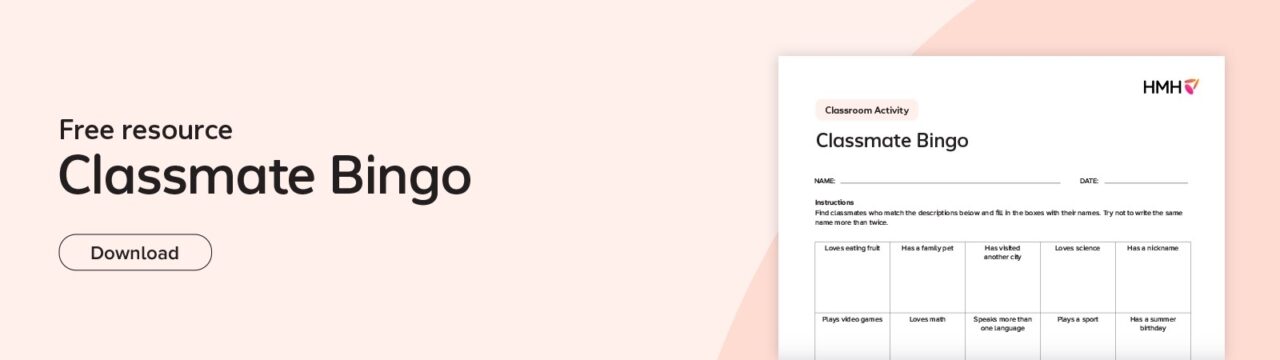
Have your students play bingo to learn new facts about their classmates. You can have them try to complete one row or column of five spaces with names. Whoever finishes first wins the game! If you have enough students for a longer game, have them attempt to fill out as many spaces as possible. Afterward, take the activity further by having your students discuss the descriptions that fit them. For example, they can share why they love science or the names of their siblings, which are all featured in the game. Have your students play bingo to learn new facts about their classmates with this free downloadable.
2. Guess true statements about classmates
Have your students come up with statements about themselves—two that are true and one that’s false. Ensure that these statements are educational by requiring that they connect back to a subject. For example, in a math class, a student could include a number:
- I’ve lived in two countries.
- I have one cat.
- I can do 200 jumping jacks in a minute.
Then, the other students must determine which statements are true. How students guess the correct answers is up to you. Have them vote or you can call on one student at a time to answer. Try to get your students to come up with more challenging statements, such as:
- I’m younger than my sister but taller than her.
- My dog’s age is greater than the age of my younger brother.
- My birthday is 10 days before Halloween.
3. Compare characteristics
A Venn diagram is a graphic organizer that notes similarities and differences between concepts. Have your students pair up and fill out a Venn diagram with their partners. Each pair should compare different features about themselves, for example, how many siblings they have, what languages they speak, and what foods they like to eat. Then each person should list their differences in their respective circles. In the intersecting section of the Venn diagrams, students should list similarities shared with their partners.
After filling out their Venn diagrams, have your students give a presentation about their partners. This activity is a great way for students to learn about their classmates’ backgrounds and see how they may be similar to their own.

Visit some of our other blog posts for more classroom community-building, science-based back-to-school, and icebreaker activities for elementary school students.
Activities for middle school students
4. Create a themed quiz game
Participating in themed quizzes is a fun way for students to learn about each other. Tools such as Google Forms can be used to create these quizzes. Here are the steps they can follow:
- Depending on your class size, have your students pair up or get into small groups based on a common interest, which will be the theme of their quiz, such as space or dinosaurs.
- Then, have each pair or group create a series of questions that other students will answer based on the theme. Encourage them to come up with a mix of question formats such as true or false, multiple choice, short answer, word banks, and more. For example, a dinosaur themed quiz may have questions such as “What is the largest dinosaur species that ever lived?” and “Which dinosaur do you think is the coolest and why?”
- Now they can start building their quiz. Ensure students select the correct settings for multiple-choice questions. Then, they can add their questions along with the answer key (this video covers the basics for building a Google Forms quiz).
- Google Forms also allows users to fill out other details, such as a title and description for the quiz and a description for each question. Users can also include photos and multimedia to add more excitement, which can also serve as hints for certain questions if they wish.
- After they create their quizzes, have your students share the links to their games so that everyone can have the chance to play them all. Not only will they learn a lot about each other, but about the quiz content as well, like cool dinosaur facts.
5. Swap personal word problems
Have your middle school students learn about their classmates through math word problems. They can write a few and trade their word problems with a classmate. Here are examples of word problems they can come up with:
- My family owns three dogs—two Labradors and one pug. One lab weighs 72 pounds, the other lab weighs 55 pounds, and the pug weighs 15 pounds. What’s the average weight of my pets?
- I like to do yard work from time to time to make money. I’m saving up for a special edition video game that’s $150, and I make $10 per hour. How many hours would I have to work to purchase this video game?
6. Conduct a show and tell for all ages
Show and tell doesn’t need to be restricted to the youngest learners. Showcasing an item that’s meaningful to us can be a chance to reflect on our relationships with objects, memories, and people—not to mention an opportunity to practice our public speaking. Invite students to bring an object to class that means something to them and discuss it with the class. The object could be something they’re wearing, something in their pockets, or one of their school supplies.
Let’s say one of your students loves music. They might present a set of headphones given to them and discuss their love of music or tell a story about the first time they heard their favorite song or musical artist. Your students can take plenty of directions to stretch their creative muscles when presenting. This activity also allows students to practice speaking skills while sharing a bit about their lives.
7. Have students decorate a virtual locker
Whether your students have lockers or not, this can be a fun and creative exercise that allows them to decorate their lockers however they’d like. For an art class, this can be done on paper so that students physically decorate their lockers. If it is on paper, they can draw the items, and if it is digital, they can find images online or use their own if they have access to them. Have a page for each student with an image of an empty, open locker that they can fill with things about themselves. If it is on paper, they can draw the items, and if it is digital, they can find images online or use their own if they have access to them. You can add prompts or guidelines based on the subject if you’d like as well:
- For a math class, an item important to them that shows a number.
- For a history class, an image of a historical figure or place that they want to learn more about or admire.
- For a science class, something representing how they think science impacts their everyday life.
- For an English class, their favorite book, a book that they read this summer, or a book that they’d really like to read but haven’t gotten the chance to yet.
Other prompt ideas for decoration can include:
- Something representing their culture or heritage
- A photo they cherish, maybe of a place, pet, or loved one
- An image depicting their hobbies, whether they are school extracurriculars or not
- School supplies that they’re excited to use this year
- An item they can’t go anywhere without
- A representation of a future ambition of theirs
Let them decorate it as they please with minimal guidelines to maximize creativity. For example, maybe encourage “one subject-related item and one or two from the prompts.” The prompts are a suggestion for those looking for a starting point or a spark of inspiration. It doesn’t have to be realistic. If they want to put a dragon or an ancient Roman emperor in their locker, let them. Half the fun is giving them a chance to be creative.
Once the students have finished decorating their lockers, display them around the room, or compile the digital designs into a slideshow to showcase everyone's completed lockers. Then have students complete a “gallery walk” where they can peruse everyone else’s locker and leave sticky notes or digital comments on their “locker neighbors’” lockers (those whose lockers are right next to theirs) to ensure that everyone gets to know a different person.
For even more ideas, check out these 5 First-Day-of-School Icebreaker Activities for Middle School Students.
Activities for high school students
8. Encourage deeper thinking with writing prompts
Responding to writing prompts can allow for self-reflection. Students can learn more about themselves through writing and see how they connect to others. Have your students pick one or more of the following prompts to respond to below. They can free write or express themselves using whatever format they prefer, such as a poem or story.
- What quote from a book, movie, or poem can you relate to the most? Research the exact quote before writing about it.
- What recent news event affected you the most? Why?
- If you could witness any historical event, what would it be? How would you react, and what would you tell people today about it?
- What’s a mathematical topic you understand now but didn’t understand last year?
- Reflect on this time last year. How much have you changed?
- World-building is the process of building an imaginary world. What would it look like if you could construct a world, and who would be in it?
- What sport do you love, and why? What athlete do you look up to the most?
- What would the theme be if you were responsible for creating a museum exhibit?
- What’s your favorite app, and what makes it impactful?
Afterward, students can share their writing in a group or with the entire class. This will allow them to see how much they have in common—and what makes them stand out!
9. Have an informal debate
The benefits of learning to debate for students are extensive. According to the American Debate League, while only 50% of urban high schoolers graduate, 90% of urban high school debaters graduate. At the beginning of the school year, you can hold an informal debate with light-hearted topics, such as “winter is better than summer” or “one cinematic universe is better than another cinematic universe.”
Later in the school year, you can have your students develop topics to vote on for debating. Then, after choosing the winning topic, have them pick their side. Every student on each side should have the chance to state one or more reasons for choosing their side. This activity allows both students and teachers to realize that even if they share a common fundamental belief, the reasoning for having that opinion can vary from person to person. Plus, they’ll be able to develop a deeper understanding of people who might not share their beliefs.
10. Pair up for an interview
Have your students pair up for an interview. Each student can prepare a list of questions to ask their partner, such as:
- What did you do over the summer?
- What goals do you want to accomplish this year?
- What club, sport, or extracurricular activity would you like to participate in?
Afterward, students can introduce their partners to the class, such as:
- This is _______. She loves to sing and plans on joining the show choir this year. If you need any help with math, she tutors, too.
11. Two-minute lightning talk
Allow students to think of a classroom-appropriate topic that they feel comfortable talking about. It should be something that they are passionate and knowledgeable about. They can teach a skill, share an opinion, or discuss an interest of theirs. Some examples can include:
- The secret to making perfect macaroni and cheese
- Tips for beginner crochet
- The best strategy for solving a puzzle
- Why snakes aren’t as scary as we think
- The coolest character in their favorite show
If the students have time to prepare before the first day of class, they can even prepare a speech or bring a prop if it would help. If you want to keep it more related to the subject, the prompts list can be tailored or require involving the subject in some way. Just be sure to encourage students to talk about something they are passionate about within the subject because students love talking about something they are interested in. Here are some subject-specific ideas:
- Science
- A natural phenomenon that they want to see
- Something they would invent if they had the chance
- Math
- How math is used in their favorite video game
- The importance of percentages in everyday life
- English
- A book that there should be a movie about
- Words with an interesting history
- Art
- The most beginner-friendly art medium and why
- A museum that everyone should visit at least once
- History
- A cultural tradition they are a part of
- Countries with less frequently discussed history
The lightning talk can be presented in small groups or pairs, or in front of the whole class. A timer can be set for each speaker to ensure there is time for everyone. Afterwards, students can reflect by writing down something new they learned about a classmate.
Need some more inspiration? Here are 13 First-Day-of-School Icebreakers for High School Students.
Share your getting-to-know-you activities
Do you have any getting-to-know-your-students activities that you love to use at the beginning of the year? Share them with us at Shaped@hmhco.com or follow us on Instagram, LinkedIn, and YouTube.
***
View more get-to-know-you-on-the-first-day-of-school activities on Shaped to get to know your students better!
This blog, originally published in 2022, has been updated for 2026.
Download our FREE calendar of activities!