




Summary
Curriculum-connected AI grounds artificial intelligence in high-quality instructional materials and student learning insights to help teachers make informed instructional decisions.
Artificial intelligence can create a lesson plan in seconds. It can generate a quiz, rewrite a passage, suggest discussion questions, or create differentiated practice almost instantly.
But speed doesn’t equal instructional quality. Quality depends on what the AI is creating from.
That’s where high-quality instructional materials (HQIM) come in. They give AI the instructional context it needs: standards-aligned, research-backed content built around clear learning goals.
Curriculum-connected AI works from that foundation instead of generating instruction in isolation. The connection protects instructional coherence: what students are expected to learn, how teachers teach it, how learning is assessed, and what comes next all line up.
That’s why what AI is connected to matters as much as what it can create.
Why should AI be connected to high-quality curriculum?
AI connected to high-quality curriculum has the instructional foundation it needs to create resources that fit what students are learning and what comes next.
Research underscores the importance of that foundation. A report from Johns Hopkins University and Learning First, drawing on existing studies, suggests that switching from a low-quality to a high-quality curriculum can boost student achievement more than other popular approaches, such as reducing class sizes or offering teachers merit pay.
When AI draws on that same curriculum, it can generate resources grounded in established learning goals and instructional sequences rather than creating content on its own. For teachers, that means less time adapting AI-generated resources and more time applying their expertise to meet students’ needs.
What are the risks when AI is disconnected from curriculum?
A general-purpose AI tool can produce content that sounds polished and plausible. But without instructional context, it may not know where students are within a learning progression, what they have already encountered, or the level of rigor expected.
That can create a new burden for teachers: checking accuracy, adjusting rigor, aligning to standards, adapting to the district curriculum, and moving content into another system.
Districts have already invested in instructional coherence through shared instructional goals, materials, assessments, professional learning, and collaborative planning. When AI operates separately from those investments, it risks weakening that coherence by introducing resources that don’t align with what schools have worked to put in place.
How does high-quality curriculum improve the quality of AI-generated content?
HQIM give AI something far more valuable than a generic prompt: context. Combined with learning goals, student evidence, and district priorities, that context helps AI provide support that is more relevant to the instruction actually happening in the classroom.
Imagine a seventh-grade math teacher preparing to teach two-step equations. A standalone AI tool can generate a lesson, but the teacher still needs to determine whether it matches the curriculum sequence, reflects the intended pedagogy, maintains rigor, and builds from what students have already learned.
Now imagine AI that starts with the high-quality curriculum being taught. The teacher can begin with the grade-level lesson already in sequence and use AI to make that lesson work for the specific students in the room.
For example, a teacher preparing an Into Math lesson sees from assessment data that some students need support with one-step equations and that some multilingual learners would benefit from additional language scaffolds. AI helps build from the grade-level lesson by creating targeted differentiation, sentence frames, and multilingual supports while maintaining the connection to the original curriculum.
The distinction is critical. Instead of asking, “Can AI make me something?” teachers can ask, “Can AI help me make this high-quality lesson work better for these students?”
How can curriculum-connected AI improve teaching and learning?
Curriculum-connected AI helps teachers use student learning insights from assessments to make timely instructional decisions and respond to individual student needs without losing sight of grade-level learning goals.
Students don’t arrive at a lesson in exactly the same place. One may need background knowledge. Another may benefit from language support. Some may need targeted practice or reteaching, while others are ready for extension.
Rather than leaving teachers to interpret assessment results and create resources on their own, curriculum-connected AI can recommend relevant lessons and help generate targeted practice, scaffolds, and extensions. Teachers can spend less time preparing these resources and more time delivering instruction that addresses what students need.
The result is more responsive teaching and greater opportunities for students to access grade-level learning.
How can curriculum-connected AI support teachers?
Curriculum-connected AI can reduce the work required to adapt high-quality instruction while supporting teacher judgment.
Teachers understand things AI cannot fully know: what happened in yesterday’s discussion, which example made a concept click, which student needs encouragement, and when a lesson needs to slow down or move forward.
AI can give teachers more time to apply that expertise by providing useful starting points and helping them create resources that respond to student needs.
The principle is simple: HQIM provide the foundation, student learning insights identify the need, and AI helps teachers tailor instruction. Teachers make the instructional decisions.
How can curriculum-connected AI support instructional consistency?
Curriculum-connected AI can help districts maintain instructional coherence through consistent learning goals across classrooms while giving teachers flexibility to meet their students’ needs.
A shared curriculum establishes what students are expected to learn and the sequence in which they learn it. Teachers can adapt lessons based on student needs without having to create instruction from scratch.
For example, one teacher may need language scaffolds, another may need additional practice, and a third may want to extend a lesson. AI can help create these resources while keeping them aligned with the same curriculum and grade-level expectations.
That means consistency in what students are expected to learn, with flexibility in how teachers help them get there.
What does curriculum-connected AI look like in practice?
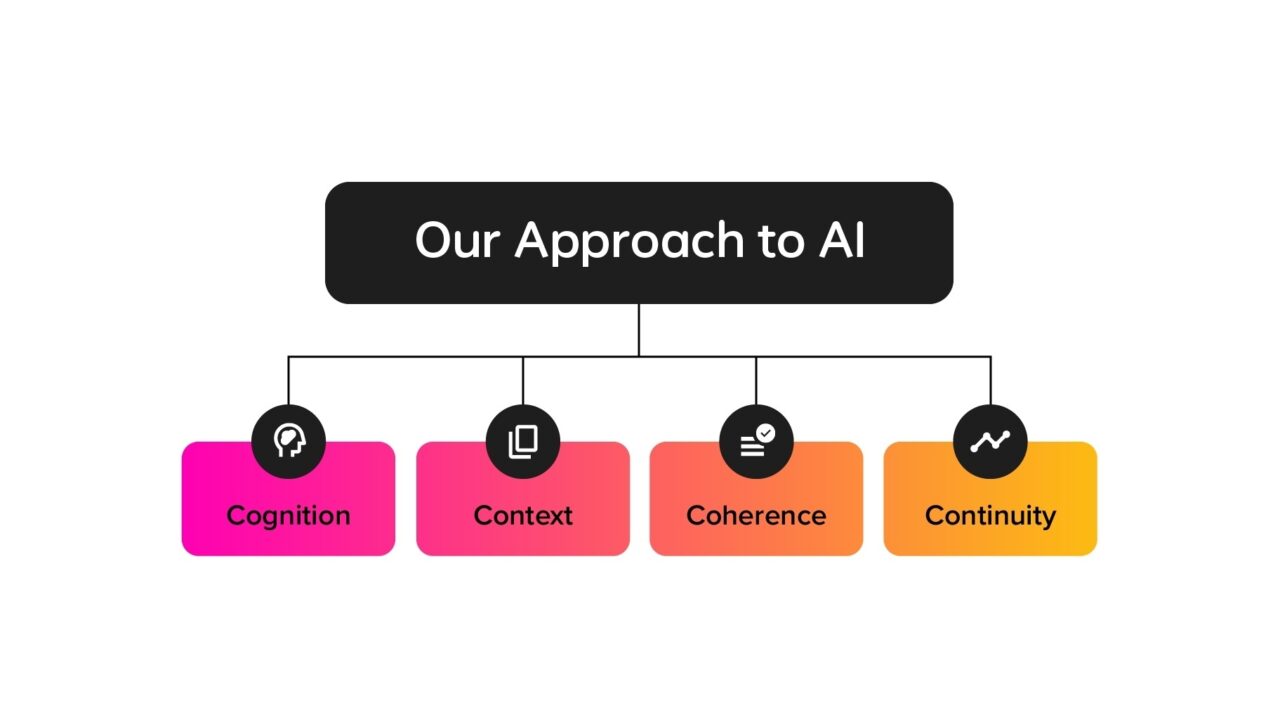
At HMH, we’re putting curriculum-connected AI into practice through an approach we call the 4Cs:
- Cognition: Applies learning science to create resources that promote student thinking and deeper understanding.
- Context: Draws on high-quality curriculum, learning goals, and student needs to generate resources relevant to classroom instruction.
- Coherence: Keeps AI-generated resources consistent with the curriculum’s instructional approach and grade-level expectations.
- Continuity: Builds on what students have already learned and prepares them for what’s next.
HMH AI Tools are designed to work with the curriculum and align with learning science. They help educators adapt and differentiate materials to meet student needs, while giving administrators control over access to align with district priorities.
Educators are seeing the value of this approach. Desiree Monges, an instructional coach in Galveston ISD, describes HMH AI Tools as a “game changer” because they help teachers use HMH curriculum with fidelity.
How can districts successfully integrate AI into instruction?
Bringing AI into instruction takes more than a technology rollout. It calls for the same thoughtful planning and ongoing support as any instructional change.
The National Comprehensive Center’s guide to implementing high-quality instructional materials reinforces this point: purchasing materials is only the beginning. Successful implementation requires clear responsibilities, professional learning, and ongoing monitoring and support.
For AI, that means successful implementation includes:
- Specific use cases tied to instructional needs
- Clear guidelines for responsible AI use
- Professional learning and ongoing support
- Workflow integration that fits how educators plan and teach
- Visibility into where and how AI is used
One principle from HMH Labs captures the larger idea well: just because we can build something with AI doesn’t mean we should. AI should serve a clear instructional purpose, not become another initiative for teachers to manage.
What can district leaders look for when evaluating AI tools?
District leaders can look beyond what AI tools can generate and consider how well they fit their curriculum, meet instructional needs, and protect student data.
The chart below highlights what leaders can look for and what questions they can ask when evaluating AI for the classroom.
What to look for |
What to ask |
Grounded in high-quality curriculum |
Does the AI draw on our curriculum, including its learning goals, instructional sequence, and grade-level expectations? |
Informed by student learning insights |
Can it use assessment insights to help teachers identify and address student needs? |
Supports teacher judgment |
Do teachers remain in control of instructional decisions and AI-generated content? |
Maintains consistent instruction |
Can teachers adapt lessons for different student needs while staying aligned with shared learning goals? |
Fits educator workflows |
Does it work with the tools teachers already use and reduce the need to switch between systems? |
Protects privacy and security |
How does it protect student and teacher data, and what controls are available to administrators? |
Privacy and security deserve particular scrutiny. District leaders can ask what data an AI system collects, whether student or teacher inputs are used to train AI models, what controls administrators have, and how the product addresses FERPA, COPPA, and applicable state privacy laws.
The greater opportunity for AI in education
Generative AI has dramatically expanded what technology can create for educators. The next challenge is making sure what it creates is worth using.
For district leaders, that means looking beyond speed and novelty. The greater opportunity is AI that draws on high-quality curriculum, student learning insights, and teacher expertise to make instruction more responsive to students’ needs.
That’s why I believe high-quality curriculum becomes even more important in the age of AI. It gives teachers a strong foundation to build on, while AI helps them adapt instruction based on what students need.
The future I find most compelling is one where AI strengthens what teachers can do, without replacing the judgment and relationships that make teaching effective.
Key takeaways
- The value of AI-generated resources depends on how well they align with the curriculum, learning goals, and instructional needs.
- AI is most useful when it reduces teachers’ preparation work while preserving their ability to make instructional decisions based on student needs.
- Evaluating AI as an instructional investment means considering how well it fits existing curriculum, teaching practices, and long-term district goals.
***
HMH AI Tools are designed to teach with you, not for you. Get support in every moment of the teaching cycle, from lesson planning and prep to post-instruction communication.
We want to hear from you! For questions, comments, or feedback, please contact us at Shaped@hmhco.com or follow us on Instagram, LinkedIn, and YouTube.
See how the right AI can support teachers, protect privacy, and advance district goals.